If you keep your ear to the ground, you probably know there’s a new set of recommendations from the American Academy of Pediatrics regarding childhood obesity. These are sometimes called “startling,” and they are – the doctors are now recommending medication for obese children as young as 2, and surgery, bariatric surgery, for children 13 and up. In between is a mix of meds and behavior modification classes, which no one really has much faith in.
I’ve now listened to two podcasts on the subject, and I was struck by one thing in particular. Gina Kolata, the New York Times health reporter, referred to obesity as something a child “has,” rather than something he or she is. So: “If your child has obesity, they’re 45 percent more likely to…,” etc. It struck me as one of those language things that seem to be decreed by a memo that I never get, as when we stopped saying people committed suicide and instead say “died by suicide,” or we no longer say “slave,” but “enslaved person.” It’s part of the thinking that makes us consider obesity as a disease, and not a character flaw.
Anyway, that’s just one thing, and not what this is about. A statistic flew by early in this discussion that didn’t surprise me: About 20 percent of American children are obese. You can see it with your own eyes, particularly if you live in the places where the rate is probably far higher, i.e. the American south. In my year-end cleaning/purging, I came across some photos of my grade-school classes. Here’s one, third grade:
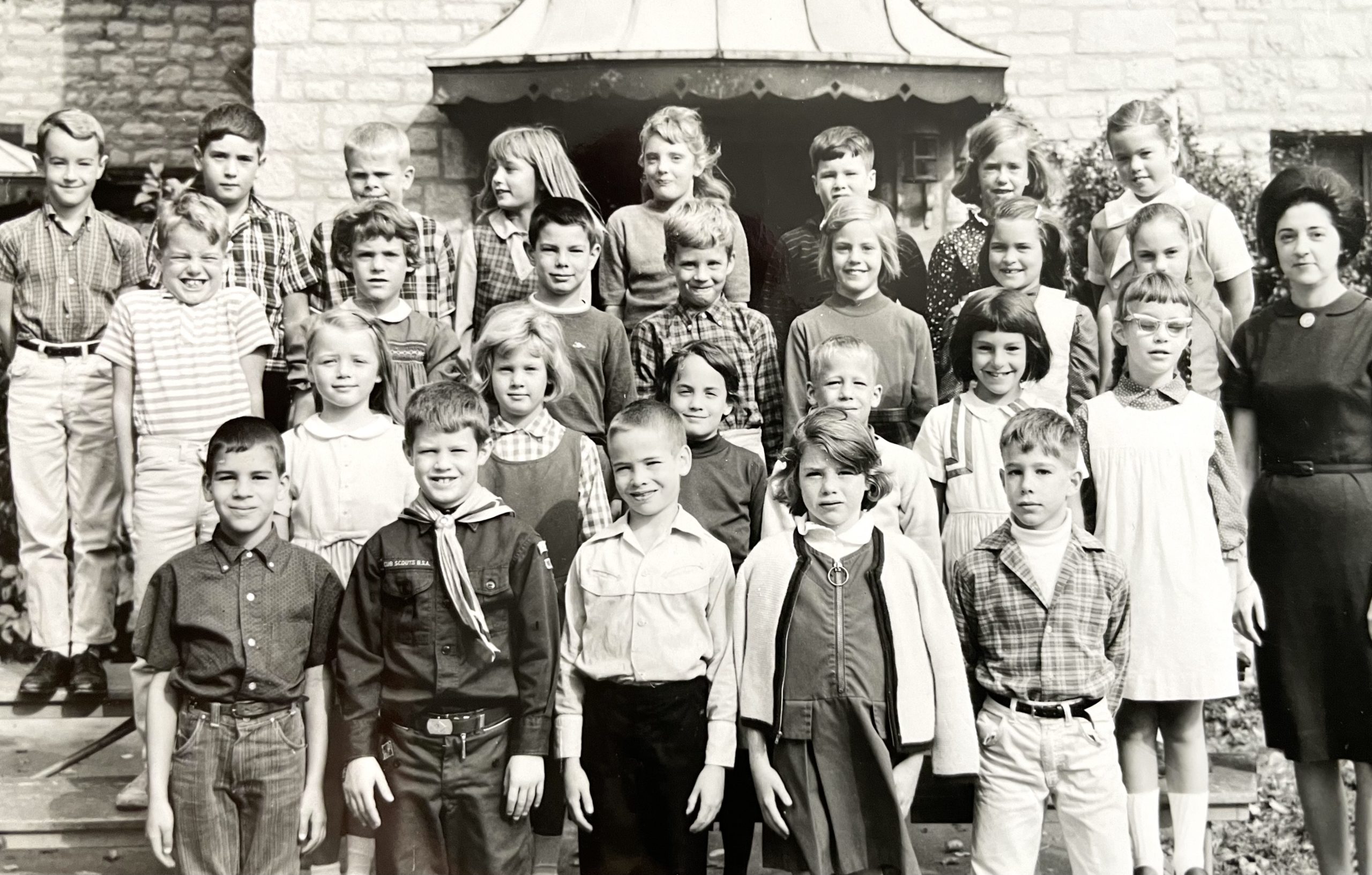
To my eye, there’s one fat kid in that group, and she wasn’t that fat, just kinda plump. I just looked her up on Facebook and she’s about the same (which is to say, she’s about like me, still in Misses sizes but a M/L for sure). Side note: 26 kids in that class, with one teacher. And yet we learned, and the school was excellent, and still is. Look at that stonework; they don’t make ’em like that anymore.
Nowadays, even in an affluent area, you’d see at least five. And somehow, the causes for this, which are myriad and diverse, weren’t even mentioned.
Don’t say it’s sugar. We all ate sugar, pure cane sugar, on everything. Pour a bowl of cereal? Sprinkle a teaspoon of sugar before you pour the milk. A favorite snack in my house was something my mom called “garden bread,” i.e., a slice of buttered white bread with, yep, a teaspoon of sugar on top. We ate potato chips, whole milk, all of it. Salads? If you like iceberg lettuce with Good Seasons Italian on it, maybe, and who likes that? By contrast, today’s groceries are cornucopia of unbelievable goodness, to my eye. Avocados, piles of pre-washed and ready-to-eat fresh greens, once-unheard-of exotic fruits and vegetables, and we’re only in the produce aisle. The rest of the store – just an ordinary Kroger, not a Whole Foods or anything like that – offers healthy foodstuffs the richest pashas of antiquity can only dream of.
A friend once pointed out the oranges and lemons in still life paintings by old masters: “That was a treasure. Think how far that orange had to travel to make it to Belgium or the Netherlands in 16-something. No wonder they wanted to capture it in art.”
I don’t have the answer to why kids are consuming far more calories than they can burn in a day, because I suspect it’s not one answer. When we go to Europe, and this was especially true in Spain, I was struck by all the children out playing in the after-school hours. They’re in every square, kicking soccer balls around, climbing on anything climbable. I’m sure some of them have video games, but they’re not playing them while the sun is out. Some of them must have phones, but they’re not staring at them, or taking a million selfies, or keeping up with their favorite influencers. And hardly any of them were fat. Presumably they eat the jamon and queso Spain is so famous for, which isn’t diet food.
I suspect the problem is a cornucopia as rich as the one in the grocery store, and it is filled with 20-ounce soft drinks; single-serving bags of snacks that were once .75 ounces and are now 1.5, yes video games; yes suburbs with a culture that encourages kids to have “play dates” and not just play; yes urban areas where parents fear to let their children roam, justifiably or not; fast-food restaurants where portions keep growing and growing, pushed by economies of scale; and, well, the list goes on. In other words, good old American capitalism-driven trends that we dare not even mention, much less criticize or shape policy to discourage.
I mean, even the dinner plates I got for my wedding in 1993 are 15 percent bigger than the ’50s-era fine china my mother gave me when they downsized.
If we really want to help kids not be fat, we don’t start with medication, let alone bariatric surgery. But it’s a crisis now, and this is what we look like.
OK, rant over. The weekend awaits. What’s on your agenda?
(Oh, and that’s me, top row, second from right.)