Bigger love.

I started this season of “Big Love” the way I do most HBO series runs in the post-“Wire,” post-“Sopranos” age — hopeful but prepared to be disappointed. And, to be sure, this chronicle of polygamy-on-the-DL-in-the-suburbs hasn’t been all that. The ratio of soap opera-like plot developments to the less flashy, more interesting glimpses of the human heart has been a bit lopsided, but OK, it’s television. And there’s a reason soap operas run for years and years — it’s always fun to check in on others’ action-packed lives.

But beyond the soapy stuff (writers, I saw Sarah’s miscarriage coming like a brass band), the show is still finding the sorts of stories that make HBO’s native series so much better than Showtime’s. Things are building to a climax in the world of Bill Henrickson and his extended family, and it’s fun to watch.

At this point I should probably note some spoilers are coming. You’ve been warned.

One theme, this season, has been how Bill’s choice to take additional wives has affected and compromised those women, as well as others who come in contact with them. His life is a wreck. All three of his wives are miserable and coping in their own ways. A fourth entered and left the family in a matter of hours. His business partner, also multiply wed, saw two of his brides run off together, a payoff we’ve been waiting for since season one, when a single shot of them playing footsie under a card table suggested they had their own special bond. And the poison is seeping into his children — a pregnant teenage daughter, a son in love with wife No. 3, a tween girl up to various nefarious activities. The more recent children, those of wives two and three, are too young to raise much hell, but their day is surely coming.

The early season questions were mainly about how the sex stuff works. This season, Bill lost a whole bottle of Viagra down the bathroom sink drain, which left him suggesting an evening of cuddling to wife No. 2, but she’s already got his number — what really makes Bill’s dick hard are his various business interests, all of which seem to involve high-wire negotiations, slamming doors and blood oaths.

But this week was an emotional payoff of sorts. Bill, who has been groping toward an understanding that polygamy has a truly evil side (don’t expect him to grasp that he’s part of the problem, not for a few more seasons, anyway), will have to confront it directly, now that his sister-in-law-to-be has had her neck broken, fleeing a forced marriage to a truly insane FLDS “prophet” and his transgendered first wife, and…

I told you it got a little soapy from time to time.

Anyway, this episode was the best of the season, as each wife digs into her personal hell and shores up the bunker walls. First wife Barb is even more the bullying boss lady. Second wife Nikki finds, for the first time in her life, a man she actually wants to have sex with. Third wife Margene, the current baby factory, is overwhelmed by the cacophony of children’s voices she endures all day and dreams of trips to the grocery store. Meanwhile, back at the Juniper Creek compound, Hollis Green stirs his creepy stew, and caught in the middle is poor FLDS pawn Kathy, the bride-to-be, with her signature braid delivering the death blow after a brief flight to freedom. Will it dawn on Bill, the part he plays in all this female misery? Of course not. But that’s why it’s fun to watch.

Discuss, if you like.

Or, we can continue to talk about Rush Limbaugh. I wonder how much those Dominican prostitutes charged him. I figure he had to hide C-notes in his flab rolls and let them go exploring. Some things just cannot be expected at market prices.

I leave you with a joke I heard the other day: One of these things is not like the others: Herpes, AIDS, gonorrhea, a house in Detroit. Can you tell which one? The answer is: Gonorrhea, because you can get rid of that.

It’s important to keep a sense of humor in dark times. Remember that.
Posted at 9:31 am in Current events, Television | 55 Comments
 

Carry on, all.

I have a very busy day that hits the ground running before 9 a.m. and won’t quit for about 48 to 72 additional hours, and may actually stretch beyond that. (Coffee, be my Rock.) A few things you can discuss today, without my benign moderating presence:

1) Paul Harvey. Couldn’t stand the guy. Everybody says, “Yeah, but he was a great broadcaster.” Woo. OK, then. Still couldn’t stand the guy.

2) “The Girl With the Dragon Tattoo,” about to leave the nightstand and return to the library. I finished it over the weekend, and had that strange experience of a book I really, really despise that is still, nevertheless, a page-turner. You keep turning pages because you can’t believe how awful it is, what fresh assaults on logic and language will be found in the next chapter. The language problems are forgivable; the novel was translated from Swedish, and it has a strange history — the author died “shortly after delivering the manuscript,” the jacket copy says. Perhaps, in Sweden, when the author is dead, it’s considered bad form to actually edit his manuscript, because that’s where the outrage is, in the amount of prose in this hefty volume that’s simply screaming for the red pencil. For example. Here’s a journalist sitting down to research a sprawling family history:

The family consisted of about a hundred individuals, counting all the children of cousins and second cousins. The family was so extensive that he was forced to create a database in his iBook. He used the NotePad programme (www.ibrium.se), one of those full-value products that two men at the Royal Technical College had created and distributed as shareware for a pittance on the Internet. Few programmes were as useful for an investigative journalist. Each family member was given his or her own document in the database.

What the hell? Is that logorrhea, or a product placement?

Warning: The book is called the first volume of a trilogy. Given that, in 465 pages, we encounter serial murder, sexual sadism, torture, rape, Nazis, muckraking journalism, international crimes of high finance and other pulpy shenanigans, I can scarcely imagine what volumes II and III might reveal. Shudder.

3) Go immediately to the “This American Life” website and download the podcast of last week’s show, “Bad Bank.” It’s a companion piece to two others I’ve touted here before, “The Giant Pool of Money,” (about the mortgage meltdown) and “Another Frightening Show About the Economy” (about the credit freeze), and nowhere will you get a better glimpse at why we’re in the fix we’re in, and how it might be repaired. (Bad news: It isn’t. Yet.) Radio doesn’t compete for Pulitzers and TAL already has a Peabody, but they, and Public Radio International, should win some sort of major award for these reports, which are truly heroic explanatory journalism. Maybe a lamp in the shape of a woman’s leg.

A friend, a fellow newspaper journalist, wrote me the other day, “Sometimes I panic. Sometimes I think: What an amazing time to be alive.” Me, too.

4) Another hazard of houses standing empty.

5) Via Playboy, of all places, a credible analysis of yet another “grassroots” movement, in this case Rick Santelli’s tea party movement. Speaking of which: Scenes you couldn’t make up if you tried.

6) Finally, a link I’ve been meaning to post for ages. Sometime last year the New York Times began including a daily recipe on their Health section web page, called, duh, Recipes for Health. After several months, there’s now quite an archive, and it’s sortable by main ingredient, which really comes in handy when you’ve got a lot of something and no particular ideas about what to do with it. I’ve made several dishes, and have only been disappointed by one — the beet risotto did not come out a cute Pepto-Bismol pink, but a disappointing muddy color. This is a pretty good percentage with me, and these last few weeks of trying to eat better, I’m turning to it more often. Bookmark and explore.

And that’s it for me. For now.

Posted at 1:08 am in Current events, Media | 59 Comments
 

Alone with oneself.

I felt guilty about leaving Meyer alone for so long. …I always feel guilty when I keep Meyer waiting. And there is never any need for it. He never paces up and down, checking the time. He has those places to go, inside his head. He looks as if he was sitting and dozing, fingers laced across his middle. Actually he has walked back into his head, where there are libraries, concert halls, work rooms, experimental laboratories, game rooms. He can listen to a fine string quartet, solve chess problems, write an essay on Chilean inflation under Allende, or compose haiku. He had a fine time back in there. if you could put his head in a jar of nutrient and keep him alive forever, he would wear forever that gentle, contented little smile.

— John D. MacDonald, “The Scarlet Ruse”

I don’t want to keep returning to Wednesday, but given that current events are so vexing of late, indulge me a little. Every so often I think about the problem of alone-ness (as opposed to loneliness). I can’t tell you how many people I knew who married the wrong person, too young, because they were afraid to be alone. The idea of coming home to an empty house, of eating a meal at a table for one, of seeing a movie alone — these things terrify many people. And that’s only the company problem. What do you do with yourself when it’s just you? Being able to amuse oneself for a period of time, without television or hand-held video games, is a talent, as MacDonald’s Meyer demonstrates.

I had a lot of time to think about this during my jury service, although I guess I sorta cheated — I brought a book. But it was interesting to look up, between chapters, and check out the faces. Some were reading, a few were socializing, a few more were doing what looked like paperwork. One woman brought provisions for a whole day, carried in a transparent tote — two bottles of water, three or four snacks, a book, a Sudoku collection and a knitting project. Others had the thousand-yard stare that could mean deep thought or a meditative state just this side of sleep.

But a few were plainly suffering. Their hands twitched, their feet shuffled, they walked back and forth between the bathroom and their seat, they stood up and stretched their legs. They were the precise opposite of contentment. I wanted to tell them: Take a lesson from Meyer. Go listen to a string quartet.

So. In precisely seven minutes I have to wash my face and head out the door for a little meeting. In lieu of the usual thousand-word blather, check out Jim at Sweet Juniper, one of the best journalists in Detroit, who finally found the place where he parts company with the Urban Explorer’s Code, i.e., take nothing but pictures. People who don’t live in Detroit can scarcely imagine the conditions around here, how many buildings have simply been abandoned. That so many are public schools only makes it worse:

After my first visit to the shattered middle school, I am haunted by what I found in one office: hundreds of file folders containing student psychological examinations complete with social security numbers, addresses, and parent information. I sat and thumbed through them. Many contained detailed histories of physical and sexual abuse, stories of home lives so horrifying I still can’t get them out of my head: sibling rape, torture, neglect that defies belief. The detailed reports explained emotional impairments, learning disabilities. There was another box full of IEPs. The dates revealed that many of these students are still in the school system somewhere. I found several of their faces in the 2007 yearbook.

I spend the next few months trying to track down someone who cares. I send e-mails to the school’s former principal, offering to go back and collect these records for her or destroy them. She never responds. I call my mom, a retired special education teacher and erstwhile administrator to determine the extent of malfeasance. Then I call the school district’s legal department and leave voice mails warning them of the liability of this gross violation of student privacy. I never receive a response. I track down the school psychologist to some address in Troy. Nothing. It turns out a daily newspaper reported abandoned records like these within many of the 33 schools closed in 2007 and the district did nothing. No one is responsible. Someone else was supposed to destroy them. The company that had been paid to secure the school never did its job.

So I did it. I went back in to destroy them so they would no longer be just sitting there on the floor for anyone to find.

And that’s only three paragraphs. Go read it all. I’m off, for the day and the weekend. You all have a good one.

Posted at 8:32 am in Current events, Detroit life | 79 Comments
 

Duty done.

Well, that was easy. A morning spent like cattle being sorted into pens ends with “Have a blessed year” around 11 a.m. and I was outta there. This time I actually got out of the assembly room and was sent to a specific courtroom, but never crossed the threshold. I had a feeling we’d not be called after we started cooling our heels, and they got cold indeed. We were asked to wait in the hallway outside, then told to take a 15 minute break that stretched to 35, then thanked for our service and sent back to the assembly room, where we were freed by a clerk who passed out excuse letters to all.

I had but one objective at that point — to supplement the 4.5 hours of sleep I’d gotten the night before — so I detoured into Greektown for an early lunch to put me in a soporific state by early afternoon. I was not the most pathetic nerd in the place, eating lunch at 11:15 a.m.; that would be the table of four ordering saganaki at that early hour, i.e., the Full Opa. Some things should only be enjoyed under the cover of darkness. An incomplete list: The music of Tom Waits and Miles Davis, single-malt scotch. To this I’d add flaming cheese.

My morning at the courthouse wasn’t wasted, however. I got 100 pages into the new nightstand volume and enjoyed seeing the sights. You’d have to go to Hieronymus Bosch to find a more interesting canvas of humanity than the courthouse in Detroit. I took my time returning to the bullpen, letting the claustrophobic elevators pass, and was rewarded with a ride down with one of the lawyers in the case. At least that’s what I assume he was. He came out of the courtroom we’d been teed up for, carrying a battered leather briefcase, the old square-bottom kind; it looked like something from the 1940s. His hair needed a trim and his jacket was of the same vintage as his briefcase, its lining drooping below the hem. He wore his reading glasses Carl Levin-style. If I were a painter, I’d ask him to sit for a portrait, and call it The Old Barrister. The bailiff said it was an embezzlement case we’d just avoided, and while I knew it couldn’t have been the fun couple from the Palace (wrong county), I wondered what I’d have said if the judge asked if I had any particular interest in the subject. Probably, “Ummm…”

Still, we were freed by that miracle of American jurisprudence: The plea bargain. Remember when inveighing against plea bargains was the hot topic for certain smartypants pundits? Remember how prosecutors started calling them plea agreements, on the grounds it sounded less sleazy? What a waste of time that crusade was. Without plea bargaining we’d have a prison on every corner. Informants would stop being forthcoming in exchange for a little consideration. Mutual back-scratching would cease. Negotiation — a skill everyone who hires a lawyer should place high on the must-have list — would become irrelevant. And we’d do a lot more jury duty.

I can’t remember where I read this, but I suspect it was a Scott Turow novel, since I’m not exactly a legal scholar — the idea that for most offenses, a trial by jury should be considered a last resort. Not exactly the nuclear option, but something that should be avoided if it can be. It explains the contempt we feel toward all involved when stupid, obvious cases come to trial; you think, someone didn’t do their job here. The phrase “rack twelve” sticks in my head. If you rack twelve, you better be ready to play the game.

Oh, well. Done for another year now. A blessed one.

I’m surprised you guys didn’t toss the Obama speech around a bit more yesterday. I had it on as I worked, and even with divided attention, it was a beautiful thing. I got the same feeling I get when I watch video clips of Secretariat, that tingly sensation that tells you you’re seeing one of the greats. I tried to remember this when judging Bobby Jindal, that even Abe Lincoln would have looked like a punk, cleaning up after Barry. Still, I think we can all agree Jindal was more than a disappointment. I’ve read a bit about the guy and know he’s considered one of the short-list best hopes for 2012, which is why watching him sing-song his way through that Toastmaster disaster left me with another tingly sensation, the one you get when you realize just how bare the opposition’s cupboard is. You can dress up thin content with a great delivery (which he didn’t), or an attractive package (Mrs. Palin’s forté), but when you don’t have either one, it’s just embarrassing.

And speaking of embarrassment, I want it on the record now that I’m going to disrespect Jindal’s religion if he doesn’t do some ‘spainin’ about that exorcism. I can respect an awful lot about someone else’s beliefs, but when they’re running for office I think I have a right to ask what the HELL about some things, and I draw the line at casting out demons. No way he’s hiding behind the “deeply religious” veil on this one. Michael Gerson did the kneepads duty Tuesday morning with this piece, the patented George Will allow-me-to-introduce-you-to-this-fascinating-outlier treatment, with whoppers like this stuffed in there like butter under the chicken’s skin:

He converted to a traditionalist Catholicism, in a nation where anti-Catholicism has been called “the last acceptable prejudice.”

Oh, really? Who has called it that? How would we explain that, given that half the Supreme Court, a huge chunk of official Washington and various other well-paid sinecure holders are just so? They like to throw around charming phrases like “culture of death,” but say, “let’s hear some more about that exorcism, Bobby,” and they run to the fainting couch, sobbing into their hankies. What a tool.

Well, maybe all that no longer matters. I can see Obama in 2012, batting this guy around like a cat with a mouse.

Look at the time. Look at the word count. Look at my to-do list. Time to sign off, get to the gym and make up for losing Wednesday.

Posted at 8:48 am in Current events, Detroit life | 53 Comments
 

My civic duty.

If memory serves, I just did jury duty a scant 2.5 years ago, but as I recall, they told us we were safe from being called again for two years, so I guess my time is up.

By the time most of you read this, I’ll be cooling my heels at the storied Frank Murphy Hall of Justice, waiting to be thrown out of the jury pool. I’m always thrown out of the jury pool. That’s what lawyers do to journalists, even though we’re trained to put our personal opinions aside and consider things objectively. (Stipulated: This is not always a skill I excelled at, but I was a columnist.) Most of us are familiar with courthouse routines and procedures and are pretty well-informed. So of course lawyers give us the heave-ho at the first opportunity.

I’m bringing a book.

So this is an open thread for whatever might be happening in the world. I figure Barry’s speech will be topic one. (Here’s Dana Milbank on the Twittering of the speech.) But if y’all want to swap soufflé recipes, that’s fine, too. Assuming I’m not sequestered for a six-week-long death-penalty case, I’ll be back tomorrow.

Posted at 1:06 am in Current events, Detroit life | 82 Comments
 

I am Alex’s liver.

I’ve always thought Richard Florida was one pound of good ideas in a five pound bag, able to provide fodder for a lively civic discussion but mostly a lot of empty space. The whole Cool Cities thing, which Florida milked like it was the last cow on earth, only the cow actually dispensed liquid gold, and it sort of did — got a lot of people talking (a good thing), but otherwise meh.

So it was with a less than enthusiastic attitude that I read his thoughts in the Atlantic Monthly on “How the Crash Will Reshape America,” and found he’s still not impressing me all that much. And then I got to this passage:

So how do we move past the bubble, the crash, and an aging, obsolescent model of economic life? What’s the right spatial fix for the economy today, and how do we achieve it? The solution begins with the removal of homeownership from its long-privileged place at the center of the U.S. economy. Substantial incentives for homeownership (from tax breaks to artificially low mortgage-interest rates) distort demand, encouraging people to buy bigger houses than they otherwise would. That means less spending on medical technology, or software, or alternative energy—the sectors and products that could drive U.S. growth and exports in the coming years. Artificial demand for bigger houses also skews residential patterns, leading to excessive low-density suburban growth. The measures that prop up this demand should be eliminated.

If anything, our government policies should encourage renting, not buying. Homeownership occupies a central place in the American Dream primarily because decades of policy have put it there. A recent study by Grace Wong, an economist at the Wharton School of Business, shows that, controlling for income and demographics, homeowners are no happier than renters, nor do they report lower levels of stress or higher levels of self-esteem.

And while homeownership has some social benefits—a higher level of civic engagement is one—it is costly to the economy. … Too often, it ties people to declining or blighted locations, and forces them into work—if they can find it—that is a poor match for their interests and abilities.

As homeownership rates have risen, our society has become less nimble: in the 1950s and 1960s, Americans were nearly twice as likely to move in a given year as they are today. Last year fewer Americans moved, as a percentage of the population, than in any year since the Census Bureau started tracking address changes, in the late 1940s. This sort of creeping rigidity in the labor market is a bad sign for the economy, particularly in a time when businesses, industries, and regions are rising and falling quickly.

I’ve been reading this more and more of late, usually written by someone who resides in New York, San Francisco or some other area where real estate is vastly expensive and it’s not at all uncommon for people, even those with upper-middle-class incomes, to rent their whole lives. Sometimes it’s accompanied by a crack about George Bailey, the sap, and quotes from his lecture to Mr. Potter: Do you know how long it takes a working man to save five thousand dollars? Just remember this, Mr. Potter, that this rabble you’re talking about… they do most of the working and paying and living and dying in this community. Well, is it too much to have them work and pay and live and die in a couple of decent rooms and a bath? Anyway, my father didn’t think so…

Since nobody else seems to be saying it, let me be a voice in the wilderness and say it now: While homeownership is not an unalloyed good across the board, it is by far something that’s more good than bad, and I’ve lived in the neighborhoods that prove it. Richard Florida teaches at George Mason University now, but he used to be at Carnegie Mellon, in Pittsburgh, and you’d think he’d know better. It’s hard to know how much of Florida’s shtick is bomb-throwing, but you suspect he’s being deliberately provocative when he spews some of this crap — that the government should encourage renting, not owning, and that an unanchored labor force is better for the economy than a homeowning, lawn-mowing one. (That part about happiness and self-esteem is simply solid-gold bullshit, so I have to think he knows what he’s doing.)

Take it from a resident of some fairly crappy neighborhoods: When, as a homeowner, you hear that the place across the street, having failed to sell after 18 months on the market, is now going to be rented, you do not say to yourself, “Oh, good — some nimble knowledge workers of the new economy are coming to the neighborhood!” You say, “Swell. Another bunch of people who will park their cars on the lawn, fail to tuck the curtain inside the tub during their showers and never be home on trick-or-treat night.”

Why is this even being debated? Homeowners have a stake in the local schools, raise hell about local crime, start neighborhood watch patrols and care intensely about their neighbors, even if it is only because it affects their own property values. It hardly counts against them. They’re also more likely to do that other economy-goosing activity: Have children. Frankly, an economy that requires me to uproot my family every three years for another rented townhouse doesn’t sound like an improvement, even over the current unpleasantness.

The problems attached to the current housing market came about because lending standards fell so far that the policy no longer encouraged responsibility, but irresponsibility. For most of the decades since the government started encouraging home-buying, through tax policy mainly, it has worked splendidly to improve communities and build wealth. Can we stop having this discussion?

Maybe some of you are wondering about today’s headline. Good thing you stuck this far:

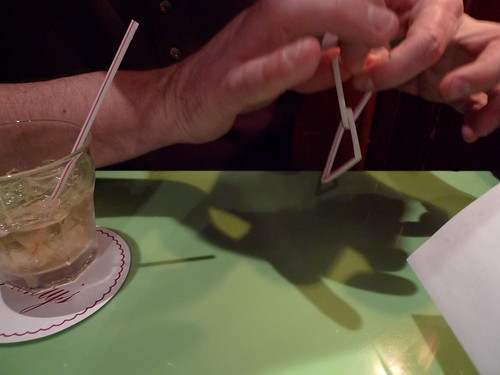
I was in Fort Wayne this weekend, so Kate could see her buddies and I could do likewise. Friday I met Alex at Henry’s, my old local, after work. Alex drinks Jack Daniel’s on the rocks, and I was reminded of one of his odd habits — he folds the cocktail straw into a triangle and saves them:

Two going on three

And then what does he do? He has a storage system:

When he fills it up, he can trade it for a new liver.

When it’s full, he can trade them in for a new liver.

And so we greet Monday, and a new week. Let an old post from Coozledad guide your actions this week: How to catch a bull.

Posted at 1:13 am in Current events, Same ol' same ol' | 52 Comments
 

Sticky fingers.

We’ve had a couple of these stories in Detroit lately. They usually attract my eye with the police mug shot of a thoroughly average middle-age soccer mom. What did this saucy minx do? I wonder, and then I find out:

She stole some money. She stole some money in a stupid, obvious way that nearly always gets you caught. She was the bookkeeper for some organization, paid all the bills. And then one day she figured out how to set up a fake supplier, send an invoice and pay it, only the supplier is guess-who. Depending on the organization, these schemes can go on for months or years, but someone with eyes finally figures out how to see. The recent cases were fairly spectacular, as these things go.

In one, a woman made off with $934,000 from a hockey non-profit in Ann Arbor. In the other a woman and her husband stole $1.8 million from the Palace of Auburn Hills. I think the takeaway lesson is clear: Non-profits sure can have a lot of money in the general fund, but for maximum theft possibilities, steal from an entertainment complex.

What depresses me about these cases is how numbly predictable the details are: The money gets frittered away on such tacky crap. People have such tiny little desires, it turns out — they want cars and clothes and jewelry. Oh, and cruises. The couple who stole from the Palace are like a walking billboard of bad taste:

The McDonalds allegedly bought themselves exotic weapons, expensive tools and high-tech electronics gear and took lavish getaways to the Bahamas and Las Vegas — where they treated themselves to $900-a-night suites, casinos, and “Ultimate Fighting Challenge” exhibitions.

What, no Barcalounger upholstered in fetal lambskin? The woman in Ann Arbor was cut from the same cloth:

“Instead of going to Meijer and Kroger, they purchased items from an actual meat market,” Grigal said. “Instead of going to J.C. Penney’s or Macy’s to buy clothes, it was Saks Fifth Avenue, Von Maur or Nordstrom. Sometimes the withdrawals were daily. Ten thousand (dollars), $8,000, $6,000, $17,000.”

(Yes, I noted the oddness of putting “an actual meat market” in the luxury tier, but maybe the cash-drunk tart had the butcher french her rack of lamb instead of doing it herself.)

Because this is Michigan, internal combustion was involved: The couple bought “three motorcycles, a John Deere riding mower (and) a utility trailer,” the single woman a Cadillac Escalade and a dump truck. For the family business, it’s explained. This is where the question of charging the spouse comes into play. “Honey, happy birthday. I bought you a dump truck.” Shouldn’t someone be arrested, just on general principles? For all-around cluelessness and willful stupidity?

Like everyone in the world, I entertain windfall fantasies — lotteries, inheritances from unknown rich relatives. I like to think that if I had access to a big pile of money, and the sufficient moral elasticity to talk myself into taking some, I’d not spend a penny on a “designer bracelet” sold on QVC. I’d buy a ticket to the Caymans or Switzerland, open an account and make like a squirrel. Half these cases fall apart when someone else in the office wonders how quiet Karen the bookkeeper could make even lease payments on a Mercedes, and where did that cocktail ring come from? My only other purchase would be an open one-way ticket departing out of someplace like Toronto, bound for a major city with lots of middle-aged white women, and the minute, I mean the minute I thought the heat was coming down, I’d be wheels-up for Johannesburg or Vladivostok faster than you can ask yourself what an extradition treaty is.

Just sayin’.

Right before I left Fort Wayne there was a really strange case like this, involving a man who worked for the city or county, only instead of stealing cash he stole heavy equipment, which he squirreled away on his acreage near Decatur. I never heard of its resolution, but I remember the guy had stolen everything from Bobcat loaders to a goddamn road grader, and no, I don’t know what he used them for. Maybe he was operating a road-building business out the back door. I’d just like to know how he did it.

(On the other hand, a member of my extended family dug a pond on his property using heavy equipment belonging to the Army Corps of Engineers, which he “borrowed” on the weekends. So maybe no one raises an eye when Bob drives off on Friday afternoon behind the wheel of a city-owned asphalt mixer.)

Thanks to all who carried the ball during my mini-break. It was a fairly productive day, capped by a trip to Ann Arbor in the evening, always a morale-booster. Or a knuckle-whitener, as you have to become aware, once again, of the odd habits of the college-town pedestrian, all of whom behave as though they walk in a force-field bubble, and if you hit them with your car, it’s the car that will explode into a million pieces, not them. One is tempted to take them up on the dare, but, well, one resists temptation.

Oh, and the winter cyclists. No lights, no bells, no manners. But a nice tradeoff for those walkable streets, those ten thousand restaurants, the energy of thousands of students. A banner on the Diag for the local Democratic students’ club: “We won, but we’re not done.” Ha.

So, bloggage? Not much:

Headlines I don’t want to know more about. But go ahead and explore, if you dare: Bible, handcuffs, diaper in abduction baffle Toledo police.

Michele Bachmann, the dope who keeps on giving.

There’s more — there’s always more — but you’ll have to find it yourself today. I’m outta here.

Posted at 8:30 am in Current events | 49 Comments
 

Your memories may vary.

I once wrote a story about a reunion of children who had lived in a particular institution in Fort Wayne. Can’t recall the name of the place — Something House — and it had been closed for decades; the children were all of grandparenting age themselves when they decided to get together.

Something House was a place the likes of which we no longer have in our society. It wasn’t an orphanage, but for children whose parents could no longer afford to keep them. There was no welfare then, no AFDC, but we weren’t barbarians — we cared for children who needed care.

Kids stayed for weeks or years. Most had lost one parent, usually a mother, and the surviving one was simply overwhelmed with the responsibility. Others were from families who were just poor, or had suffered reversals that required the children be farmed out while parents relocated and reestablished themselves in another city or state. There was a procedure in place for parents to visit their kids, but not take them home. It sounded like visiting hours at any institution — everyone dressed up, small gifts, a nervous tousle of the hair and a quick goodbye.

It sounds perfectly awful, but the former residents described a merry Disney movie of bunk beds, raucous mealtimes and a pervasive feeling of love and camaraderie, “The Cider House Rules” with Michael Caine bidding them goodnight. The reunion was all fun and stories and laughter; the most uncomfortable memory anyone shared was of the weekly dose of castor oil.

Several of these adults expressed the opinion that our society needed to bring these places back, that giving money to poor people to care for their own children only invited waste of public money, that kids “need structure,” which Something House had in spades. It was a fashionable opinion at the time that had the added advantage of never having a chance in the world of happening, so purveyors of the “bring back the orphanage” movement only had to talk the talk; no walking necessary.

Some weeks after the story ran, I received an angry, nearly illegible letter from a woman from out of state, who said she wished she’d known about the reunion so she could have come and told the story about a delivery man who paid a weekly call and was given unsupervised access to the girls’ dormitory rooms, where he — well, you know. Fumbling and secrets and shhh don’t tell anyone. She cursed the place every day she lived there, and had spent her life trying to put the memories behind her. I tried to find her, but she didn’t respond to my letter. The more I thought about her story, the more I believed she was telling the truth. That didn’t mean the other residents’ stories weren’t true, only that not everyone had the same rosy memories, that child molestation is nothing new, and that predators will take advantage of the powerless. That’s all.

Around that time, my best friend was working for a publisher that specialized in the good ol’ days, and she supervised the production of a book of reader memories of the Great Depression. All these people had been children then, and their stories were like the reunion memories of Something House, of adults who kept up a brave front while standing in food lines, who made milk toast suppers seem like haute cuisine, who slept five to a bed with their siblings and remembered it as a nest of puppies, not a tangle of sharp elbows. A few weeks ago, “This American Life” ran a show featuring the oral histories collected by Studs Terkel, covering the same period. Many of these people were kids then, too, but were from the illegible-letter school — they remembered hunger, evictions, parents who came home and took their frustrations out on their kids, things common sense should tell us go along with a 25 percent unemployment rate, but things we’ve tried to forget. To talk to some, the Current Unpleasantness will fade some day, and we’ll be left with Busby Berkeley movies and a lot of new ways to stretch a food dollar.

Well, perhaps.

All of this is, perhaps, a ridiculously long-winded setup for two stories I read in the Sunday paper, which I’m offering as a conversation-starter today:

One is about how worldwide unemployment is opening the door on a host of other issues, many of which could have an impact on the world’s political landscape. Idle hands aren’t only the devil’s workshop, they also tend to rewrite national economic policies in ways we might not be comfortable with, change or reverse immigration patterns and, um, smash windows. Recommended.

The second was the NYT Book Review, a look at “Lords of Finance: The Bankers Who Broke the World,” about not the ones of our period, but of the late 1920s and ’30s, whose mismanagement of world economies led to, among other things, the rise of Adolf Hitler. Just in case you didn’t think the stakes were high enough, you know.

I guess my point is this: We don’t know what’s going to happen at the other end of this, but common sense suggests we should consider all the stories about the past, not only the ones that confirm our prejudices. Just a thought.

Happy Monday to you all, the start of another week.

Posted at 1:15 am in Current events | 46 Comments
 

Is this war?

So sad.

Officially the liquidation at the store above is due to retirement, not bankruptcy, but in the grand scheme it hardly matters — this is the current disease of the age, and you can see signs like this all over the commercial districts in the Pointes. The fact this store is the prime purveyor of the sort of pink-and-green, Lilly Pulitzer, whale-print-pants prep attire that still flies around here just gives it a certain fin de siécle feel.

Kate had a new friend over after school yesterday, and I thought just this once I’d be Florence Henderson and pick up some fancy Valentine cupcakes for their snack. The bakery on my errands route didn’t survive the winter, apparently, and had the FOR LEASE of death in the window. I try not to read too much into these things — even in good times, all small business is a matter of hanging from a ledge by one’s fingernails, and it doesn’t take much to knock loose, but still. In the past, the storefront would be filled by another hopeful entrepreneur within a few weeks. Today, I’m sure it will be months before it’s filled. If it’s filled.

Well, whenever it’s filled, we know Judd Gregg won’t be commerce secretary. I’m trying to figure out how it’s possible that a man nominated a week ago could somehow be unaware his boss was planning a big spending bill that would conflict with his deeply held principles, and I’ve decided it’s impossible. I don’t want to be paranoid, but it’s 1992 all over again, and it’s increasingly clear that for the GOP, nothing but catastrophe will do. They are like the mother who told King Solomon go ahead, cut the kid in half, only the kid is the country. It’s time for Obama to pull up his socks and set to work grinding these folks into the soil, then sowing the soil with salt and maybe irradiating it for good measure. You extend the hand of bipartisanship, and they bite it. OK. Hold up the bleeding hand, say, see what I’m dealing with here? and then pull the choke chain as tight as you can. They understand little else.

I’ve often wondered, since this crisis began, how smart some of my comrades are. Keeping up with what’s happening in the financial industry takes a lot of attention and a willingness to familiarize oneself with some fairly baroque economic concepts. I freely admit I still don’t understand it; it’s like when a computational cosmologist spoke to my fellowship class at Michigan and tried to get us to understand just how big the universe is. I could only grasp it in fleeting glimpses, but I think I got the gist. And this is a pretty frightening state of affairs. “Total economic collapse” is something I hope to never live through, but if so, I hope others will be trying to understand it, too. Since last fall, I’ve heard people I’d always thought had a brain between their ears describe what was happening as though it was the 1987 stock-market reversal, or the dot-com bubble. Laissez-faire, laissez-faire, they preach; all will be well.

Well. I live in a cold climate, and I don’t want to spend next winter rooting for grubs in the back yard while trading shifts in the sniper’s nest with Alan. I want everyone in Washington focused and on task, or I want to know the reason why, and whining about the census doesn’t count as a reason.

No bloggage today. I have to jump in the shower and scrub up for a full day of economic activity. Have a good weekend and remember: If winter comes, can spring be far behind?

Posted at 9:01 am in Current events | 92 Comments
 

Surly bubble.

The problem with modern life is, we all live in a bubble. Our bubbles float through space, occasionally bumping into other bubbles, but you know how that happens — the two bubbles don’t become one, but just adhere for a while. We can look into the bubble next door, but there’s still the membrane between us.

The better your bubble, the more secure you are. On the other hand, the better your bubble, the harder it is to hear what’s going on outside it. Bubbles can be called by other names — I prefer “Graceland” — but it’s still a bubble. My membrane is thin at the moment; I am not secure. On the other hand, I am not Peggy Noonan, either:

On Wednesday, in an interview with Politico, Dick Cheney warned of the possible deaths of “perhaps hundreds of thousands” of Americans in a terror attack using nuclear or biological weapons. “I think there is a high probability of such an attempt,” he said.

When the interview broke and was read on the air, I was in a room off a television studio. For a moment everything went silent, and then a makeup woman said to a guest, “I don’t see how anyone can think that’s not true.”

A makeup woman. Peggy’s bubble has adhered to another’s. She peers inside at the strange life there, and is pleased to see the makeup woman shares her anxieties. Makeup people, taxi drivers, “an e-mail from a reader” — these are how the pundit class takes the pulse of the mob. It doesn’t matter; it’s still a bubble.

Actually, the whole column is just classic Noonan, and I know I’ve said this a million times, but every time I picture her at her laptop, working, I see her stirring a highball with her index finger, sucking the bourbon off, tapping out a few lines, back to the highball. I can think of no other explanation for an opening line like this: All week the word I kept thinking of was “braced.” Peggy doesn’t write so much as she streams her consciousness, whatever shape it’s in at any given moment. Who knew that Hunter Thompson’s legacy would carry so far from the pages of college newspapers? It is to marvel.

Eh. I can’t get excited about picking on the holders of wingnut sinecures this morning. It’s Thursday, almost the end of my week, but not this week. I’ll be working every day, on one job or another, for the foreseeable future, which makes me a little glum and, like Peggy, very thirsty. So let’s turn to the one place that never fails to cheer me up: The big world outside the bubble.

Here in Detroit, the city council president is… well, what is the word I’m looking for? Insane? Maybe. You tell me how to describe a woman who cannot check into a hotel without police being called, who reduces a public meeting to chaos by flinging insults at a colleague? Insane implies she’s irrational, when she’s clearly not. Bloggers and commenters not affiliated with mainstream media reach for more racially tinged descriptions; “ghetto trash” seems to be the term of the moment. She’s always wagging her finger, metaphorically or not, in someone’s face. There was another incident last week:

Detroit City Council President Monica Conyers had to be restrained during a confrontation last week with Councilman Kwame Kenyatta in which she hurled insults at Kenyatta about his hearing aid, health and education.

…When Kenyatta asked her what she said, Conyers responded he needed to learn how to talk to a woman.

Kenyatta shot back that when he was with a woman, he would do so. That prompted Conyers to yell at Kenyatta that he was stupid, citing his lack of a college degree, to tell him he “can’t hear” — a dig at his hearing aid — and to try to rub in his face rumors that Kenyatta has cancer.

It sounds like an episode of “Rock of Love Charm School,” only without the hope of elimination at the end of the episode. Oh, wait. Monica may take care of that herself:

“Sometimes, I think of this job, it’s like, Is it all worth it?” she said in a half-hour interview. “It’s just so much scrutiny for nothing that I didn’t even see none of this when I wanted to run for this office. But now here I am in this office, and it’s just like, beat up on Monica.”

Narcissists are such interesting people, aren’t they? Poor them.

Meanwhile, in totally unrelated musings, Supergay Detroit has some thoughts.

But that wasn’t the only outrage coming out of Detroit this week. (Is there ever only one? No.) The same day one of the city’s few successful and legal businesses lays off 250, it also hires one: Kwame Kilpatrick. And while you can read the legitimate stories about this in the usual places, for pure summing-up pungency, you really can’t beat Detroitist:

Kleptocracy uber alles.

Oh, hell yes.

Dana Milbank can be a bit full of himself, but for a certain sort of Washington reporting, no one does it better:

In another time, Stew Parnell, the man whose peanut butter killed eight people and sickened 550 more, would have been put in the stocks or the pillory. Congress didn’t have such tools at its disposal yesterday, so lawmakers did the modern equivalent: They put him through the walk of shame.

The House commerce committee hauled Parnell up to testify under subpoena, even though lawmakers knew the Peanut Corporation of America boss would take the Fifth. Before calling him to the witness table, they heard from the grieving relatives of Parnell’s victims. They made him take the oath, then invited him to sample some of product he shipped even though he knew it had tested positive for salmonella. Finally, they forced him and his lawyers to take a quarter-mile perp walk on Capitol Hill, chased by television cameras and reporters jamming microphones in his face and shouting questions:

“Mr. Parnell, did you put profits ahead of the public’s health?”

“People died, sir. Do you have anything to say to their families?”

More constrained reporters had to settle for wussy adjectives like “theatrical,” but I thought Milbank’s “sketch,” as these pieces are called, captured the absurdity of the situation — posturing on one side, weaseling on the other — rather neatly. He should cover Detroit.

And with that, I think I should drag my stinky ass through some hot water and try to make some sense of the day. Some days, you think Joaquin Phoenix is the only one who really has it figured out. Hilarious clip behind the link.

Posted at 10:13 am in Current events, Detroit life | 53 Comments