Here’s a novel resolution some of you might be interested in. I know I am. And it is:
Use fewer words.
Ha ha, said Little Miss Logorrhea, knowing this would be one of those resolutions that would fall to the wayside by noon on New Year’s Day. Still, I think it’s important to take a stand. What made me think of it was this quote from Kwame Kilpatrick in the Freep today, a reconstruction of how their own reporting reverberated in the mayor’s inner circle last year:
“I’m going to need you to step up,” Kilpatrick said.
A generation ago, he’d have said, “I need you to step up,” or “I need your help,” but the “I’m going to” is the mark of our age of blah blah. It so happens I watched “Office Space” over the weekend, and this is how the evil boss talks: “Yeah, Peter, I’m going to need you to go ahead and come in on Saturday…” All those filler words thrown in there, like packing peanuts, the mark of the passive-aggressive personality. Not: “You have to work Saturday,” but “I’m going to need you” and “go ahead” and “come in,” etc.
The other day I saw a sign in the salon where I was fighting another skirmish against the gray:
“Start the new year right! Swap out your old cosmetics and get a 20 percent discount.” When did “out” hook up with “swap,” anyway? No one just says “swap” by itself anymore, and now we have two words doing the work that used to be done by one: “Exchange.”
“Change up” — that’s another one. I first noticed it on “The Wire,” and I always assumed it was ghetto usage, until it started spreading like an ink stain: “And then he changed up, and it was all over.” Or else he changed up and swapped out, which I swear I saw somewhere living in the same sentence, but I forgot to clip it.
Everybody talks and writes these days like they’re being interviewed by Charlie Rose, and no one wants to sound stupid by not giving a full answer. And so we change up and swap out, and we’re going to need you to go ahead and come in this Saturday, mmm-kay?
Use fewer words. Cultivate that tight-lipped air of mystery.
That doesn’t mean fewer letters, however. Somehow I got on a Star-Tribune mailing list and thought I’d immediately unsubscribe, until I was sucked in by this amusing urban-trend story, about a man who shot a 15-point buck — and friends, that’s a trophy anywhere in the world — with a crossbow on the shoulder of a busy Minneapolis freeway. How often do you get to read a sentence like this?
The buck jumped back over the fence and died in a nearby parking lot.
“Bed, Bath & Beyond, I bet,” said Alan. Discussing what constitutes a “point,” however, reminded us of a story last month in the Free Press, about a teenage girl who hunts with her dad, and bagged a “three-oint buck” her first time out. We thought it was a typo, but it was repeated later in the story: a three-oint buck. Cutbacks on the copy desk, I guess, or maybe a novel way to save ink.
Today’s holiday photo wasn’t submitted as such, but I like it and I’m stealing it. Readers, our own Coozledad, taking his new toys out for a spin down on Vegetarian Farm, or whatever he calls his acreage:
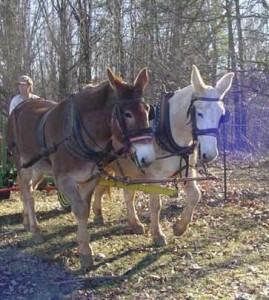
I’ve said before that little makes me happier than seeing animals doing the work they were bred to do, and something about the expression on Andy and Barney’s faces as they bend to the task at hand — hauling firewood — makes me smile. Plus, I like equines in furry winter coats (until they roll in the mud, and you have to spend an hour currying it off of them).
See you in the new year, then. Safe celebrations, all.