Some clippings.

Boy, did Proposal 1 ever go down hard. They may have to invent a new word for it; how can you call a ballot prop that went down in two counties by 90 percent merely “defeated?” It was loathed across the spectrum, and that doesn’t happen often. Historic!

But now it’s in the rearview, I think I’m finally done writing about it, and it’s time to look at some excellent bloggage I stumbled across. First, a heartbreaker about the HIV outbreak in southern Indiana, the one that prompted the right-wing governor to allow an experimental, 30-day needle exchange program. The 30 days is up and some would like to allow exchanges in other communities, but they best get schooled, because not only are the prosecutors against it, it’s not working so well:

Officials here say the need for education is urgent and deep; even local health workers are learning as they go. Brittany Combs, the public health nurse for Scott County, said she was stunned to discover from talking to addicts that many were using the same needle up to 300 times, until it broke off in their arms. Some were in the habit of using nail polish to mark syringes as their own, but with needles scarce and houses full of people frequently shooting up together, efforts to avoid sharing often failed.

Ms. Combs also learned that many addicts were uncomfortable visiting a needle distribution center that opened April 4 on the outskirts of town. So she started taking needles directly to users in their neighborhoods.

At the same time, H.I.V. specialists from Indianapolis — who have evaluated about 50 people with the virus here so far and started about 20 of them on antiretroviral drugs — are fighting a barrage of misinformation about the virus in Scott County, where almost all residents are white, few go to college and one in five live in poverty, according to the census.

As I said on social media earlier today, what the hell are we going to do with these people, living in these hollowed-out parts of rural America? What is there to do in Scott County, Ind., if you can’t get a job and you’ve got a bad back and a doctor willing to write scripts for painkillers? What are we going to do with these people?

Sigh. Moving on:

I wasn’t paying full attention to the news this weekend, and missed that the shooting in Texas was wrapped around the loathsome Pamela Geller. I’m glad Neil Steinberg did, and wrote this blog about it.

“This incident shows how much needed our event really was,” she told the New York Times. “Freedom of speech is under violent assault here in our nation. The question now before us is: Will we stand and defend it, or bow to violence, thuggery, and savagery?”

And how do we defend free speech? Oh right, by insulting Islam. An oddly selective defense. If Geller’s show was a general collection of sacrilegious art, I might be tempted to buy her ruse. But it isn’t, it’s a stiletto designed to stab at Muslims. To prove how free we are.

Actually, Muhammad shows up in the “Inferno,” receiving a particularly gruesome punishment, split from chin to anus, his entrails hanging out, as contrapasso for his splitting of his world by forming a new religion. Muslims do not, to my knowledge, attack those reading the 700-year-old work of literature because, unlike Geller’s stunts, the “Inferno” isn’t a hate carnival designed to stigmatize and marginalize a certain group (Well, it is, but that group is Florentines, and they’ve adjusted themselves to it by now).

The comments are pretty good, too.

Finally, circling back to the NYT, a look at the differences between Baltimore and Muskogee, Okla. It turns out they have a lot more in common than you might think!

In Muskogee County and in Baltimore, the percentage of households composed of married couples with children dropped from 2000 to 2010 for both whites and blacks.

The violent crime rate in both cities has fallen over the past decade, just as it has nationwide, although the 22.3 percent drop in Baltimore is four times as large as the 5.6 percent decline in Muskogee.

Over time, Lesthaeghe foresees a convergence in the marital and reproductive behavior of whites and blacks — and of red and blue states — with low marriage rates, dipping fertility, and rising cohabitation rates for both races.

It’s a sad story. I’m not gloating.

Tomorrow there’s a radio interview for me, lap swimming and, whaddaya know –the downslope of the week.

Posted at 12:36 am in Current events | 32 Comments
 

No cold pizza here.

Did I just say I had some breathing room at work? I don’t have it Tuesday night. There was an election today, there was but one question on the ballot, but it was the one I’ve been writing about for a month, so I have to handle the follow-up. (Or, as we journalists like to put it in our internal memos: the “folo.”)

I’m writing this about an hour after the polls closed, and this question is going down like (insert fast-falling imagery here). Like a rock in a pond. Like a plane with one wing. Like a whore at a bachel– never mind. I haven’t seen a margin slimmer than 75-25 percent yet. Well, anyone could see it coming. I’ve never seen internet comments quite like the ones on this issue, seething rage from left to right, all of it directed at a legislature that simply couldn’t get anything done, even in a lame-duck session (important in Michigan, because of our term limits).

They got this thing done at 5 a.m. on the last day of the session. And this is what happened. Back to the old drawing board, boys and girls.

One quick note before I get on this conference call with the Democratic leadership: You “Mad Men” fans who’re watching the final episodes may have an opinion on the sexual-harassment plot line in the latest one. Hanna Rosin did:

…this episode depended on some pretty crudely-drawn enemies. The bros at McCann were like guys you usually encounter only on workplace training videos about sexual harassment.

You want to know how much things have changed since the c-1970 period depicted there? Look at that observation by Rosin, who almost certainly was an infant at the time. I had a friend whose boss literally chased her around the desk, and when she complained, she was transferred, but the boss, deemed too valuable to the company, was left in place, a new assistant dropped in to amuse him. So was it bad then? I was years away from entering the workforce, but it was bad when I did a decade later, so I have no problem believing what Joan Harris was fictionally enduring up on the screen.

Many of you readers went through this. Tell some stories. Me, I gotta hoover up some quotes.

Posted at 12:24 am in Current events, Popculch, Television | 43 Comments
 

The new new thing.

What a whirl of news lately, at a time when I’ve been up to my neck in my own work, so I feel like a periscope. Every so often I stick my head up, look around, try to scan Twitter and then pull it back down, overwhelmed.

On the other hand, this might be the best way to absorb a breaking story. Every so often I turn on CNN, seeking news of Baltimore. The last time I did, Ben Carson (I refuse to call him Dr. when he’s not actually talking about pediatric neurosurgery) was praising some woman who smacked her son in the head. And wasn’t that story peak weirdness? I watched it the first time wondering how the hell do we even know who this woman is to this ninja-looking man? But I guess there was some direct observation of the encounter, and OK — it was his mother. And she’s chasing him, smacking his head, telling him to get his ass home, and of course the rest of America went nuts. MOTHER OF THE YEAR!

I guess there’s a time to smack your kid upside the head, but that was a very uncomfortable piece of video to watch. On the other hand, it was a great excuse to turn off CNN. It’s like they scan Twitter, no, Facebook all day and count the stupidest posts possible, then pitch their coverage directly at that demographic.

On the other hand…

I did find two interesting things in all of this.

This lengthy Q-and-A with David Simon is absolutely worth your time, as it dives deep into the dysfunction of the Baltimore police department, i.e., all urban police departments, and its relationship with the politicians and cities it’s entwined with. To wit:

It used to be said — correctly — that the patrolman on the beat on any American police force was the last perfect tyranny. Absent a herd of reliable witnesses, there were things he could do to deny you your freedom or kick your ass that were between him, you, and the street. The smartphone with its small, digital camera, is a revolution in civil liberties.

And if there’s still some residual code, if there’s still some attempt at precision in the street-level enforcement, then maybe you duck most of the outrage. Maybe you’re just cutting the procedural corners with the known players on your post – assuming you actually know the corner players, that you know your business as a street cop. But at some point, when there was no code, no precision, then they didn’t know. Why would they? In these drug-saturated neighborhoods, they weren’t policing their post anymore, they weren’t policing real estate that they were protecting from crime. They weren’t nurturing informants, or learning how to properly investigate anything. There’s a real skill set to good police work. But no, they were just dragging the sidewalks, hunting stats, and these inner-city neighborhoods — which were indeed drug-saturated because that’s the only industry left — become just hunting grounds. They weren’t protecting anything. They weren’t serving anyone. They were collecting bodies, treating corner folk and citizens alike as an Israeli patrol would treat the West Bank, or as the Afrikaners would have treated Soweto back in the day. They’re an army of occupation. And once it’s that, then everybody’s the enemy. The police aren’t looking to make friends, or informants, or learning how to write clean warrants or how to testify in court without perjuring themselves unnecessarily. There’s no incentive to get better as investigators, as cops. There’s no reason to solve crime. In the years they were behaving this way, locking up the entire world, the clearance rate for murder dove by 30 percent. The clearance rate for aggravated assault — every felony arrest rate – took a significant hit. Think about that. If crime is going down, and crime is going down, and if we have less murders than ever before and we have more homicide detectives assigned, and better evidentiary technologies to employ how is the clearance rate for homicide now 48 percent when it used to be 70 percent, or 75 percent?

I was glad to see that bit about cameras. I think there’s a PhD dissertation on the role of cheap-but-excellent cameras we all now carry in our pockets in this story, and in many stories. Anyway, a long piece but recommended.

Here was the other smart thing I read, about Periscope, just one of the amazing live-video apps that will transform stories like this and make Wolf Blitzer’s gaping fish mouth that much more stupid and irrelevant:

In photography, the golden hour is all about timing. It’s when the subjects in an image are depicted under warm, natural light. It’s when shadows are the least visible, and the details of a scene are enhanced. Likewise, there is a window when journalists can capture the richest part of a breaking news story.

On April 27th, with nightfall approaching, several journalists, armed only with their iPhones, wandered out in Baltimore. Through a sequence of expertly-documented live footage, including on-the-ground interviews, Guardian US correspondent Paul Lewis used Periscope to “observe a community making sense of the destruction and chaos” in real-time.

In one of his first Periscope feeds, Lewis speaks with a local in front of a neighborhood corner store. The shop is being looted as they talk on camera. After a minute of conversation, he is threatened by a bystander to stop recording.

“I’m gettin’ ready to beat you” is heard in the background.

Lewis’ live Periscope feed ends abruptly. For nearly five minutes, several hundred users remain active on his feed, exchanging messages and posting shell-shocked reactions about his fate.

P.S. He was OK. It’s a fascinating thing to consider. The 40th anniversary of the Detroit riots is approaching, and I’m looking through archival material. It’s truly an archeological process that makes you wonder why any of us journalists bother — all we’re making is core samples, snapshots, Vines, whatever, and nothing close to reality.

Off to bed for now. Follow those links — you’ll be glad you did.

Posted at 12:17 am in Current events | 57 Comments
 

TV explains it all.

I expect we’re heading for cord-cutting within the next few months. (When “Mad Men” wraps, and then “Ray Donovan,” and then “the Knick” and oh, it’s just gotta go.) But we’ll be doing the HBO Now when we do, and in part because of shows like “Silicon Valley,” which in its most recent episode introduced a character who explained digital-economy finance better than anyone or anything else I’ve heard or read. Mike Judge really has a great sense of satire. I can’t reproduce the dialogue, but this recap nails it:

As usual, “Silicon Valley” is gleeful about ripping off real-life story lines of the Valley. So you have Hanneman espousing one of the tech businesses’ happy secrets, which is that for young companies, making any money can actually be detrimental to its prospects. “If you show revenue, people will ask how much, and it will never be enough,” he advises Richard, who’d foolishly believed that the point of starting a company is to make money. “It’s not about how much you earn but what you’re worth,” Hanneman says. “And who’s worth the most? Companies that lose money.”

Hanneman’s analysis is largely correct. Google bought the home-device company Nest last year for $3.2 billion, a relatively small sum for a company that actually sold products that people were willing to pay for. Meanwhile companies that had, at the time, spent little time trying to make any money at all — like Snapchat and Pinterest — were valued at many billions more.

Thank you, fictional Hanneman guy. This has baffled me forever. How can Instagram be worth $1 billion? There are no ads and it’s free. ‘Splain this. No one can.

Much good to read today, so let’s get to it.

On the Baltimore situation, here’s Hank on CNN:

On a night like Monday, no one involved — Baltimoreans, city officials, CNN reporters, and, indeed, all journalists doing live TV or filing dispatches tweet by tweet and photo by photo — had the time to parse their own words. Words such as “riot,” words such as “thug,” combinations of words that are mostly metaphorical exaggerations, such as “the city is burning.” You can only be so careful with the sting of smoke in your eyes and the taste of pepper spray in your mouth.

Likewise, CNN doesn’t always have the time to think deeply about the images it beams live back to the rest of the country. One assumes there are a lot of people calling the shots at CNN, but it’s hard to see the power of a guiding hand or principle. It is CNN’s nature to jump into the fray and seek out the most dramatic events it can capture on camera and then summarize them as they occur, while queueing up a long line of experts to weigh in.

The strongest visual will always win. CNN would be shirking its duty if it declined to show such events to appease some nobler effort to accentuate the positive, which, in this case, included the many people who chose peaceful protest. TV news frequently finds itself explaining why non-burning buildings and people standing still (or staying home) don’t make the cut.

I’ve really come to despise live cable news in a breaking story, even while I freely acknowledge that it’s the first place I turn when news is breaking (plus, y’know, Twitter). Sometimes I hate myself as a news consumer.

Also, from the WashPost: The burning of Baltimore and “The Wire.” Some smart stuff, some dumb stuff, but if you were a fan and you were watching CNN Monday night, you had to think it: Is that the street where Kima was shot? It looks so familiar.

Time to return to Twitter.

Posted at 12:39 am in Current events, Television | 45 Comments
 

Trending!

Since I lost weight I’ve been buying new clothes, and while I’ve never been a fashion plate and have no interest of becoming one, it is fun to look at fashion magazines and websites again and see what’s going on out there. I can report a few headlines and my own reactions:

The ’70s are back, big-time. I keep hearing that wide-legged denim is here again, and so just pack those skinny jeans up and throw them in the trash, because BELLS, BABY. As I age, there are very few things I am certain of, but one is: Not going back to wide-legged denim. I only recently bought some skinnies, but then, I live far from fashion’s nerve center. Around here, jeans and a Detroit-themed T-shirt will take you everywhere but the symphony, and probably there, too.

Anyway, no elephant bells, and I’m also going to let trendier people discover the styles of the ’70s, most of which I couldn’t purge from my closet fast enough when the ’80s finally came along. (You know what I loved best about the ’80s? All of a sudden it was all about natural fibers. Linen, cotton — man, was that a relief.)

That said, I found this interesting: Google’s predictions of spring fashion trends, based on what people are searching for. To my relief, wide-legged jeans are not on the list, but skinnies are in “seasonal decline.” Also declining: One-shoulder dresses — perfect, because I just bought one. Waist trainers? On the way up. (I think it’s a 50-shades thing.) Normcore? Outta here.

It’s a good time to be a middle-aged woman whose basic outfit is jeans, T-shirts and nothing with too much color.

A little bloggage? I think we can do that.

Here’s a profile I wrote of a high-profile tea partier in the Michigan House, but the link won’t go live until 6 a.m. Be advised.

Riots in Baltimore, but you probably already knew that. Mr. Lippman weighs in, too.

Waiting tables always seemed like pretty sucky work to me, and it is, but every so often you get a good customer. A few of those stories.

Off to bed.

Posted at 12:36 am in Current events, Popculch | 54 Comments
 

Ten years after.

I’m writing this on Sunday the 19th, which means you’re reading it on Monday the 20th. April 20. If ever a date deserved the #abandonallhope hashtag, it’s April 20. Very dire portents — Hitler’s birthday, anniversary of the Columbine shootings. Today, the 19th, was the Branch Davidian fire anniversary and the event it ultimately inspired — the Oklahoma City bombing. The Boston Marathon bombing was on April 15, and I cannot tell a lie: I was sure it was carried out by domestic terrorists seeking to make a point about taxes and freedom and the rest of it. Of course, they were domestic terrorists, but not that kind.

It’s a zero anniversary for the OKC bombing. Twenty years. At 20 years, you should understand pretty clearly what led to a tragedy like this, but I’m not sure we do. Anyway, I’m grateful that Hank Stuever posted this piece from his WashPost reporting days, about the father of one of the victims, who chose to forgive Tim McVeigh. JefftMM, you’re going to want to read this, if you haven’t already.

I will admit it: I find forgiveness difficult. I suspect most people do. As a child I picked scabs and I guess I never got over it, but let’s face it: Forgiveness is hard. That kind of forgiveness, to forgive a man who murdered your child? That has to be the hardest kind of all. And the funny thing is, I think I’m fairly good at empathy; it’s what makes people interesting to me. But to use that empathy to get to a place where I can let an offense go? Man, is that hard. So I recommend you read Hank’s piece about Bud Welch, and take its lessons to heart, to the best of your ability.

Here were some key phrases: Finding his way to a mercy he still doesn’t fully understand and “What’s the difference between ‘reconcile’ and ‘forgive’? Really, I don’t know,” he says and I finally realized it was an act of vengeance and rage if we killed either one of those guys. And that was why Julie and 167 other people were dead — because of vengeance and rage. It has to stop somewhere.. I think that’s the hard part. The surrender to something you don’t understand, especially when people like McVeigh haven’t even asked to be forgiven. You just have to do it.

That might be the final lesson of April 19, 1995, as it was lived in Oklahoma City and everywhere else in this country. Which brings us to the other thing I dug up today, also an old piece, from the Observer. It’s about the OKC memorial, which opened with a speed after the event we’ve heretofore not seen in this country. I think Philip Weiss gets to the problem with it:

There are so many symbols here as to obliterate the poetry of any one of them. There are so many faces on televisions inside the museum describing their pain to you that you feel wrung out like a rag. Worst of all, the memorial has nothing to say about the important historical issues that triggered Timothy McVeigh’s madness.

The problem is obvious. “The wishes of the Families/Survivors Liaison Subcommittee are to be given the greatest weight in the Memorial planning and development process,” said the memorial’s mission statement. This was a mistake. The victims’-rights movement has been an important one that has reformed the justice system. But here it has gone too far, and turned a memorial that should address issues of national disunity into a site for the bereaved. When Mayor Bloomberg said recently that he does not want a “cemetery” downtown, he may well have had in mind the field of 168 chairs, which resembles a graveyard and is inaccessible to the general public, roped off on the day that I and hundreds of others showed up by the busload. In 100 years, those chairs will seem meaningless.

Meantime, the memorial declines to show the curious where McVeigh parked his Ryder truck packed with fertilizer. And the National Park Service Rangers who work the site sound like funeral-home workers.

A memorial should emphasize the Who, of course. But if it says nothing about the Why, it fails. I guess Maya Lin’s Vietnam memorial in Washington D.C. began the contemporary emphasis on the Who; while local monuments might carry every name that perished, a national one never did (or rarely did, I’ll qualify; what I’m really saying here is, “I don’t know of one”) until Lin’s tremendously sad wall. Lin is a native of Ohio, but of Chinese ancestry, and the wall has a certain Asian minimalism, the way it starts small and swells to the crescendo of 1968 and then tapers off again. If it had been left alone it would have been perfect, but the usual squawkers started meddling with it, so now we have a row of flags, and the Three Ethnically Diverse Soldiers Looking at It, along with the Don’t Forget the Nurses statuary.

But it’s real legacy is the names. The 168 chairs is a direct result of the Vietnam wall, and I don’t see how you can deny that. Where else would you leave your bouquet of flowers? Who even mourns in cemeteries anymore? I think Weiss’ broader point, that memorials have to be more than just places for flowers and teddy bears, is very sound, though. Time has to pass, sometimes, for that to happen. When I was a Knight Wallace Fellow, we had a seminar one night by the man who chaired the 9/11 memorial committee in New York, and I asked him the too-soon question. He said that was probably true, but hey — New York City real estate can’t just sit around waiting.

Maya Lin did that one, too.

So. New subject.

Did anyone read the story in the New Yorker a few years ago about the guy who was running fake marathons? Or fake-running fake marathons? Whaddaya know, it too is online. A good story about deception and the way it can ensnare a person. Interesting that it happened to be marathon running; remember when Paul Ryan said he’d had a sub-three hour marathon, but “couldn’t remember” his exact time? A friend of mine, who’s run three Bostons, said, “You NEVER forget your time once you break three, or in fact, ever.” He’s right. There’s really nothing like a marathon to encourage obsession, is there? The months of training, the online training diaries, the months of boring your friends with your workouts (“Hey, come back here, I wasn’t finished!”), and finally, the race itself. It really lends itself to lying and deception. So the guy in the New Yorker story is one, and now there are two (that I know of), a woman who crossed the finish line in St. Louis to “win” the women’s race, only not really. It’s funny when you consider bragging rights is all you’re competing for in most of these races, and honestly, a winner’s story isn’t all that interesting. I’ve never heard one, I should say; who knows people who actually win marathons? Those are super-humans who are usually on the next flight out of town and en route to their next training run, culminating in the Olympics or something.

Lying about your marathon performance is like lying about yoga — what’s the point?

So now this weekend, that started out warm and sunny, is closing out gray and chilly. Such is April, but I’m still glad we got a gorgeous couple of good ones before the week begins. We were owed, dammit.

Happy week, all. Let’s get it going.

Posted at 12:30 am in Current events, Popculch | 25 Comments
 

Alice, again.

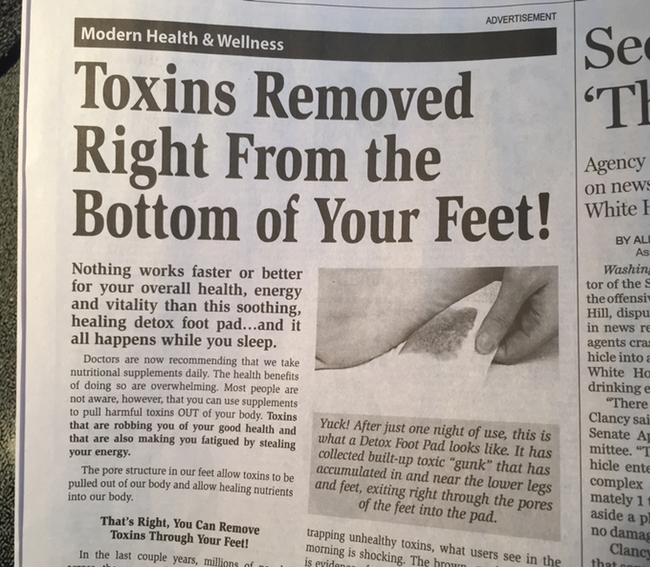
Every time I get irritable about terrible health quackery peddled on the internet, something happens to remind me that newspapers were really on the bleeding edge of this stuff. Behold:

clip

I felt like sending away for some, just so I can see how those pads manage to pull all that gunk out of the soles of your feet. Toxins!

Another mixed grill of bloggage today, because my life is just that boring.

You know a city has arrived jumped the shark when the people who left a hundred years ago come back and everybody makes a big stupid fuss over it. In this case: Alice Cooper and John Varvatos. The former called the latter “pure Detroit,” and delivered this stunningly dumb line, although he gets a pass because he was the paid entertainment and it’s not like we expect pith or intelligence:

“This is great,” Cooper said before his performance, “because Varvatos is pure Detroit, and this is the beginning of building this downtown area the right way. The restaurants are all here. People are coming into these old buildings and they’re opening these really cool restaurants, which is going to draw people and they’re gonna start drawing in the boutiques and everything, and pretty soon it’s going to be a very hip city.”

Back to Arizona on the first flight, I expect.

Evildoers II: Change one letter, go back to war! Coming soon to a campaign near you!

Alan, today at breakfast: “In any other city, this would be on Page One.” In Detroit? Page three: It takes cops five tries to find a body in a house. The house was being looted the whole time. Now there’s a contrast with that gala boutique opening, ain’a?

Bridge had some good stuff this week, about a class-action lawsuit filed by juvenile prisoners incarcerated in the adult system. You can find the links on the right rail.

OK, I gotta get on the horn with some people. A great weekend to all, and to all some nice weather for a change.

Posted at 10:09 am in Current events, Popculch | 41 Comments
 

Bitches be crazy.

Back in 2008 I was sitting with an acquaintance in a bar, one of those funny loudmouths who likes to troll you in casual conversation, and especially in bar conversation. He said he was voting for Obama over Hillary, because you couldn’t trust a woman with her finger on the button. Hormones, you know.

I laughed, even as I understood that there were people in the world who believed that, and weren’t joking when they said the same thing. (Although probably all were voting for Mike Huckabee instead.)

So imagine my non-surprise when I saw this thing, written by an author whose work I sorta respect, if “been meaning to read ‘Weekends at Bellevue’ ever since I heard a thing on ‘Fresh Air'” counts as respect, on that very topic. I guess Time magazine, like all media outlets, is just click-whoring these day, but for cryin’ out loud:

The long phase of perimenopause is marked by seismic spikes and troughs of estrogen levels, which can last for more than a decade in many women. But afterward, there is a hormonal ebbing that creates a moment of great possibility. As a psychiatrist, I will tell you the most interesting thing about menopause is what happens after. A woman emerging from the transition of perimenopause blossoms. It is a time for redefining and refining what it is she wants to accomplish in her third act. And it happens to be excellent timing for the job Clinton is likely to seek. Biologically speaking, postmenopausal women are ideal candidates for leadership. They are primed to handle stress well, and there is, of course, no more stressful job than the presidency.

In other words, bitches be crazy, but after they dry up, they’re wizened crones, natural-born healers and midwives and oh go fuck yourself.

I am not, repeat not, a woman who sees sexism lurking around every corner. I understand that social change takes time, and am buoyed by the different gender landscape I see forming in the young people of today. And even though this piece reaches a crescendo of a group hug about women’s beautiful differences and the necessity of treating our moods as nature’s “intelligent feedback system,” I just don’t need this crap right now. Totally.

Although it did bring back a flash memory I haven’t recalled in ages, about a former Washington bureau chief at the Columbus Dispatch who once told a reporter doing a “girls on the bus” feature in the ’80s about how he didn’t think women were suited for campaign-trail work, because Periods, and he always knew when one was in progress, because of his very sensitive nose.

It was a good thing that guy only came to town twice a year, is all I can say.

Speaking of moody bitches, there’s not much in Slate that gets me reading past the first take, but I did enjoy this piece on “haterbragging,” i.e., the practice of using one’s online critics as self-promotion, with novelist Jennifer Weiner as the queen of all haterbraggers, citing her epic online joust with Jonathan Franzen, who always comes off as a dour old poop while she runs giggling rings around him.

A final female-centric story to make it a hat trick: The return of sidesaddle riding. Charlotte comes from an old horsey family, maybe she knows better, but as for me, this is one style I was never, ever tempted to try. One thing I learned from this, though: If conventional, leg-on-either-side horsemanship is known as riding astride, sidesaddle is called “riding aside.” Two letters makes all the difference.

Finally, I remember a friend whose sister went to work for Yugo, the now-defunct car company, in the former Yugoslavia, which was at the time a guaranteed-employment economy. The day she first toured the plant, the leader was embarrassed to come upon a large bin of upholstery scraps with two or three loudly snoring workers catching a midday nap. I guess this story shows it could have been worse.

Happy Tuesday! Sorry for the late update today — I did Kate’s taxes last night. She’s getting a refund.

Posted at 10:30 am in Current events, Popculch | 42 Comments
 

Wha gwan Internet?

Storms moving through right now. We were promised temperatures in the 60s, but hour after hour passed and things couldn’t seem to get past 50. Then there was sort of this big exhalation out of the southwest, the temperature went way up and as soon as I thought bike ride the rain started, and the tornado warnings started, so none of that stuff.

The tornado warnings were ridiculous. Nothing spotted, just some sketchiness on the radar, but it robbed me of my simple early-evening pleasure – “Jeopardy,” of course – as the weather guy broke in and riffed live for A SOLID HOUR on some stupid thunderstorms, as though Miss Gulch and Toto were right outside the door.

It is not for myself that I weep, however, but for the old people who missed “Wheel of Fortune.”

But now we slide into the weekend, and my soul is at peace, now that Proposition 1 is done, edited, published and filling the comments queues. Tomorrow I’m heading downtown; maybe I’ll have lunch with adults! So wonderful.

Today I took Kate in for a check of her jaw, after she reported “a lump” that wasn’t on the other side. The doctor pronounced it a hematoma. I told her, “That’s ‘hema,’ meaning ‘blood,’ and ‘toma,’ meaning ‘something bad.'” The doctor had just started to say, “that’s right,” then did a double-take and said, “So what do YOU do?”

“I’m a writer,” I said.

“So you’re supposed to have a command of the English language,” he said, already sorting me into that surgeon’s hierarchy of People Who Are Beneath Me, But Whose Order Is As Yet Undetermined.

“I do,” I told him. I hope it came across with the right amount of smugness. As a person with scintillating scotoma, I’ll be the one who decides what “toma” means, asshole.

Bloggage:

Orthodox Jews, seated next to women on airplanes, demand the woman move. I would have but one question: Is the seat I’m being asked to move to in first class? Yes? Then I am happy to do so.

I had never heard of this creature until he killed himself last week, and I learned he was the model for a Martin Short cameo in “Unbreakable Kimmy Schmidt.” Seriously.

“Wha gwan Jamaica?” This guy. I mean. This is going to be a fun last couple of years.

Hope your weekend is good. Hope mine is, too.

Posted at 12:30 am in Current events, Same ol' same ol' | 55 Comments
 

Like a dog with a deer leg.

Dead eyes on this one, don’t you think?

Well, you better angels were right: The reaction to this shooting on one side of the cultural divide was hardly the shrug that I’ve come to expect. There was the odd Facebook page, and surely there’s something more out there, but to my relief, the country does seem to believe that shooting an unarmed fleeing man in the back is a bad idea.

Glad that’s settled.

Man, this Proposition 1 business has wrung me out. Today I started back to work on other things, and I am happy not to be nose-to-nose with a policy story. But as long as we’re on a dog theme this week, and a photo theme, let me reproduce here a photo shared on Twitter by Charlotte, our commenter. I hope she won’t mind. It’s her dog with a prize he’s been carrying around for a while:

CCHH515UgAAG-iP.jpg-large

How beautiful is Montana? The gravel road, those driftwood-y looking fenceposts, the blue sky — oh, how I’ve missed those ere this long long winter — and, of course, the deer leg in his mouth. (I remember a hilarious story in Outside magazine a few years ago, where a writer in rural Montana attempted to follow his free-roaming dog through a few typical days, to learn exactly what lured him hither and yon in that amazing landscape, as well as what he was eating — it was one of those dogs that would let loud, repulsive farts and then turn around and bark at its butt.)

On the other hand, Michigan has water, which is more than I can say for the American West these days.

Another rough night, and I don’t know why. Sometimes you just have to push through insomnia. I haven’t been taking the best care of myself the last few days, but I’ve hardly been on a bender. Oh, well, this much I know: One rough night is often followed by a great night’s rest, but two rough nights always is. So I have that to look forward to.

So, bloggage:

When Obama announced our rapprochement with Cuba, a friend and I decided this was the beginning of the Fuck All Y’all phase of his presidency, and that we liked it. With the White House bully pulpit now being used to condemn “conversion therapy” for LGBT people, especially teenagers, I’m liking it even more. (The Scott Walker stuff is just the cherry on top. Bone up, son.)

There was a small dust-up here yesterday over whether the University of Michigan should screen “American Sniper” to a student audience as part as some sort of social event. First it was cancelled, then it was un-cancelled, and of course no story out of Ann Arbor is complete without the football angle. It was one of those stories where you can feel equally contemptuous of both sides. Mmmm, misanthropy.

Finally, the return of “Mad Men” means the return of T-Lo’s Mad Style, the appearance of which yesterday nearly made me weep with joy.

Off to work with a lighter heart, but sandier eyes.

Posted at 9:05 am in Current events, Same ol' same ol' | 33 Comments