Woody, not Bo.

In the Freep, Bill McGraw visited Woody Hayes’ grave. (If I’d known, I’d have had him wave to my friends Jeff and Craig Clark, brothers, buried just a few doors down at Union Cemetery. AIDS, if you’re wondering. Both of them.) He spent a second entry remarking on the epitaph etched on the headstone:

And in the night of death, hope sees a star, and listening love hears the rustle of a wing.

The author is Robert Greene Ingersoll. McGraw said it seemed “slightly out of character” for Woody, and I guess if all you knew about him was his football persona, it does. “Three yards and a cloud of dust” might seem more fitting, but you didn’t have to know much about Woody Hayes to know he was a lot more than the bullnecked coach you saw on the sidelines.

He was what you might call old-school, a student of classics who made his players keep their hair trimmed. He didn’t allow them to appear in Playboy’s Pigskin Preview. After his famous flame-out at the Gator Bowl he laid low for a while, then emerged as an elder statesman. He lectured at Harvard on the essays of Ralph Waldo Emerson, which he used in his coaching.

The best thing I ever read about Woody Hayes was a column by Columbus Dispatch columnist Mike Harden, written after Woody’s death in 1987. It’s almost 20 years old now and I’m going to quote from it liberally, probably busting copyrights all over the place, but what the hell, I just paid $3 for it from the Dispatch archive and I’m giving credit where it’s due. Here’s how it starts:

When Woody Hayes wheeled his Chevy into Glenn Webb’s Shell Station in West Jefferson, Ohio, he paid scant attention to the loitering locals, the scrawny kid resting his back against the Coke machine. But the kid noticed him, and so did the locals. With the possible exception of an occasional horrific wreck on Rt. 40, not much stirred in the Madison County hamlet. So when Woody Hayes, the Woody Hayes, pulled in for a fill-up on that lazy summer day in 1963, the news traveled up Main St. to Smitty’s bar before the coach’s gas tank was half-filled and was already old gossip at Doc Mellott’s Rexall by the time Glenn had scrubbed the last dead bug from the coach’s windshield.

Sidling up to the car, the kid peeked into the window at a back seat buried beneath a pile of helmets and pads. It was proof sufficient. Timidly, he made his way around to the driver’s side.

”Are you Woody Hayes?” he asked the thickset driver in the white short-sleeved shirt.

The coach turned slowly to size up a youth whose name would never appear on his recruiting schedule. He formed a fat, fearsome-looking fist, then slowly flexed his arm until a great hummock of bicep was the only thing that stood between his grin and his gape-mouthed admirer.

”What do you think?” Woody asked, nodding toward the muscle.

…In my youth, my opinion of Woody Hayes was a mixture of personal awe coupled with the echo of comments voiced by my father and his cronies as they sat around the radio nursing longneck Strohs and listening to the game. To them, Woody was half prophet, half good ol’ boy — Moses with Charlie Weaver’s voice. It was not that they thought him above reproach, for their hindsight refinements of the plays Woody called were always good for another six-pack after the game was finished. Years later I would recall my father’s post-game dressing down of Woody, aimed, as it was, at the radio speaker of the Philco. I was seated in the stadium watching the coach as he paced the sideline studying what appeared to be an index card. He called three consecutive power slants into the line, gaining four or five yards at the most. The punting team ran onto the field, and Woody was still contemplating the card when the fan seated next to me shouted, ”Dammit, Woody, turn it over. There’s plays on the other side.”

If you grew up in Columbus in the Woody era, you know that scene like you know Christmas morning. He was simply part of the fabric of life, whether you attended OSU or not, whether you liked football or not. But of course, the times they were a-changin’; Harden continues:

Woody Hayes and Ohio State football were congenitally joined at the hip; yet, the first time I personally heard him speak in public, it had nothing to do with the game. It was the spring of 1970. My first quarter as a freshman at Ohio State was about to be cut short by the campus riots. The Oval was filled with strikers, gawkers and campus cops. Some firebrand revolutionary who wouldn’t have known Lenin from Irving Berlin was admonishing the crowd to seize the moment as they chanted, ”On strike! Shut it down!” There in the throng, sandwiched amid the tie-dye revolutionaries, stood Woody Hayes. Arms folded across his chest, he listened quietly to several speakers until one of the organizers spotted him and summoned him to the platform.

To the strikers, it was intended to be a moment of high camp. They had spotted Quasimodo in the bell tower and hauled him down to make sport of him.

As Woody stepped to the microphone to catcalls and hisses, the strikers taunted, ”First and ten, do it again. First and ten, do it again.”

I can’t remember precisely what he said, but it had something to do with sportsmanship and fairness as those ideals applied to the crisis at hand. It was an appeal to reason squandered on a group to whom Woody represented the father who never liked their politics, their hair or their music.

Of the myriad of feelings I had experienced growing up with Woody, pity was a new one. How, I wondered, could he ever have imagined that a fatherly pep talk would have calmed that hellbent rabble?

…I was watching the Gator Bowl at a friend’s house in 1978 the night Woody took the swing that ended his career. He went down, a writer friend of mine observed, like Melville’s Ahab, a man pinioned to his obsession. It was sad. All of my life, he had been bigger than life. I was not merely witnessing a man losing his job. Popes are supposed to remain popes till they die.

I fully expected Woody to become an embittered recluse, whiling away his last days watching old game films in a darkened room like some latter-day Philip Nolan in E.E. Hale’s The Man Without a Country.

He did not, and, peculiarly, what transformed him from exile to elder statesman was his tenacious hold on the values and ideals I had thought so shallow on that spring day when he took on several hundred campus protesters.

Compensation. The pay-forward theory. It had seemed like some flimsy platitude penned by a greeting card company for a high school graduation card. Not for Woody. He lived it, breathed it.

I don’t know why I’m thinking about Woody Hayes today. Bo Schembechler is the one who just died. But I didn’t grow up with Bo, except as once-a-year nemesis. I grew up with Woody.

UPDATE: I assembled most of this entry last night but didn’t post it, for two reasons: I wanted the Tibetan girls to stay at the top of the blog for at least 24 hours, and I wanted to see if the Freep’s star columnist could top Harden. He wrote approximately four times the length, but it should not surprise anyone who’s read both writers to know the answer is: No.

Posted at 9:39 am in Current events, Media | 14 Comments
 

Chili and a g-string.

If I had to think of one thing that’s different about adult life in my generation as opposed to my parents’, it would be…well, about a million things. But today I’m thinking about restaurants.

My parents went out to eat only occasionally, more often as they got older and started hanging with my dad’s gang of handball buddies, but as I recall, going to a restaurant was still a dress-up-and-shine-your-shoes deal for the most part. Fast food, a daily fact of many of today’s children’s lives, was fairly rare for me, something my mom treated me to when dad was out of town on business. We went to Arthur Treacher’s, the Original Fish & Chips. (If you’re old enough to remember Arthur Treacher, you’ve definitely entered the Bifocals Years. Of course, I can sing the jingle.)

I don’t know why I’ve been thinking about restaurants lately, except that I was trying to decide which was the worst restaurant I’ve ever eaten in. There have been so many contenders, but I finally settled on one that was, top to bottom, a disaster. The concept was bad, the decor was bad, the food was bad, the service was bad, and everything else? Bad.

A little background: For years, there was a restaurant on West Fifth Avenue in Columbus called Presutti’s Villa. It was a typical ’50s-era Italian place, checked tablecloths and chianti-bottle candles and spaghetti and meatballs. If there wasn’t a Venetian gondola scene painted on the wall, it sure would have fit right in. It was beloved by its neighbors and customers, the sort of place you’d think would be there forever.

But one night they had a fire. And the restaurant never reopened as Presutti’s. There was a period of mourning, and then remodeling crews started work, and before anyone knew it, the place had reopened, but not as Presutti’s.

As JoAnn’s Chili Bordello.

At first I thought this was simply a spectacularly bad one-off, some coke-crazed sex addict’s idea of fun, sort of a proto-Hooter’s. The slogan was something like “17 varieties of chili served in an atmosphere of sin,” and was the cue for everything else. The place was decked out as a Hollywood version of a New Orleans whorehouse — flocked wallpaper, red everything — and the waitresses wore underwear. Really. Merry Widow corsets with garters, stockings and panties. Honestly, I think Playboy Bunnies wore more, and they were mostly serving drinks. The idea of eating actual food, which doesn’t have the disinfecting properties of a stiff drink, served by a woman whose junk and all its filth are covered by only a thin film of polyester, well — someone probably thought it was sexy, but I just thought it was gross.

Anyway, at first I thought it was just a single bad idea. I was wrong. Googling around, I see it was part of a chain. A chain! Someone opened one and thought, let’s do this again! I’m speechless, even as I acknowledge that this fact means some have left documentary evidence behind.

I ate there once. The waitress’s corset was green, and I have rarely been so embarrassed for another soul in my life. The chili was barely average, but the place had an ambitious dessert menu, so I tried to salvage the night with a piece of chocolate cake. A really exquisite chocolate cake is hard to do, but a truly bad one is almost equally hard. (I mean, it’s chocolate cake.) It was called Better Than Sex Cake. I think the restaurant critic for one of the dailies described it best when he said: “It isn’t.”

Anyway, it lasted longer at its other locations than it did in Columbus, where it opened and closed pretty quickly. I hope this is a testimony to my hometown’s superior taste in eateries, but it probably has more to do with women not wanting to accompany their husbands and boyfriends to a place with that much cleavage.

OK, the bloggage: Slate takes an entertaining look at that journalism perennial, the bus plunge: Bus plunges had become an inside joke, with editors scouting the wires for new ones. “If a bus fell anywhere, they would cut that story from the wire and send it to the copy desk and put it in the paper, whereas earlier perhaps they wouldn’t have,” Siegal says. It was no longer a matter of how badly shorts were needed. “They became newsworthy in and of their own right because it was amusing to get the expression ‘bus plunge’ into the paper as often as possible.”

I liked this part: At the Times, the shortest stories—a one-line hed and a single paragraph of copy—were called “K-heds.” “The great challenge was to edit those things as short as they could be and still have them make sense,” Siegal says. Great acclaim came to the editor who could artfully reduce wire stories to their absolute essence. One of Siegal’s favorite K-heds, which ran in the Times in the 1950s, read in its entirety:

Most snails are both male and female, according to the Associated Press.

I’m impressed the Times had a special name for what everyone else called fillers. Fillers were on their way out when I entered the business in 1979, but still, every Friday the wires moved a few stories that consisted of nothing but hermaphroditic snail factoids, and if you had time, one of the duties in our department was to slap little heads on them and typeset a bunch in three column widths, to be used whenever a story came up short. I know editors who collected them, which is one reason they can be such pains in the ass when you play Trivial Pursuit or Jeopardy! opposite them.

In Columbus, we ran a one-line filler about some museum that hung a Matisse painting upside-down for a year before someone noticed. The headline: “Matisse hung wrong.” Another carried the headline: “Jaguars fear dogs.” The text: “Jaguars are afraid of dogs.”

Go ahead, laugh. But that was a time when circulation was strong. Chili, anyone?

Posted at 10:01 am in Media, Same ol' same ol' | 25 Comments
 

E-Day.

Yesterday’s most interesting robo-call: The voice of a young African American woman tells me Jennifer Granholm “takes our money and gives it to the suburbs.” She doesn’t care about “us.” “We” can’t trust her.

It’s like the old punchline of the Lone Ranger joke: What do you mean “we,” white man?

This is interesting on several levels, starting with the assumption that, because I live in the 313 area code, I’m black. If you saw “8 Mile,” you remember that last rap battle scene, where Rabbit asks everyone in the crowd to th’ow it up for the 313. Like everything here, it’s a racial code, as well as telephonic. Wayne County, where Detroit is located, is the 313. Oakland and Macomb Counties, where most of the suburban communities known as “metro Detroit” are located, are the 248 and 586, respectively, although there may be some 734s over there in western Oakland. However, Grosse Pointe, overwhelmingly white, is in Wayne County, too, so if I’d been at that rap battle in a pink cashmere cardigan, pearls and a cute madras headband, I’d have been entitled to th’ow my hands in the air for the 313, too. (I’ve always found this image amusing, yo.)

However, if you robo-bomb 313 phone numbers with a coded message aimed at African Americans, chances are you’ll get more hits than misses. Detroit is something like 82 percent black, after all.

The other level upon which this is interesting? Um, consider the alternative.

Ah, but it all ends today. Election Day. I was a newspaper reporter long enough that I feel like its rhythms are part of me. Reporters get to sleep in on Election Day; traditionally, if you’re covering a race, you don’t come to work until polls close. So it’s a day to catch up on your errands and watch “The View” or whatever. If you’re not covering the race, your job is to vote on your way in to work and ask the poll workers how early turnout looks, then report it to the city desk when you arrive. Either way, the long stretch of voting is, shall we say, down time.

If you’re a copy editor, at least for a p.m. newspaper — and I may be the last journalist left in American who never worked for an a.m., and how the hell did that happen — you come to work extra early on Wednesday. Frequently you greet the reporters leaving in the wee small hours of the morning.

The reward for both shifts is food, which the company springs for. Reporters get pizza, editors get donuts. If you like salty things for breakfast, there’s usually a cold pizza left to chew on.

(If this sounds pathetic, it is. Small-market journalism is a study in self-debasement. Hey, free pizza!)

In between, though, my but it’s fun. You go to campaign headquarters, where someone writes the incoming results on a blackboard. There’s liquor, which means some of your interviews will be with people half in the bag, which means you have half a chance of getting a quote that doesn’t sound like it came from a robot. Although don’t count on it, because there’s always spinning galore.

I was never a political writer, but I did my share. Two vivid memories:

In 1984, shortly after I’d been hired in Fort Wayne but before my column started, I was drafted to cover the election-night festivities of the third parties — at the time the Libertarians and a weird splinter called (I think) the American Party. Both were wan, cheerless affairs, but the American Party vigil was the Island of Misfit Toys. I think they were meeting in an Eagles hall or something, with a few 2-liter bottles of pop and potluck snacks. The folks were right out of Diane Arbus, and the official spokesman was turned out in a vivid polyester leisure suit with contrasting topstitching, the sort of thing that Herb Tarlek used to wear on “WKRP in Cincinnati.” I couldn’t take my eyes off it. I remember that evening as my first exposure to the can’t-catch-a-break, pissed-off, paranoid demographic that would fuel the crazier frequencies on talk radio. And that leisure suit. It belonged in a museum.

The other was one night in Columbus. The publisher’s dad liked to go over to GOP headquarters and tip a few, then come back to the newsroom to soak up the atmosphere. What the hell, he owned the place. One election night, late, he was trying to leave the parking lot, only couldn’t get out of his parking space. He would pull forward and tap the bumper of the car ahead, then back up and tap the bumper of the car behind, up and back, up and back, tap tap tap, never making any progress. A reporter was leaving work at the same time and saw this, and said, “Sir, why don’t you let me help you? Step out a minute and I’ll get you out of this spot.” So he did, and the reporter had his car out in half a minute, and even though the old man was probably too drunk to drive, the reporter let him get back behind the wheel.

As he climbed back in, the ex-publisher pressed a fiver into his hand. The reporter still believes, I’m sure, that the old man thought he was the parking attendant.

Go vote if you haven’t. I’m headed for the showers and the polls, in that order.

Posted at 10:23 am in Current events, Media | 24 Comments
 

The candidate.

My current congresswoman is so cemented in office that if I didn’t go looking for her, I wouldn’t know who she is. It’s not like she has to break a nail to keep her seat. It took a threat to her son’s elected office — mayor of Detroit — for me to even see what she looks like; she got up at a rally and had a screechy meltdown that was a high/low moment in the last city election.

My previous congressman was/is similarly cemented in office, thanks to the usual redistricting shenanigans. But he usually has an opponent, and in election years Mark Souder can be counted on to run his usual campaign. A large component is radio ads on right-wing talk stations, with some homey instrumental track and Souder, in his Porky Pig voice, talking about his hometown of Grabill. It’s a farm town in northern Allen County that long ago reached “ruburban” status in its relationship to Fort Wayne. Lots of Amish there, lots of antique stores. Souder’s family business was and is still called a “general store.”

Of course, Souder hasn’t lived in Grabill for decades. He moved away to Washington to be an aide to Sen. Dan Coats, and when he moved back to establish residency for a congressional run, chose to live in Aboite Township, a far less quaint but more affluent bedroom community on the other side of the county, with the singular advantage of having a college-prep curriculum at the local high school, suitable for the upwardly mobile children of a congressman. (It’s also closer to the airport, essential for a commuting dad.) Still, Souder relentlessly trumpets Grabill in his ads, and never mentions Aboite. The ads are the usual values-voter crapola, in the sense values that they talk values endlessly values about values. Values values values. And sometimes the Amish, and of course their fine rural values.

This year, though, Souder has an opponent who, in a different time and with a less shamelessly gerrymandered district, might make him break a sweat. Of course he will win handily, but he’s taking no chances. He started his campaign after the May primary the olde-timey way — by sliming his opponent at every opportunity.

The campaign has been relentlessly ugly, made even more so by the nature of Souder’s opponent. He’s Dr. Tom Hayhurst, a Fort Wayne city councilman and the sort of medical professional who makes Marcus Welby look like Dr. House. My friend Frank Byrne was a partner with Hayhurst when they both practiced pulmonology in town. I remember one day, when we’d had one of our every-six-weeks-or-so lunches, and were getting ready to go back to work. Frank was stalling, which was odd, because he not only liked his work, he always had too much of it. What gives, I asked.

“Oh, I have a get-acquainted visit with a new patient. She couldn’t get along with Hayhurst and asked for a new doc. How the hell am I going to make her happy when she can’t find anything to like about Dimples?” The point of the story being, it’s a rare patient who can’t get along with Dr. Hayhurst. And yes, he has dimples.

He also has deep roots in the community (born and raised in the district where he lives), a middle-class background, a record of military service (Souder, Iraq war hawk, was a conscientious objector) and a modest lifestyle. He and his wife successfully raised two brilliant daughters, one a doctor herself. Along with Dr. Byrne, he started a pulmonology clinic at the local free clinic, so that the poor people hacking up a lung on a frigid January night can see a specialist.

With a decade on city council, he’s not a Washington expert, but not a total greenhorn, either.

So what has Souder found to smear on this sterling character? He’s “rich,” for one, and because he’s retired from practicing medicine, that can only mean the doc is looking for some yuppie hobby in his twilight years and settled on Congress, the way a CEO might decide to take up mountain-climbing in his 40s, doncha know. The ads are pathetic, mean-spirited and desperate, and are revealing Souder for the pathetic, mean-spirited and desperate soul he is. Adding to the nastiness, the National Republican Congressional Committee recently parachuted in and did a “push poll” in the district. Push polling is the when-did-you-stop-beating-your-wife campaign tactic beloved by Karl Rove; no one will release the wording of the latest one, but a Hayhurst campaign worker received a call, and said it asked “whether the person would be more or less likely to vote for Hayhurst if the person knew he supported abortion and amnesty for all illegal immigrants.”

But do they work? Is Souder going to win? Of course he is. A Soviet factory worker couldn’t have a more secure job.

However, if nothing else, it’s making for a more interesting race than usual. I was stunned to see my old boss come creaking out of retirement to write a guest column for both dailies, condemning Souder. While this was hardly the voice of the oracle, it stands in rather glaring contrast to the usual amen-corner newspaper endorsements Souder has collected over the last 12 years. The letters to the editor have been relentlessly anti-Souder. And, mirabile dictu, Hayhurst has raised more money.

I’m not getting my hopes up. But I am paying attention.

Update: Mitch Harper thinks the RNCC poll doesn’t qualify as a push poll, but sounds like more of a fishing expedition to gauge hot-button issues for a late campaign rush. A push poll question would be much nastier than the question above, he believes. How comforting.

Posted at 10:07 am in Current events, Media | 30 Comments
 

It’s here! It’s here!

Live TV is a very dangerous game:

Posted at 4:51 pm in Media | 6 Comments
 

Where’s Waldo?

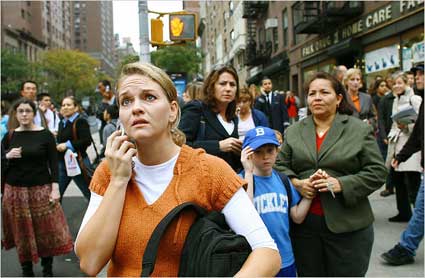
nycstreet1.jpg

This photo by Fred R. Conrad was on Page One of the New York Times today. I looked at it a long time last night; it’s not exactly “The Garden of Earthly Delights” but there’s a lot to see.

The woman in the pumpkin-colored sweater is clearly what the photographer was aiming at. Her open face, and its expression of pain and bewilderment, is the story in a single image. But I love the woman in the dark blazer that we can see over her left shoulder, looking at the photographer with a suspicious scowl — damn media ghouls! The little boy’s blue T-shirt reads BUCKLEY. It’s a private school for boys on the upper east side. The school’s website suggests they have a blue-blazer dress code, so his casual dress pegs the time period as late afternoon. And the plump Latina holding his hand? Everything about her says “nanny.” Look at the grip she has on him; this is a woman who knows her job. There’s a woman at far right, out of focus, in a pale trench coat. She has a goofy smile on her face, but we’ll make no judgments about her, beause pictures lie. Another out-of-focus man talks on the phone directly behind the boy, and he’s wearing a uniform. I’m thinking doorman. And because this is New York, note how many people are moving, especially the woman on the left, holding a white bag. Look at the length of her stride. New York is the only place where my usual walking pace (brisk) is frequently too slow for the flow of traffic. People in New York always have someplace they gotta be. Gotta make some money. Gotta pay that nanny.

Another day of keyboard-clattering for me, so how about some quick bloggage?

Desperate times call for desperate measures: Aggrieved that younger, prettier and more fecund celebrities are stealing her Mother Bountiful thunder, Madonna picked an African country, parachuted in with her entourage and left with the ultimate party favor: an African baby of her own. (She’ll never be a brunette again. And look for her to wear lots of white from here on out, so the baby photographs better, riding on her hip.) I’m puzzled by one thing, though: The child is not an orphan. He lost his mother at birth, but his father is still alive, and is said to have approved the adoption. If Madonna is such a champ philanthropist, why not write a check to dad, make him a rich man, and let the child be raised by his own father? I’m sure what Madonna spends on dry cleaning in six months could set the whole village up in style. And I’m sure, in gratitude, dad and the other villagers would be happy to provide children for photo opportunities well into the future.

Just wondering.

Forget what all those jerks say about the internet making film criticism obsolete. We’ll always need the good ones. It wasn’t until “The Departed” was released, and Roger Ebert didn’t review it, that I realized he wouldn’t live forever. I’m sure that thought occurs to Ebert himself several dozen times a day lately, but in the meantime, he’s recovering, and I hope he has a few more reviews in him before he goes to the screening room in the sky.

I tried to read “Snow” and couldn’t get past the first chapter. Of course, Orhan Pamuk just won the Nobel Prize. Back to the old drawing board.

I keep a weather-radar widget on my computer desktop. Yesterday, bands of green blobs marched across the screen from west to east. Today, cottony white ones. Sigh. And so it begins.

Posted at 9:08 am in Current events, Media, Movies, Popculch | 6 Comments
 

Nearly forgot…

…our own Ashley “I am not a girl” Morris is featured — with photo — in this story, from Newhouse News Service, on New Orleans expats who came home to rebuild the city. You know why he keeps turning up in stories like this? Because the man is what we journos call a Quote Machine:

“Jack Nicholson in `The Shining’ was me in the winter in Chicago,” he says.

Oh, and for those who still think he’s a girl, just remember: He was named after this one.

Posted at 4:48 pm in Media | 7 Comments
 

Jealous.

I see now that the greatest mistake of my career was not moving to Florida straight out of college. It is certainly the nation’s most fertile soil for weird stories, which grow like its tropical vegetation.

Whenever news breaks in south Florida, I think of my old pal Carolyn, who is surely at her desk at the Palm Beach Post as we speak, directing coverage of both the family-values Republican pervert and the sticky-fingered priests, both local stories.

And to think, she prepped for this in Fort Wayne, Indiana, where you’re lucky to get a yarn like this once every two years, if not five. Courage, Carolyn! I’m sure you’ll get a few hours of sleep before local resident Rush Limbaugh is found walking naked down Ocean Drive.

Posted at 10:56 am in Current events, Media | 5 Comments
 

Strike the match.

Thanks to all who offered advice, especially on the wi-fi problems. I did, indeed, make the change Ash and Jay suggested, and it made my connection noticeably quicker, but I’m still having the drop-out problem, so. Probably time for a system upgrade.

And as for the ashcanned snark, well, someone else wrote it. Good for him. It’s better than what I wrote, since what I wrote was banged out in 20 cross-eyed screechy minutes on my couch yesterday morning. As for why I ashcanned it, well, it’s because I’m a coward.

(If you don’t want to click the link, here’s the money quote: (Mitch Albom is) a huckster evangelist for the soccer-mom set. Truer words, etc.)

I do a little work here and there for the Freep, and while losing it wouldn’t really dent my income, it just seemed like a test of my so-called adulthood to leave this bridge unburned, although I realize there’s a good chance no one would even notice it, or care. Mitch is on the staff at the Freep, but I get the feeling he’s not so much of the paper as he is a dirigible that floats over it, lightly tethered. Many of the people below resent that it often blots out the sun, but they’re not in control, and so they shrug and say what-can-you-do.

Unlike Bob Greene, Albom seems to behave himself, most of the time. There was that incident with the column about the two basketball players who didn’t go to the game, and there was the Curious Case of the Spiked Bad Review, and there are stories people tell you over beers, but I’ve never heard anything involving teenage girls and the Marriott Hotel, so that’s good. Journalism is full of cheerful hacks who laugh all the way to the bank, from screeching pundits like Ann Coulter to the warmer-and-fuzzier sorts who trade in dog stories, and the first thing you learn about them is this: 68 percent of the collegial bitching about them is rooted in jealousy. People say “I’d never write sentimental bullshit like that,” but what they really mean is, “Why didn’t I think of it first.” Albom has jerked easy tears for years, collected them in a golden bucket, and taken them to the bank, where he’s traded every one for a fistful of C-notes. His slight, repackaged tales of feel-good spirituality are routinely savaged by critics, but sell and sell and sell some more, and I don’t know about you, but nobler souls than I have made that bargain and sleep well at night over it. (It’s easy to sleep well on high-thread-count sheets.)

But where my eyes start to cross and steam emerge from my ears is when I read stories like this, about the kickoff for Mitch’s book in Detroit the other night:

(Singer Tony) Bennett was moved to tears as he spoke about one portion of Albom’s novel, which went on sale earlier this week.

“This book,” Bennett told the gathering, “teaches you if you apologize to the people you hurt…” before he covered his face in his hands and wept, unable to continue until host Albom offered comfort.

Man, just reading about it makes me want an apology from Mitch Albom. Let’s start with, “I’m sorry I keep writing treacly books that reduce 80-year-old singers to public tears” and go from there. I don’t mind the guy making his money however he can, but is it too much to ask that he lay off the Dr. Phil-meets-the-Dalai-Lama crap? How long before someone asks him to lay hands on a sick child?

It’s an open secret — not even a secret at all — that the man who stayed on the best-seller list for years with a book that revealed how important it is to stop and smell the roses does nothing of the sort. He’s working harder than ever, with radio, TV, fiction, even playwrighting. He’s in the paper at least twice a week, not just in Sports, and by my measure he’s phoning it in; having written columns for years, I know exactly how to pull one from my nether regions, and many of Albom’s Sunday pieces smell like that’s where they came from. (I recall one in recent months, which took off from a half-baked proposal to exhume Mozart’s corpse for some reason. Mitch disapproved, and suggested it would be better to “honor him by playing his music.” Noted.)

I don’t know the guy, though. Maybe he has “roses, stop and smell” in his BlackBerry somewhere. Maybe he’s the world’s most efficient multi-tasker, able to wedge his relationships into neat blocks of time between the radio show and lunch with Jeff Daniels. I once took a writing seminar at the Freep, and Albom led a session with warmth and apparent humility, touting not his own work but Joan Didion’s. He also paid us the ultimate modern-age compliment; when his cell phone rang, he pulled it from his briefcase and turned it off.

I do know this, though: I’ve never read anything by the guy that felt true to me, that didn’t feel manipulative and false and sentimentalized for my protection. I don’t follow sports, and so I’m talking about his non-sports, post-Morrie work here, and to give him his props, people who read him pre-Morrie say that a lot of his sports work was excellent. But what I recall are the columns that gave my head cramps from the eye-rolling. There was one he wrote around the time the TV-movie version of “The Five People You Meet in Heaven” was on the air, which a writer to Romenesko boiled down to, “Thanks for loving me, Detroit,” and that’s pretty much on the money.

I see a lot of his books in garage sales, along with “The DaVinci Code” and “The South Beach Diet.” I try to imagine the impulse that sorted them into the garage-sale pile rather than the keepers. I think of a woman who read “Five People,” wept at the ending and later felt bad about it, sort of the soccer-mom version of post-coital remorse. I think of someone who was given “Tuesdays With Morrie” when their father was dying, read it and thought, “Jesus Christ, is this ever a load of crap” and tossed it aside. (And I consider the very real possibility that someone gave them the book and they already had three copies, the way people kept giving me “What to Expect When You’re Expecting” when I was pregnant. There’s a reason books become best-sellers.)

I saw one in a sale last week, and it reminded me Albom had a book coming out soon. The Freep story says he’s off on a 10-week — ten-freakin’-weeks — book tour. Which means Mitch on Oprah and Mitch on the Today Show and Mitch at charity readings to raise money for the homeless. Which means more people crying like Tony Bennett. It’s going to be a long, long autumn.

Hey, is that a siren I hear? Fire trucks? Looks like someone set the bridge ablaze.

Posted at 9:46 am in Media | 12 Comments
 

Pee-pees in high places.

So the Raleigh News & Observer ran a Page One note Friday, warning their readers that they would find nudity in that day’s paper. It read:

Today’s Life, etc. section includes a photo of a famous fresco by Michelangelo that includes nudity. The headline was, “Advisory to Readers.”

Here’s the fresco:

god1.jpg

Yup, that’s nudity, all right.

Actually, as often happens with these things, I’m wondering something else, that is, who felt the need to describe the image as “famous.” It’s certainly true, but is such a trite and tinny modifier that it’s more amusing than accurate. And yet, I can imagine the near-unconscious impulse that put it there: Already nervous about the shocking transgression of putting a 500-year-old image of Adam’s wenis in a family newspaper, the mind seeks justification. “Important?” Nah, sounds too eggheady. “Glorious?” Nope, that would be editorializing. I know, I know — “famous.” That’s the ticket. If anyone objects, we’ll just point out how famous it is. Paris Hilton is famous, after all, and that’s why we put her in the paper.

It might also have been inserted by the copy desk. There’s a wide streak of pigheaded literal-ness on the desk that would insist on the modifier, because otherwise why use the image? The story’s about how different religions depict God, so why use this one? Because it’s FAMOUS.

OK, OK. I’m jesting because if I stop I will start to throw things. (This is a throwin’-things kind of Monday; be forewarned.) And how’s this for a tin-eared engagement with the readers? From the ombudsman’s blog:

Well, we’ll find out just how sophisticated an arts community this is with reader reaction to today’s Life Etc. front page.

Oh, is that what this is? A test of sophistication? Just shut UP.

Guess what the second graf of that entry says: Displayed across the page is the famous Michelangelo fresco… Famous!

I think it’s really pretty simple, and I think Mitch Harper nailed it:

The newspaper is either filled with unworldly and unsophisticated rubes or it is a window on how the newspapers views its readers. I suspect it is the latter. The newspaper shows what disrespect it has for its readers but is also a measure of the disrespect they have for the quality of their own product.

Yup. Yup. Yup.

So, bloggage:

I was offline most of the weekend, and when I came back I found the Pope had provoked Muslims. That is, the Pope quotes from a 14th-century dialogue between two forgotten scholars, and the Religion of Peace responds with angry demonstrations, death threats, effigy-burnings, possibly the murder of a nun and other peaceful acting-out. In the Free Press a local Muslim is quoted saying, “Our religion is the most peaceful religion.” Noted.

Life imitates “The Wire” in this NYT piece on a local body collector, local being Detroit, bodies being “the ones found lying around the city.” A nice detail:

Do not judge him. A happy attitude is necessary in his profession. It keeps the mind from shattering, salts one’s sanity. Call the job dirty. Call it 14 bucks the hard way — $14 a human body, $9 an animal. He said he made $14,000 last year. He made most of it at night.

UPDATE: There’s an outstanding video version of that story on NYTimes.com, too.

Back later. Be peaceful.

Posted at 9:25 am in Current events, Media | 21 Comments