“Whisker Wars” starts tonight on IFC, and even though I get that channel on cable, I’m not convinced this is exactly appointment TV yet. But who can resist, really? A whole subculture of men whose activities are not only of no or little interest to women, it actively repels them? You could almost compare them to homosexuals, but every smart girl has a gay boyfriend, and some are even sexually attracted to them. Whereas if a competitive bearder even came near me with one of those waist-length things, I’d run away as fast as possible. And I bet you would, too.
Oh, but what am I saying? There’s a match for every sock in the world; you just have to look at bit harder, is all. My youth was a big era for facial hair. My male confederates had beards and moustaches of all shapes and sizes. One of my favorite boyfriends had a splendid moustache, in fact, although I doubt he still does, as one day we all woke up and they were called “pornstaches,” a cruel jape, because as every man with a weak chin eventually discovers, facial hair can cover a multitude of sins, and sometimes that sin is an upper lip that is too thin, too stiff, too something, and a moustache can salvage it.
(There was a TV personality of my youth, fella named Bob Braun. A friend of mine, a hilarious and dead-on mimic, could conjure him out of the air just by pulling down and fortifying his upper lip. Bob Braun could have used a moustache.)
The facial hair of my yout’, however, was generally not something to be fussed with. Trimmed, yes. Groomed, certainly. But it was either there or it wasn’t. (With a few exceptions, like the aforementioned Joe Namath and his famous Fu Manchu.) These latter-day beards, with their fanciful trimming? No. Show me a man who grooms it like this, and I’ll show you a real asshole.
Alan had a beard, long before I met him. He looked like a young Bob Seger. My dad grew one in his young manhood, and it came in all gray and white. The other guys called him Frostypuss, so he shaved and never ventured forth again. But it strikes me the real problem with beards is, they invite stroking by their owners. It’s very hard to stroke one’s own chin without looking like a total douche. In fact, the very gesture of chin-stroking, the phrase itself, is shorthand for someone who talks too much and rarely proposes action of any value, but rather, thinks the whole room needs to do some supplemental reading before we revisit the topic at a later date.
At which point the room rolls its eyes and makes the jackoff gesture.
Boy, am I in need of a vacation, or what? Which, by the way, I will soon be taking. We’re heading north in a week, and I will be away from the internet for most of that time. I might have asked J.C. to maybe fill in here while I’m gone, but as it turns out, that’s who we’ll be visiting. There may be supplemental material, however, and comments will be open all week. You all are so good at playing amongst yourselves. We’ll see.
The bad decisions of August also include the impulse road trip. You and a college friend are sitting around talking about Crazy Bob from your fraternity. Next thing you know you are on the road to Kalamazoo, where Bob lives, for a surprise visit. At his house you find only his mother, an old and broken woman who informs you that Bob killed his wife with a ball-peen hammer and then set himself on fire. Always call first.
Again! I swear I published this at 10:30 a.m. Apologies. Maybe it’s a bug, or maybe the bug is me.
The city of Pontiac closed its police department forever this week — no money. Policing the unfortunate city was turned over to the county sheriff’s department, and I hope they go with God on this one, because Pontiac is a pretty rough town, and they may need divine intervention to make it work.
Meanwhile, I visited the home page of my former employer this morning, and saw the cops were driving the hostage rescue vehicle around for National Night Out festivities last night. The website being a p.o.s. I can’t link, but it just so happens I have a photo of that vehicle which I took way back in 2003, during a flood:
As you can see, its high clearance makes an excellent flood-navigation vehicle, although most often, you see it in this situation:
Hey, kids! Ever want to see the inside of a real tank?
The city of Defiance, Ohio, has one of these, too — we saw it in the Halloween parade. I think it was the year they were talking about closing the city’s swimming pools for lack of funds, but I’m not sure.
Do any of you Hoosiers know if this thing has ever been used to rescue a hostage, or is it just trundled around as a gas-guzzling vehicle of diplomacy, like an armored limousine?
I’ve been covering city governments long enough to know that the money for these items rarely comes from the general fund. Homeland Security likes to sprinkle dollars around the hinterlands from time to time, in the event al-Qaeda ever targets northwest Ohio. And never count out a hungry police chief when it comes to finding grant money or weak spots in the armaments of the county treasury. Remember, Fort Wayners, when the Ku Klux Klan rallied at the courthouse in the ’90s? It was a greenmail dream come true for every badge in both city and county. The courthouse, as courthouses tend to do, sits smack in the middle of town, but it’s a county building, so you had two forces elbowing for the right to be on the front lines. The sheriff’s department got to be the primary perimeter around their building, and they turned out in riot helmets and shields so new you could almost see the ghosts of the price tags on them. The city protected the area around the courthouse, and I think the entire force was there, likely on overtime. So few people actually showed up, the police-to-rallier ratio was about 3-to-1. But nothing bad happened, so every penny was defensible. Right?
Ah, it was the ’90s. We had so much, then. Riot shields, functional police departments, rising property values. The good ol’ days.
I still count the column I wrote about that rally among my favorites. Couldn’t find it today at gunpoint. Newspaper columns, like the good times, aren’t made to last.
Folks, the coffee ain’t working today. Let’s pop down to the bloggage, shall we?
Bradley Cooper speaks French, Mila Kunis speaks Russian. The translated title of her movie, “Friends With Benefits?” “Sex Friendship.” Some things just don’t translate. Did I ever tell you about my friend in Paris, who sent me the titles for the porn listings in the local weekly? American porn producers favor dirty versions of existing movie titles (“Pumping Irene”), whilethe French go for a more clinical approach. One, as I recall, used a verb that means “to break in” or “to enter with violence,” for a title that ran, “I’m breaking into you sans Vaseline.” Ick.
The big tree Morgan Freeman finds a letter under in “The Shawshank Redemption” was torn asunder by a storm this week, prompting a wire-service story. Best reader comment? Ooh, you gave the ending away!!! How long are spoiler alerts required for a movie made in 1994?
And that’s all I have today. Off to drink more coffee.
I think it was Dave Barry who, when the Rock and Roll Hall of Fame was still on the drawing board, suggested its singular feature should be volume. People should always be calling the Rock and Roll Hall of Fame, telling it to turn itself down, he wrote, in an observation that goes to the heart of what was always my problem with it. Lots of other people have it, too, i.e., how does a cultural movement which still has youthful disaffection and rebellion at its creative heart warrant a hall of fame?
Pretty simple, that one, and you can tick them off if you like. It’s an artistic movement of decades’ standing, incorporating uniquely American strands woven into an original, and new form. It’s a cultural force to this day, and if you don’t believe me, ask Lady Gaga. And from a purely commercial perspective, like a Kiss concert, it’s going to sell a lot of tickets. Sometimes I think the defining emotion of my generation — not the first to rock ‘n’ roll, it goes without saying — is nostalgia, but that’s what happens when your adolescence gives critical mass to a unique cultural force. What do you do in your 20s? (Go punk.) In your 30s? (Start disapproving of hip-hop, which isn’t even music, with all that scratching and sampling, and you call that singing? You might give a nod to the Seattle sound, but honestly, that’s when you stopped keeping up, right?)
What do professional nostalgists love most? A hall of fame. A museum. Put them both in an avant-garde building by I.M. Pei on the shores of a Great Lake, and it’s no surprise that as a business proposition, the Rock Hall, as it’s known on second reference here, is such a draw.
But that’s being unfair, a little, because it’s not just nostalgia being sold here. My advisor for this trip, Michael Heaton of the Plain Dealer, told me not to miss the introductory film that starts the tour, “Mystery Train,” a 12-minute triptych film montage that shows the roots of rock in bluegrass, Texas swing, country, blues, and (my favorite) the field hollers of Southern stoop laborers. Sam Phillips is famous for what he said about finding a white man who sounded like a black man, but the quote of his that always stuck with me was about the time he stopped for a Co’Cola at some backroad southern watering hole, and saw a woman hanging laundry across the road. She was black, and sang as she worked, and Phillips reflected that these folks were the most naturally creative people in the world. Which is two-thirds paternalistic romanticism and one-third true, and when you see the brief shot of black railroad workers knocking rails into place, making the clack of their tools part of the rhythm of the song they’re singing, you can see it plainly. But the film is only 12 minutes, and pretty conceptual. I got it, but I was traveling with two 14-year-old girls who could have used a little more David McCullough-style narration. On to the permanent collection.
I’m not much of a relic person. One Fender Telecaster looks pretty much like every other one, and with the exception of the exceptions — Bo Diddley’s cigar boxes, most notably — the instruments quickly blurred together. It’s the technique, not the tool. But the rest of it charmed me. The clothes and costumes, the programs and posters, the set lists, the scribbled early drafts of classics — it draws you in, and it helps when it’s intelligently arranged and annotated. Video loops at significant stops along the path detail mini-movements like Motown, psychedelia, grunge, rockabilly. Kate liked Sly Stone’s fringed jacket and Jimi Hendrix’ shirts; I liked the spiral-notebook page with the first draft of “Rainy Day, Dream Away.” By the time we arrived at the best of the stage outfits, with David Bowie’s Ziggy Stardust wardrobe, Bootsy Collins’ glasses and, yes, Michael Jackson’s glove, more than two hours had passed. And we’d only seen one floor.
Time was running short, so I made the executive decision to head up to the top floor and check out Women Who Rock, a temporary exhibit about guess-what. It was crowded, and I can’t believe we never saw Lady Gaga’s meat dress, now jerky-fied and preserved for the ages, but we got a taste of everyone from Mahalia Jackson to Aretha Franklin to Joan Jett to Debbie Harry to Madonna, and that was enough to fill out the afternoon and bring us almost to closing time.
Next time: Allow more time.
Worth a visit? Absolutely. Worth several. I’d feared the Rock Hall would show the music I love preserved in amber, instead of a living, breathing art form that continues to evolve (although, admittedly, not as quickly or as creatively as it once did). The professional nostalgist would find plenty to wallow in, but nearly as much that says move along now, there’s still more to see.
Oh, and Dave Barry got at least part of his wish: There are outdoor speakers, but they don’t really boom. The only neighbor who would ask it to turn itself down would be the football stadium next door, and you know how those guys like to party.
No bloggage today; I’m hoarding links for tomorrow. It’s Monday and, as usual, I have to run. Some thoughts on Oslo, maybe, and a few more things worth reading for a week that promises to be nearly as miserable as the last. Until then, stay cool.
Here’s something I see more often these days — a lament for dangerous playgrounds. Frequently the argument has an undercurrent of hostility; I recall one by a father of two that basically boiled down to, these kids today could all use a few more broken arms, but I’m sorry, I can’t find it now. Most of the people advocating it seem well-intentioned enough, although I note they tend to live in the land of the anonymous “some” who are ruining childhood, but not for attribution.
That many of the Some may be made of straw and live in the Land of Oddly Articulate Taxi Drivers occurs to me, yes.
Here’s how the argument goes: Children’s playgrounds are being, or have already been, ruined. By lawyers, by — finger quotes — experts, but mostly by Some, who want to take all the risk out of childhood, and hence, all the fun.
There’s some truth to this, at least to the bare fact of ruination, although I wonder how much it has to do with risk and how much with money. But I’ve seen some pretty wan playgrounds in my time. The one at a nearby elementary school in Fort Wayne had a single piece of equipment on it — something that looked like a folded slice of Swiss cheese, with a total height of maybe five feet. I gather you climbed on it. Not that I ever saw a child do so.
But something else happened along the way, and playgrounds started getting fun again. When I was a kid, I played at the elementary at the end of my block. There were four or five different playgrounds, sized for the range of grades, and if I remember correctly, they were basic — swings and monkey bars and slides and see-saws, anchored to asphalt. If you fell, you fell hard, although that was rare. But it happened. My major dread of the playground was being dumped from the high position on the see-saw; I had a friend who specialized in it, with a truly perverse timing that suggests she had a bright future in torture of all sorts.
By the time Kate was born, the playground had changed. The “playscape” had come on the scene — sprawling constructions that mimicked kid-size castles, with spiral slides, swinging footbridges, climbing walls and all manner of things you could swing on, jump from and otherwise exhaust your energy and imagination.
A few of our favorites: Planet Westerville, near my sister’s house in suburban Columbus; Kids Crossing and Foster Park’s playground in Fort Wayne; and a Kids Crossing clone here in Grosse Pointe Woods’ Lake Front Park.
One thing all these playscapes had in common was some sort of soft footing underneath, usually wood chips, although I’ve also seen sand and shredded rubber. I honestly never gave these a thought, other than to be grateful for them. It seemed like, oh, progress, the way a padded dashboard is progress, and seat belts, and bike helmets.
I’m now informed I was all wrong. Modern playgrounds destroy children’s natural risk-taking impulses:
When seesaws and tall slides and other perils were disappearing from New York’s playgrounds, Henry Stern drew a line in the sandbox. As the city’s parks commissioner in the 1990s, he issued an edict concerning the 10-foot-high jungle gym near his childhood home in northern Manhattan.
“I grew up on the monkey bars in Fort Tryon Park, and I never forgot how good it felt to get to the top of them,” Mr. Stern said. “I didn’t want to see that playground bowdlerized. I said that as long as I was parks commissioner, those monkey bars were going to stay.”
His philosophy seemed reactionary at the time, but today it’s shared by some researchers who question the value of safety-first playgrounds. Even if children do suffer fewer physical injuries — and the evidence for that is debatable — the critics say that these playgrounds may stunt emotional development, leaving children with anxieties and fears that are ultimately worse than a broken bone.
Excuse me, but New York Times? What a crock of shit. I can go a long way with this movement — yes, kids must take risks to grow; no, playgrounds shouldn’t be made entirely risk-free — but when you need to tuck “stunted emotional development” in there, hiding behind that big “may,” I’m going somewhere else to play.
The story goes on with the usual reporting; a Norwegian psychologist consults her clipboard and identifies “six categories of risky play” and then we get to the inevitable sources for these types of it-seems-one-way-but-it’s-really-not stories — an evolutionary psychologist. The more bullshit I find in the world, the more I can trace back to evolutionary psychology, the talk radio of soft-science scholarship.
“Risky play mirrors effective cognitive behavioral therapy of anxiety,” they write in the journal Evolutionary Psychology, concluding that this “anti-phobic effect” helps explain the evolution of children’s fondness for thrill-seeking. While a youthful zest for exploring heights might not seem adaptive — why would natural selection favor children who risk death before they have a chance to reproduce? — the dangers seemed to be outweighed by the benefits of conquering fear and developing a sense of mastery.
“Paradoxically,” the psychologists write, “we posit that our fear of children being harmed by mostly harmless injuries may result in more fearful children and increased levels of psychopathology.”
I always wanted to use “posit” as a verb. So here goes: I posit that all this hand-wringing over too-safe playgrounds is perpetrated by a handful of people who really don’t like children all that much. As I said before, it’s important that kids take risks and try new things, but this barely disguised yearning for them to fall from the top of the monkey bars and break bones is deeply hostile. To them I say: OK, your kid goes first. And if you don’t have any, shut up.
I used to be lonely, in my discussions with fellow Elmore Leonard fans, when the topic of film adaptations would come up. “Of course, ‘Get Shorty’ was the best adaptation of a Leonard novel,” someone would say, to nods all around. No! No! I screamed inwardly. “Get Shorty” was a huge improvement over all that came before, and a breakthrough, but no way it’s the best, because that title belongs to “Out of Sight,” and this guy agrees with me, so er’body just shut up.
So, two videos:
You wanted to tussle; we tussled. My favorite scene from “Out of Sight”:
And a video I worked on with my summer interns. I’m not much of a video producer, and it’s hard for me to teach this stuff, because I barely have a handle on the technology, and what I see in my head is so different from what appears on the monitor. Still: The assignment was to do a slice-of-life video aboard a Mackinac racer. We were invited out for a Thursday night of fun-type racing. Took two small cameras, the Flip and the GoPro, mostly handled by the interns. And virtually all the audio turned out like that in the first 10 seconds — spoiled by a persistent roar of wind. (Cheap mics are the bane of cheap cameras.) I fixed it by going back a few nights later with my good USB mic, going belowdecks, and reconducting the interview in acoustically cleaner conditions. My critique of the video is: Too many cut-off heads, too few detail closeups to cut away to, not enough of a narrative arc — it plays like a sketchbook. On the other hand, given the raw materials, I don’t think it turned out too-too badly. Tell me what you think, and have a great weekend. Stay cool.
Nothing like a trip to Warped to make you fear for the future of your country. Hey, you — yeah, you with the one-inch ear grommet. (I’m told they’re called “gauges.”) Now that your passion for individual self-expression has tipped over into self-mutilation, what with the Ubangi earlobe and neck tattoos, are you aware that you’ve now entered the shadowlands of the economy, that no one will hire you for anything more than hawking CDs of bands that will never get a major-label record contract? Maybe you’ll get beamed up to roadie someday, and you can pick up the girls the band rejects. Motorcycle maintenance — there’s another career path, if you have the skills. Or you could be the next Cat Whisperer, although you should note he has not done that thing with his ears, and if he wore a long-sleeved shirt and gave up on the stupid facial hair, he’d look relatively normal. You, however…
Oh, and you over there — yes, you, the sweet, lovely 18-year-old, although you look younger, hon. I’m assuming you’re 18 because you too have self-expressed through permanently inking parts of your body that will be revealed in standard white-collar office garb. It’s possible you are younger, though, and did this to yourself with a fake ID or even parental approval. Someday you’re going to get tired of working at Costco and want a leg up, maybe into a spot as a dental hygienist or LPN. Dentists are professionals, and like professional office staff; do you really want to spend the rest of your life dabbing concealer on that stupid butterfly under your earlobe? Tell me the story behind that one. Oh, you got it because a butterfly represents transformation, and you used to be really shy, but then you met Kenny and he brought you out of your shell — sorry, your pupae stage — so you thought you’d demonstrate your love and devotion by making it permanent. And then he left, but hey, it’s not like you put his name there or anything. Butterflies are pretty. Stupid dentists.
(Pause.)
Oh, don’t mind me. I’m just spinning conversations with the air. It’s entirely possible this generation will march boldly into the future and seize it with both hands, and that one day the cover of Fortune magazine will feature a CEO with a net worth of $20 billion and a giant grommet in his ear, and that my teeth will be cleaned someday by a hygienist — nay, my dentures fitted by a dentist — with an inky sleeve depicting the battle of Armageddon, enacted by anthropomorphic toothbrushes. And no one will think anything of it.
And maybe monkeys will fly out my butt. Just watch.
Back from Cleveland in the nick of time for the heat to find another gear of misery. Today’s expected high: 100 degrees. Today’s expected cloud cover: 0. Percentage of today I will spend in the great outdoors: Not bloody much. But I’m glad I went, both for the midweek break and the chance to see some things I haven’t seen before, and meet the wonderful Michael Heaton, who led us to a great bar just west of downtown, the Parkview, where I was introduced to deep-fried asparagus. We were to meet him on the street out front and follow him there, so I said, “What kind of car do you drive?”
“A red convertible,” he replied.
Expecting a Mustang, or something worthy of a blogger who calls himself the Minister of Culture and the brother of a famous Hollywood actress, I was nonetheless taken aback when a Chevy Cavalier with deer damage pulled alongside. Oh, well — he is a journalist, after all.
More on the Rock and Roll Hall of Fame later. One last word about Warped:
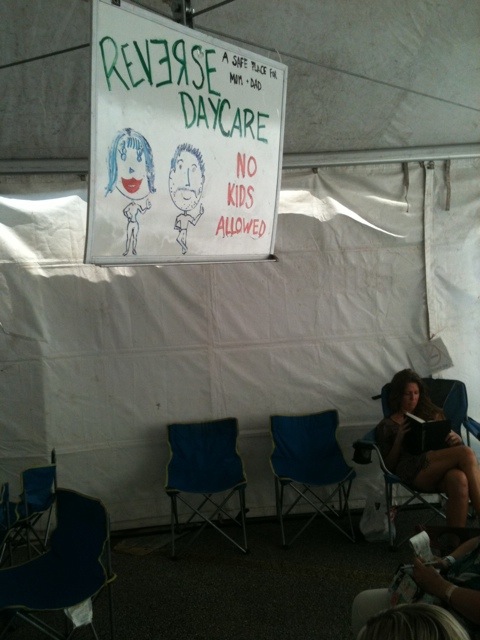
I won’t apologize for enjoying the parents’ tent as much as I did — the air-conditioning, while not terribly effective, was a pleasant break, and the ice-cold water a wonderful treat. I read “A Clash of Kings” on my iPad and watched other parents — the woman who alternated between Virginia Woolf on her Kindle and mad texting on her phone, another who went through two issues of the Chronicle of Higher Education before turning to “American Psycho.” Reverse Daycare was staffed by a cute girl of Indian bloodlines who, I decided, must be a student of the hard sciences at the higher-ed level — she was self-assured among her sweaty elders, and her tattoo was small, on her shoulder blade, and depicted the DNA molecule.
But I did get out every couple hours or so, to walk around until I wilted and listen to some music. The music was? Loud. The sights were? Arresting (and I’m sorry, I can’t get this photo to rotate):
(You wonder how I handle these moments as a parent? Teachable!)
Now, off to catch up on a few days’ of put-off work. Stay cool, all.
Light posting over the next two days. When I agreed to take Kate to see her beloved Vans Warped Tour in Cleveland — the Detroit date came while she was at summer camp — I thought it was possible it would be an uncomfortable experience. I hadn’t planned on an epic heat wave, but oh, well. Summer — what are you going to do?
We leave in two hours. First stop: Rock ‘n’ Roll Hall of Fame. Then a nice air-conditioned hotel, then Blossom Music Center tomorrow. It’s a pretty cool setting — grassy swards and the like — and I’m finger-crossing that we have no sudden fierce thunderstorms, which this sort of weather breeds.
This will be the second of three summer concerts we have planned, and yes, I am the best mom ever. First was Matt & Kim in Detroit, tomorrow this, then next week, yet another date with Anarbor in Pontiac. This is the first headlining show for Anarbor, and they’re offering a special VIP-level ticket. It gets you in early for a meet ‘n’ greet with the band, a signed poster, the usual. The price for all this swag? Twenty bucks. I hear Bon Jovi had a similar pricing level on their last tour, closer to $1,500. I could pass this one off on Alan. It’s his turn and it’s on a night when he could go, but I feel as though Mike the guitarist and I are likethis (see above).
On the other hand? Pontiac.
Matt & Kim was a good show, very energetic. Their greeting to the crowd: How the fuck are you, Detroit?! It went on from there, with f-bombs, mf-bombs and the like dropped into every utterance. I told Kate that the use of profanity is a little like cooking with hot peppers. A little enhances everything and makes the flavors pop, but too much is simply numbing. Matt & Kim, a couple of ex-Pratt art students whom you’d think would know a thing or two about understatement and subtlety, showed very little in that regard. On the other hand, they hardly stand out. Enhance your vocabulary, rokkers.
So I’m taking my last few moments of calm to read more about the phone-hacking scandal. We have careers ending in disgrace and now, a body count. One thing missing, however — how difficult was this, and is it still possible to do? Does anyone know? And just to provide a perfect illustration of how paranoid thinking can always justify itself, the scandal has given fresh life to? Yes, the anti-vaccine crowd. The trail goes: Andrew Wakefield, the author of the original vaccine-autism link study, which has since been discredited, was attacked hard by Murdoch’s Times of London; James Murdoch sits on the board of GlaxoSmithKline, a British pharmaceutical company; ergo, the fix is in!!!!!!
I am growing to despise my other job, at least this summer, when I’m doing it for the lordly sum of $0. A certain amount of pro bono I can handle, but now it’s Wednesday, I haven’t done my grocery shopping for the week and now I have a news explosion to clean up after.
Fortunately, bloggage galore:
Another listicle from Cracked.com, worth passing along: 8 words you’re confusing with other words. They missed one of my pet peeves — defuse/diffuse — but they got the biggies, including phase/faze and reign/rein and tenant/tenet. Oh, and people? “Tack” is a sailing term; it refers to the zigzag course that boats must steer to move into the wind. A tacking boat changes direction frequently, hence the phrase “take another tack.” Not “tact.” Thank you, that is all.
The longer I write on a keyboard, the less I can write by hand. Still, I love notebooks of all sorts, and so does the keeper of this blog.
If I had to choose between the two New Yorker film critics, David Denby and Anthony Lane, I’d be on Team Lane all the way. But Denby makes some good points in this essay on computer-generated effects. Nut graf:
Storytelling thrives on limits, inhibitions, social conventions, a world of anticipations and outcomes. Can you have a story that means anything halfway serious without gravity’s pull and the threat of mortality?
I remember watching “Crouching Tiger, Hidden Dragon,” a movie with many pleasures for me, until it arrived at a climactic sword fight in a shadowy bamboo forest. Suddenly the characters, who had been grounded, gravity-limited human beings, were able to run straight up the sides of bamboo trees as slender as a pool cue. It was all staged as a dreamy ballet, but it took me out of the story, frankly. Oh, we can run up the sides of trees now? OK, let me file that one away.
A guy I used to work with lost his father recently, and is sharing brief remembrances of the man via Facebook. (Facebook grieving: Now there’s a master’s thesis.) I was amazed to learn that after the death of his mother, his father had married Peg Bracken. Many of us are boomers here, and likely remember her as, first, the author of a great book of whimsy, the “I Hate to Cook Book” and later, as spokeswoman for Bird’s Eye vegetables. She introduced herself in the commercials: “I’m Peg Bracken, and I hate to cook.” She was such a hoot. The remembrance inspired me to do some googling, and I found her obit from the NYT, in 2007. From her recipe for Skid Row Stroganoff:
Start cooking those noodles, first dropping a bouillon cube into the noodle water. Brown the garlic, onion and crumbled beef in the oil. Add the flour, salt, paprika and mushrooms, stir, and let it cook five minutes while you light a cigarette and stare sullenly at the sink.
I love to cook, but a woman who had the ovaries to write that in 1960 is one after my own heart.
OK, I think that’s it. Off to restock my larder. How come no one says that anymore? “Mom, I want breakfast.” “Check the larder for some Cheerios.” A question for Peg, maybe, but me, I’m gone.