I found this via Tumblr, so the usual cautions about authenticity apply, but what the hell, it’s worth sharing. This is a purported listings page from an unnamed New York newspaper in November 1963. The hell with JFK — talk about mourning a lost world:
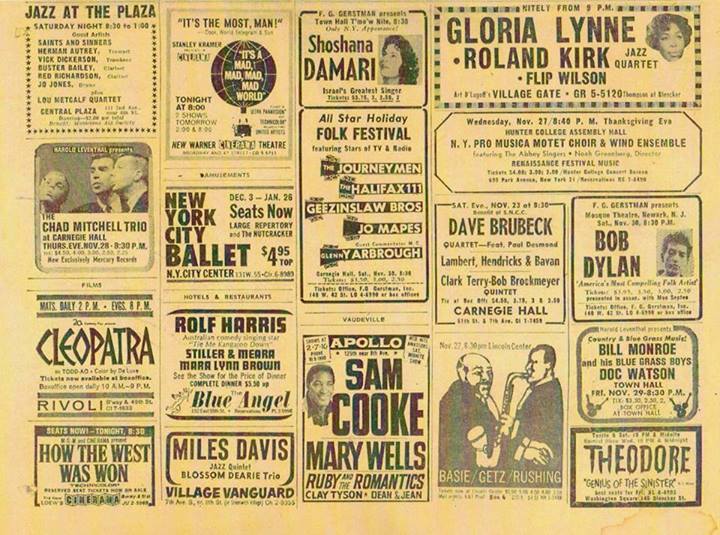
This, pals, is why I regret never living in New York City. Imagine an entertainment buffet spread with everything from Bill Monroe to Miles Davis to Sam Cooke to Bob Dylan. I looked it over twice before I noticed Stiller and Meara hiding in the cracks.
Was everyone’s Thanksgiving wonderful? Ours was just fine, if a little repetitive of last year’s. I was looking up a green bean recipe I like at this time of year, and a menu fell out of the book — exactly the same one I’ve been making for a while now. Oh, well. With a table set for only four, two of them picky eaters, what’s the point of adventure? That’s what dinner parties with friends are for.
The rest of the weekend was devoted to lazing on the couch watching Netflix, errands and the usual. Kate and I went to the DIA for a few hours on Friday, to tell “The Wedding Dance” we would always love it, even if it’s sold to Rupert Murdoch. Watched a couple of movies I would likely not have seen without streaming — “What Maisie Knew” and “The Panic in Needle Park,” which I was astounded to learn was written by Joan Didion and her husband. I cannot tell a lie: I love many, many things about the 1970s, and its strong tradition of antiheroic cinema is one of them.
So, then, some bloggage:
Today’s NYT ran a smoochfest on Jim Delany, whom I didn’t know about. Evidently he’s the guy responsible for the Big Ten conference being little more than a “brand.” Rutgers? Maryland? Now in the Big Ten? Fuck that noise. I prefer the Grantland take on this development:
In ways that matter to college administrators, Delany is a genius: The Big Ten Network is a money-making machine, and the conference actually made more money last year than even the SEC. Last fall, when I spent a day with the Indiana football program, they informed me that they’d been able to upgrade their facilities almost entirely with money procured from their Big Ten Network share. But that’s what makes this so frustrating for those of us who actually give a damn about the product: Speaking to Rittenberg, Delany appeared to characterize the conference’s football woes as a short-term concern, as something that could be attributed to an influx of new coaches and the consequences of immoral behavior at Penn State and Ohio State. He made no real acknowledgement of the long-term statistics, of the Big Ten’s 34-52 bowl record since 2000, of the fact that the Big Ten has won 37 percent of its nonconference games against nationally ranked teams since Ohio State won the national championship in 2002. The top of the conference is largely shaky, and the bottom has never been worse: I imagine Purdue and Minnesota and Illinois would struggle to finish .500 in the MAC.
Anything else? Yes, these rather astonishing-not-astonishing charts, about who uses marijuana and who gets busted for it, via Ezra Klein.
Finally, a fine piece by John Carlisle, former Detroitblogger, now roving columnist for the Freep. It’s about a community of legal scrappers in one of the most cursed neighborhoods in Detroit, who eke out a living digging holes in a now-vacant scrapyard, seeking out the long-buried bits of metal there. If you’re thinking, “why, that sounds like something you’d find in the Third World,” join the club. I was struck by the comments, which swung between that sentiment and a certain witless, attaboy-to-the-bootstrappers attitude, which ignores the fact the bootstrapping isn’t leading anywhere. Unless it’s to another generation of metal men:
Domenic Anderson used to follow his dad down here and watch him dig.
“Everybody would sit there, dig, get along,” he said. “All the grown-ups would be doing their own things, running their own crews out of here, making their own money.”
Now he works here, too. He stood on a dirt mound next to his twin brother, David Anderson. The 19-year-old brothers live just down the street and work in the lot six days a week. They’re rough edged and dirt streaked, and they share a distinct southwest Detroit accent and a kind of small-town genuineness.
For them, it’s not just work; it’s also their social life. Most of the neighbors moved away long ago, so there weren’t many kids to play with when they were younger, and there aren’t many to hang out with now that they’re older.
People around here like to say that we’re America’s future, so hey — look forward to it.
And so the long slog toward the holidays commences! Can you feel my excitement?