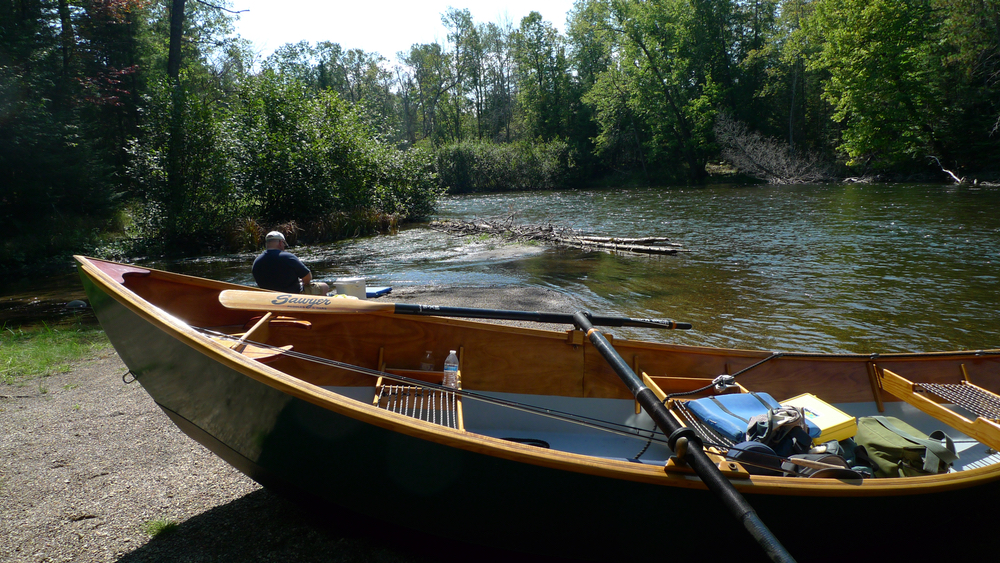
I remember something medical ethicist Art Caplan once told me in an interview, which I’ll paraphrase here: “Americans are great at saving the baby from the well.” (This was not long after the Baby Jessica story, which most of you will recall.) He went on: “We’re not so great at buying her a pair of glasses so she can see the well in the first place.” In the disaster in Texas — in every disaster — a lot of people have valiantly, heroically, pitched in to save the baby from the well.
That link goes to a WashPost story on the “Cajun Navy,” the assemblage of mostly Louisiana people who turn out with their low-draft boats to save people left in dire straits by floodwaters. I believe they first came to national prominence in the northern Louisiana floods last year, and they’ve turned out to help in Houston, of course. And that is a great thing, because lives are in acute danger. What’s much harder is caring about people when they’re not in danger, when they’re not wading chest-deep through the wreckage of their lives, holding their pets on their shoulders, or their children, or each other.
It’s harder — for some people, anyway — to admit that climate change is having a direct effect on these storms, and maybe we should swallow hard and make some difficult decisions. Maybe it’s time to buy the baby some glasses.
During the 1993 Mississippi floods, some towns were so inundated that after the waters receded the hard decision was made to actually relocate them, to rebuild on bluffs instead of bottomland. This wasn’t 100 percent popular — history blah blah blah 500 year storms blah blah blah — but cooler heads prevailed. Or maybe they were cash-register heads, because the argument was pretty plain: If we want to rebuild on this soggy plain, we will be uninsurable, period. The next flood will take what it wants with no hope of recompense. And so the town trudged up the hill, and rebuilt there.
The floods in Houston are said to be similarly rare, a once-in-five-lifetimes thing, even though other no-way storms and damage have hit with more yes-way frequency in recent years – Katrina, Sandy and the the 2016 Louisiana floods, to name but two. Just in my little corner of the world, we have inches-in-not-many-hours rain events nearly every year, filling basements, closing freeways and overwhelming infrastructure that once could handle anything. We had one last night, in fact. We had one last summer. In 2014, Detroit got four to six inches of rain in four hours one night in August, doing a cool $1 billion in damage. And chances are, you didn’t even hear about it.
Maybe it’s time to buy the baby some glasses. Climate change is a done deal, southern Louisiana is nearly lost, but perhaps we can start acknowledging that this thing our modern age did to the planet exists, and plan or modify our infrastructure accordingly. At the very least. Something.
Otherwise, it’s just us and the Cajun Navy, CNN, and the rest of this televised pathos-porn we love so much. Which is not enough.
So, bloggage:
This week also marks the 20th anniversary of the death of Princess Diana. A complicated woman, a tabula rasa for the princess fantasies of millions of young women, who were collectively flattened by her violent end in a traffic accident, as a drunk-driving chauffeur tried to outrun a pack of photographers. I stuck with that story three days before I couldn’t watch another minute, but it went on for three weeks, maybe more. It was a rare case of worldwide hysteria. I mostly remember snapshots:
My local Borders bookstore had a table set up with a blank notebook, where customers could write their thoughts and condolences, with the promise it would be sent to the royal family. The pen was one of those with a feather glued to a ballpoint, I guess because it seemed more princess-y. There was a bud vase with a single flower and a box of Kleenex. This was an exercise that would arouse strong emotions; you needed a tissue. I wonder whether the book was ever sent, and if so, which mail clerk in the royal retinue fed it to the furnace and whether he laughed over it first: “Nigel, it says ‘ere, ‘Charles U R a monster and U deserve that horseface hag.’ Ha-ha!”
The classic-car auction in Auburn, Ind. a couple days later featured a Rolls-Royce with a single claim to fame — it had been used to carry Charles and Diana around on one day of a years-earlier trip to the U.S. Which is to say, she had sat in it for… maybe an hour? Two, tops? Sounds about right. The auctioneer treated this thing like it was the jawbone of a saint with centuries worth of provenance to back it up. The dumbasses at the auction lined up to fling some gladiolus stems into the back seat, like they were seeing on TV in London. I’m sure some tissues were dampened there, too. That they were bestowing near-religious significance on a car, to commemorate the death of a woman who had just died in a car? This seemed lost on them.
I wrote a column after 10 days or so wondering if maybe we weren’t all getting a little overexcited. I received a letter from a woman accusing me of hating Diana for her beauty, because I was so plain. That’s the word she used — plain. I’ve been on Team Camilla ever since, because Plain Girls Rock, or at least Survive. Plain girls don’t date vapid playboys and entrust themselves to their private-sector chauffeurs, anyway. At least I hope not.
My favorite single detail of the whole tawdry affair: Four people were in that car, three of them unsecured, all of whom died. The fourth, the princess’ palace-issued bodyguard, was sitting in the passenger seat. He fastened his seat belt, and survived. Let’s all lift a glass to Trevor Rees-Jones, and remember to buckle up.
Oh, and here’s a Hilary Mantel essay about Diana.
Finally, I remember Alex met an earlier partner at an event in Huntington, Ind., called the Nut Fry. Apparently nut fries are a thing in Indiana, and no less an authority than Rex Early, aka a “GOP power broker” used to host one.
And now you know.