Don’t fence me in.

Deborah asked yesterday about the pay model that Andrew Sullivan’s trying. He wrote today that the first day of the fund drive raised $333,000, with more than 12,000 jumping in. I wish him well, really I do, but I won’t be one of them. And I don’t see a pay model for NN.c anytime soon, barring catastrophe (job loss, etc.). It will be very difficult to do even under those circumstances. I lack Andrew Sullivan’s towering sense of his own worth.

I don’t read the Daily Dish, and haven’t read Sullivan (much) since 9/11/Iraq war. (Isn’t he the one who came up with the infamous “fifth column” observation? Why, I think he was.) My boss is a fan, and occasionally passes stuff along, and I gather he’s not as much of a douche as he used to be. But the site simply isn’t important enough for me to consider it a cheap magazine subscription. If you read his initial post on this, you know it’s not the entire site going behind the wall, just some longer posts, and even then, you get a few freebies a month before the wall goes up. That will suit my Andrew Sullivan needs for pretty much ever.

Still, I want him to do well. Writers should be paid, and he obviously has lots of readers. I also want to see various forms of pay-for-content schemes duking it out in the marketplace. Maybe one will work for me.

When we were doing GrossePointeToday.com, we were approached by a micropayment site, whose name I forget now — Jingle, Ka-ching, something like that. Here’s how it worked: You designated a monthly amount you were willing to pay for online content, sort of like a public-radio sustaining pledge — $10, $15, whatever, billed to your credit card. When you read something online that you liked, and that site was a Ka-jingle member, you clicked a button. At the end of the month, your ten bucks would be divided between all your clicks. If you only clicked one, they got $10. Two sites, $5 each. And so on. I don’t think it got off the ground, as I have never seen their logo anywhere, but the idea is interesting.

After 9/11, when “warblogs” were all the rage, a lot of them had “tip jars” through Amazon or PayPal, but I could never bring myself to put one up. If I accepted even a dime, I’d feel obligated, and I have enough obligations already. I always tell myself that if this gets to be too much of a grind, I can walk away without guilt. Believe me, there are many, many, many days when I’ve given a little less than my all here. If it bothers any of you, you’ve been kind enough not to say anything.

To my mind, the best free-to-pay transitions will be like Sullivan’s (and Talking Points Memo, which is trying something similar): Most of the site remains free, and premium content is there for paying customers.

No, I’m waiting until I do something else, I hope a book (and not lose my job and tumble into the fiscal abyss). Then, I’ll ask you to buy it, but this joint, for now, is and remains what it’s been since January 2001 — just a little key-clattering for fun, to take or leave as you see fit.

John Scalzi, as smart about balancing the paid-writer/unpaid-blogger life as anyone, mentions just a few of the headaches here:

To anticipate the question of whether I would/should/could do something like this, my short answer is that even if I could – a proposition I consider questionable for a number of reasons — I would prefer not to. Among other things it requires keeping track of subscriptions and handling customer service issues and doing all sorts of other stuff that I already know I would rather drag my tongue across a razor than to do. If I were hard up for cash I would probably put advertising up on the site before I did a subscription scheme. But I would be far more likely just to write something and put it up for sale; that seems to me to be the easier and more effective route for me.

In the ’80s, when I lived in a four-unit apartment building across the hall from Jeff Borden, he made an interesting observation about the party culture of the time. This is when cocaine was starting to appear at parties among the cool set, and Jeff said the ritual surrounding it was interesting and a little depressing.

Marijuana, he said, was a social drug. Light up a joint at a party, pass it around, make some friends. Cocaine was anti-social; you found a buddy or two, maybe someone you wanted to impress, and asked them to meet you in the bathroom for a special treat. You probably saw these duos and trios coming out of a bathroom or back bedroom many times, eyes glittering, noses twitching, expressions smug and superior. Sucks to be you, loser. This site will remain marijuana for the foreseeable future, or at least early ’80s-era marijuana — cheap or free, just mildly intoxicating, a giggle at best, sometimes a headache. Those other bloggers can deal in stronger stuff in their paywall bathrooms. But not here.

Bloggage? Some:

This is so outstanding, but be warned, it’s the unbleeped version: “Downton Abbey” cast members mash it up with “Breaking Bad.” Stephen Colbert’s staff are geniuses.

And while we’re on the subject: Vince Gilligan talks about crafting the final season.

Ezra Klein: Good riddance to the worst Congress in history.

A good weekend to all, and the full-week grind restarts Monday.
Posted at 12:48 am in Current events, Media | 113 Comments
 

That’s one way of looking at it.

I wandered into a discussion about journalism today — which is sort of the cue for anyone with half a brain to turn the page — but it occurs to me that what it’s really about is something else. First, a piece by Susan Shapiro, writing teacher, over an assignment she gives her “feature journalism students,” i.e. “the humiliation essay,” which she calls her signature assignment. Students are required to:

…shed vanity and pretension and relive an embarrassing moment that makes them look silly, fearful, fragile or naked.

You can’t remain removed and dignified and ace it. I do promise my students, though, that through the art of writing, they can transform their worst experience into the most beautiful. I found that those who cried while reading their piece aloud often later saw it in print. I believe that’s because they were coming from the right place — not the hip, but the heart.

She goes on at some length about this assignment, and how to make it worth reading. It’s a good one. I’ve always felt the first job of any writer, whether one works in fiction or nonfiction, is to tell the truth. Telling the truth about yourself is frequently the hardest thing you’ll do as a writer, so learning how to do so early in your career is probably a useful exercise.

Hamilton Nolan at Gawker disagreed, making the very good point that a journalist’s last job should be to write about themselves. He points out that Shapiro, who seems to be only about 50 or so, has already published three memoirs, and maybe that’s not the craft’s highest calling. He’s onto something there, and notes:

…let us more generously interpret Shapiro’s attitude as not a cause, but a symptom—her own honest reading of the state of the professional writing market today. In a way, she is not wrong, although she is also part of the problem.

Shapiro is, in essence, telling her students that they only way they will get published and sell stories and books and have careers as professional writers is to exploit every last tawdry twist and turn of their own lives for profit. Why, she could be the editor of any number of popular websites! Her takeaway from editors’ and agents’ demands for interesting stories is, “Sharing internal traumas on page one makes you immediately knowable, lovable and engrossing.” She is teaching a gimmick: the confessional as attention-grabber. Her students could just as well include naked photos in their essays, for the same effect.

They’re both right, and they’re both wrong. Journalism students should be learning, first and foremost, how to write about other people, not themselves. But. Making yourself your toughest assignment is hardly a waste of time; besides what I mentioned before, confronting your own awful story may well help you when you’re trying to write someone else’s. So I’ll defend the assignment.

But Nolan’s position is more than defensible, and from how she described them in her piece, I doubt I’d find Shapiro’s memoirs very interesting. In fact, the one she talks most about — “Five Men Who Broke My Heart” — sounds ghastly. I have five heartbreakers of my own; why would I give a fat rat’s ass about yours, Susan Shapiro? He’s right that a typical memoir of today traffics in just this sort of overheated crap, which is why I don’t read many of them. But to reject the personal essay/memoir out of hand as “not journalism” is simply ignorant — “Out of Africa,” “Ten Days That Shook the World,” etc. etc. and more etc.

The difference, of course, is that these great storytellers were writing about something outside themselves, through their own eyes. They have the sense to know what’s interesting and what’s just self-indulgent twaddle.

I really don’t know much about Shapiro’s students; maybe “feature journalism” is what she calls memoir or personal history.

Ultimately, one of my favorite writing lessons is the one Norman MacLean’s father delivers in “A River Runs Through It” — an assigned essay of a certain length, which he requires his sons to cut in half, cut in half again and maybe a third time, after which he delivers the final verdict: “Now throw it away.”

Most writing can be thrown away, when you come right down to it. Newspaper work teaches you that, as you’re virtually assured that your precious words will end up wrapping fish, lining birdcages, training puppies, abandoned atop the toilet tank or shredded into insulation. The best you can hope for is to be pinned to someone’s refrigerator for a while.

A book note before I go, while we’re on the subject:

I didn’t say enough good things about “Capital” last week. The author is British, and I’d forgotten how much fun their slang is. “Naff” took me a while to figure out, and I’m still not sure I’ve quite got it. (I think it means tacky, but that’s not exactly right.) Speed bumps are “sleeping policemen.” And then I was sidetracked by the in/on thing.

New Yorkers stand on lines, everybody else stands in them. But there’s a difference between English and American English on the subject of addresses. Brits are more likely to describe life in a road than on it. Why is that? I always figured that the older the road, the more likely it is to be cut into the countryside by years of passing conveyances, and maybe there’s more in than on to them by then.

I’ll leave it to our resident Brit commenters. Because I’m mighty tired, and think I’m off to bed.

Posted at 12:35 am in Media | 59 Comments
 

Back to work.

From the comment chatter, I gather everyone had a nice Christmas. I did, certainly — one of the advantages of a smaller family is that holidays are more relaxed. We spent Christmas Eve sitting at the kitchen table with my sister-in-law, drinking champagne and playing Scrabble. If there’s a better time to be had on a snowy night in Michigan, I don’t know what it is.

(And a voice from the Upper Peninsula calls out: Cribbage! Noted.)

The loot was all very nice and appreciated, too. I asked for, and received, a set of pull-on ice cleats. Don’t laugh. I’m convinced the trouble with my knee is at least partly the result of many, many winter falls, along with a few high-heel mishaps. I took them out for a three-mile shakedown Saturday, and they did the trick, as well as being very clickety-clickety-click on the paved sections.

But the big present was from us to ourselves: We finally broke down and got a big-ass high-def TV. Holy shit. I mean: HOLY SHIT. I’ve seen them before, of course, but there’s something about having one in your TV room. I’m watching the Rose Bowl now, wondering why anyone bothers to actually attend a football game in a stadium anymore. I can see panty lines on these players. Alan ran out the next day and added an Apple TV and is currently happier than the proverbial pig in excrement, able to listen to all of his favorite internet radio stations on the good speakers. His current No. 1 is KEXP out of Seattle, which he says plays more interesting Detroit music than the local stations. (I’m happy with KCRW and WWOZ.) I have a feeling we’ll be having a long talk with Comcast very soon.

And now, it’s time to get back in the saddle. I’ve been consciously trying to avoid a lot of the news these last couple of weeks, with the exception of this and that. If someone says “fiscal cliff” in my presence before I’m fully reintegrated into working life, I might explode.

So I don’t have a lot of bloggage today, although there’s this oldish thing: Blues Cruise, an account of the post-election National Review cruise through the Caribbean for a little wound-licking.

Back to the mangle. You, too?

Posted at 12:24 am in Same ol' same ol' | 51 Comments
 

Three Fs for 2013.

Poaching some eggs on the last day of 2012, thinking about 2013. Laura Lippman was the one who came up with the idea of the one-word New Year’s resolution. It’s a good idea. No long lists, just one sustained effort distilled down to one word. Last year mine was: Focus. Results? Mixed.

I took a new job almost exactly one year ago, and it required more sustained focus — some of it pleasant, some not — than I’ve had to do in quite some time. Work is hard, challenging work especially so. I think it was Mr. Laura Lippman who once said, “If it was fun, they’d call it show fun. But they call it show business.” The year, and the job, has been all I thought it would be and a lot more, and I’m grateful for it. But focus is an ongoing battle with me. My brain over-revs, I find it difficult to be centered and quiet, and so, for 2013, I continue with that one: Focus.

I have two more. Sorry, Laura. I’m just not perfect yet.

The second one is Finish. I have a lot of ideas about things I want to do, a big fiction project that either has to move forward or be buried in the back yard, a rewrite of something else, you know the drill. If I can finish them, then next year’s resolution will likely be Persevere. But for now, they just need to be done. Done or gone.

The third is Floss. Because, duh. If I can make flossing a daily victory, who knows what miracles may await beyond it? Exercise? Weight loss? A BETTER ME IN 2013? The sky’s the limit.

So, that’s it for me in 2013: Focus, finish, floss. How about you?

Happy new year to all, thanks for stopping by this year and all the ones that came before it. Blogversary is coming up later this month, but looking at the January schedule at work, it’ll likely fly by in a blur, so let me say it now: Every click is an honor, and I treasure you all.

Posted at 7:35 am in Same ol' same ol' | 64 Comments
 

A little light reading.

One of the best thing about this interval between the holidays is the lack of pressure, and freedom to do what I want, which today has meant a) eating tortilla chips with guacamole and b) reading. I do too much of the former and too little of the latter, and both are my own damn fault, but let’s not get into the self-laceration, yet. Let’s keep this to what it is, a breezy update on the two books I’ve completed in the last few days.

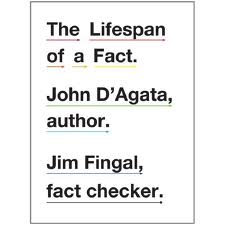
lifespanofafactThe first, “The Lifespan of a Fact,” I recommend highly, mostly to my journalist friends and anyone who writes for a living or a hobby, but really, to anyone who’s ever contemplated the difference between facts and truth. The book consists of the seven years’ worth (condensed and, to some extent, recreated) of correspondence between John D’Agata, writer, and Jim Fingal, fact-checker. D’Agata has written an essay about the suicide of a teenage boy in Las Vegas, although, being a capital-W Writer from the get-go, it’s really about a lot of other things. (Every story is really about a lot of other things, but D’Agata is on the muscle about his larger purpose — to create art, compose lyric sentences and riff on life and death and Vegas and so on. His essay was originally written for Harper’s, but rejected for factual errors, which is where Fingal evidently entered the picture. (It was later offered to The Believer, a magazine where Fingal worked.)

The two clash from the very first sentence, much of which Fingal can’t verify. D’Agata tells him to stop bugging him about this shit — it isn’t important, it doesn’t matter, anyway he’s an essayist, not a journalist, and he takes liberties, and who cares whether there really were 34 strip clubs in Las Vegas at the time, and whether the tic-tac-toe game with the chicken happened on this day or another one? Fingal does, and to his credit, doesn’t allow this University of Iowa professor to intimidate him. And so the process begins. Fingal isn’t editing; that’s someone else’s job. His task is to take every single statement presented as fact and verify whether it actually is.

A college classmate of mine did this job for a while in New York City; it’s a traditional entry-level position in the prestige-magazine trade, and it is thankless. (The fictional narrator of “Bright Lights, Big City,” the thinly veiled autobiographical voice of Jay McInerney, did the same job at a magazine similarly veiled, but obviously The New Yorker.) She was paid a poverty-level wage to take the hallowed prose of writers like Tom Wolfe and Christopher Buckley — to name but two of the unlisted phone numbers in her Rolodex — and peck at it like a chicken. If Wolfe wrote that the morning of July 2, 1973 was hot and rainy in Anniston, Ala., she consulted almanacs or weather stations to make sure it wasn’t really unseasonably cool under a high-pressure system. She called interview subjects to verify they had Remington bronzes on the credenza behind their desks, as described in the text. Were you wearing a navy suit with a pocket square that day? And so on. The only thing she didn’t fact-check were quotes, because people invariably got cold feet when confronted with their own words and tried to back out of them.

It’s a good job for a beginner because it teaches you research skills, and I imagine it also teaches you how to hold your own when some Bigfoot writer, confronted with his own laziness or lousy reporting, pushes back. In “The Lifespan of a Fact,” D’Agata pushes back again and again and again, but then, he gives Fingal so very much to work with. He seems to think that, by declaring he isn’t a journalist, he can do anything he wants with the building blocks of reality, those pesky facts. He changes the name of a school because he thinks the correct name is stupid. He changes the color of a fleet of dog-grooming vans from pink to purple because he needed a two-syllable beat in the sentence. When challenged on these points, he compares himself to Cicero, among others.

Before long, the insults are flying, and Fingal, who grabbed my early sympathy just by getting such spectacular rises out of D’Agata, is becoming something of a pedant himself. There’s a long section on linguistics and quibbles over whether a slot machine called Press Your Luck is named after a short-lived game show or the expression of playing out a winning streak. Was the carpet purple or red? Was Roxy’s Diner on the left as the boy passed the casino’s guest services desk, or down the hall on the left?

It all reaches a crescendo where the two are fighting over the nature of memoir as interpreted by James Frey (D’Agata, you should not be surprised to know, is on Team Frey), the nature of the essay as interpreted by D’Agata, and whether it matters that the kid leaned on a railing that was either four feet high or three feet seven inches high.

By the end, you don’t know whether to laugh or cry. D’Agata’s was a powerful essay, but it’s a more powerful book.

On edit: I’m thinking I’m being too hard on D’Agata here. Part of me sympathized with him, because I’ve writhed under a too-tight editing thumb myself more than once — which, as I explained above, is different from fact-checking. There are editors who simply cannot leave a fact unattributed to a higher authority, and will happily lard a piece up with clunky phrases, destroying whatever narrative effect the writer might be trying for. One of my favorite illustrations of this came from a colleague who was doing a tick-tock piece on a spree killer. He wrote that the guy stopped at a local grocery and passed two bad checks. The editor asked where he got that information. From the grocery-store owner, he said, who still had the checks (they’d been returned, after all), and showed them to him. The editor insisted on inserting “police said” even though the police had said nothing of the kind, out of some knee-jerk fear that a guy sitting in Riker’s Island on multiple felony murder charges might sue us for libel or something. So I’m sympathetic to rhythm and flow in a piece of non-fiction writing. I just don’t think you have to change the color of a truck to get it. End edit.

All of this interests me because I was once seated at a wedding next to an executive from a large company whose name you would recognize. Some years earlier, another company this man worked for had allowed a famous writer, whose name you would also recognize, to embed in their plant for a book he was writing. The book was published, and contained an anecdote about a close call the writer had had with his personal safety on company property. He wrote that he had been so rattled a particular foreman (whom he named) had taken him to his car and given him his first taste of homemade whiskey.

The executive said he’d confronted the writer later, telling him that he remembered the writer’s first taste of homemade whiskey, because he, the executive, had been there: It had happened after work, off company property, outside a bar, in fact. He was upset because the business could be dangerous, and even bringing alcohol onto company grounds — much less nipping out during work hours for a shot — was a firing offense. The writer, he said, shrugged and basically said it made the story better, the way he told it. It was a bit of harmless embroidery in the service of making the book more readable. And it was, until there was a fatal accident at the company sometime later, and during negotiations with the survivors, the lawyers produced the book and said, “So, you allow your employees to drink during work hours?”

All this by way of saying that facts seem unimportant when you’re concerned with getting a two-beat note at the end of a sentence, but ultimately, they’re very important. And whether you’re a journalist or essayist, they deserve respect.

Book two is “Capital” by John Lanchester, the one on the nightstand, which I’m finishing now. It seems to be taking forever, even though I’m enjoying it quite a lot. A look at the residents of one block of Pepys Road in London, it traces events in a dozen or more lives in 2008, leading up to you-know-what. The throughline is a series of unsettling communications — postcards, a website, graffiti, dead birds — from an anonymous party or parties, proclaiming a simple message: “We want what you have.” I had high hopes for a mystery with mounting tension, but the book is more a Dickensian novel of manners and social mores at a particular point in time. And while it hasn’t made me think hard the way “The Lifespan of a Fact” did, it has been as delicious as a Christmas cookie.

(If you choose to buy either of these, as always, you’re welcome to use the Kickback Lounge to make your purchase.)

With that, I return to previously scheduled light duty, and I hope you are, as well. The snowstorm looks like it’s just about over, and I have to go fire up the blower.

Posted at 6:50 pm in Popculch | 115 Comments
 

Hey.

Not everybody eats turkey today, y’know.

(Max having Christmas breakfast.)

(Not our bird.)

20121225-110702.jpg

Posted at 11:07 am in Holiday photos | 59 Comments
 

Happy holidays.

Weird. It’s snowing around Indianapolis and well into southern Indiana, and in Detroit, it’s 46 degrees with a steady rain. Weather, you are an endless bafflement.

And with that inane small talk, let’s segue into the long slide into the holiday week, which I have off for the first time in maybe forever. And while it’s possible I might be moved to blog and blog some more over the next 10 days or so, I’m far more likely to throw some links and pix up from time to time. Keep coming back if you like; we won’t be entirely dark, but the lights will be dim.

I will spend today madly shopping. Will you be the lucky recipient of a tchotchke, a sweater or a bottle of decent likker from the Nall-Derringer co-prosperity sphere? Check under the tree to find out!

For the rest of you, some links:

If Robert Bork wasn’t dead, Jeffrey Toobin would have killed him with these few well-chosen words:

Bork was born in 1927 and came of age during the civil-rights movement, which he opposed. He was, in the nineteen-sixties, a libertarian of sorts; this worldview led him to conclude that poll taxes were constitutional and the Civil Rights Act of 1964 was not. (Specifically, he said that law was based on a “principle of unsurpassed ugliness.”) As a professor at Yale Law School, his specialty was antitrust law, which he also (by and large) opposed.

The 50 worst columns of 2012. Can’t argue with too many of them, although the two chosen from M—- A—- aren’t even close to his worst for the year.

Some people’s worst nightmare: She’s marrying her sorority sister. It’s like a porn movie, but not.

Olympian/mom/real-estate agent in Wisconsin, but in Vegas? Look out.

I almost emailed this photo to Cooz today while I was shopping, but I couldn’t find his address in my phone. This’ll have to do. It’s a shop for plus-size sexywear. It is not. I have been corrected by the fabulous Nancy Friedman in comments. It’s just a trendy shop for plus-size teens. Let’s all get our freaks on — it’s almost Christmas.

torrid

And have the best one ever, OK?

Posted at 12:28 am in Housekeeping | 110 Comments
 

Drop it.

I love babies as much as the next person — possibly more — but even I was sort of disappointed to learn the eagle video wasn’t for real:

It totally fooled me. I was talking once to a guy in the Upper Peninsula; we were talking about seeing a salmon that had chosen a nearby shoreline to wash up on, and the carrion-eaters that would soon carry it away. Raccoons. Eagles.

“I go walking on the ice in the winter with the dog” — a cairn terrier — “and sometimes those things circle around like they’re thinking about having him for lunch.” A cairn terrier weighs less than a six-year-old, but it’s always nice to have your worst fears confirmed.

But I guess this one is just a clever final exam in an art class. Still, en route to watching it, I did discover these driving dogs:

So that’s good. The only thing missing — not enough horn-honking. I always thought a world where dogs could drive would include a lot more honking.

It’s been almost a week since last Friday, and I’ve started to calm down, not tearing up unexpectedly, punching pillows, etc. But as the dust settles, it looks like I’m going to have to start fussin’ again, because I can’t get past something that now looks like a permanent part of the debate. That is, the pro-gun contention that “gun-free zones” are part of the problem.

I confess, I’d never been aware of it until 2004, when I spent some time in the Twin Cities and saw a big sign on the door to Minnesota Public Radio, advising the building was a gun-free zone. It was explained this was part of the new law, with lots of eye-rolling. OK, I get it: If you want to opt out of the state’s new yee-ha-freedom gun laws, you may invoke your other sacred right (private property) and do so. I stopped noticing them after about a day. And I assumed everyone else did, too.

The problem with carrying a gun, at least to me, is one of practicality. Those suckers are heavy. Holsters are big and clumsy, hot in warm seasons, impractical in all of them. There’s a reason cops are universally seen as lousy dressers; their sports jackets hang all wrong. I know a few people who pack heat in Detroit for reasons of their own, and they all opt for the time-honored Motor City holster — the glove compartment. Women have purses, but, again: Heavy. The slenderest, most compact ladies’ model Smith & Wesson would crowd out my wallet in even my roomiest bag, make reaching for the Tic Tacs problematic and eventually cut a rut in my shoulder.

So when we talk about gun-free zones, who are we talking about? Open carriers? Are there that many out there? You all live all over the country, so you tell me. One of my colleagues in Fort Wayne had a brother in Texas who wore a holster everywhere, all the time, but I don’t see it around here. (Of course, in Detroit, it’s wise to assume that every single person you meet is packing, which has resulted in our extremely civil, virtually violence-free metro area. But they don’t wear them on their hips, for the most part.)

If we’re not talking about open carry, how are gun-free zones enforced? No one asked to look in my bag when I was in Minnesota; it was all on the honor system. And because people who feel threatened enough to feel they must be armed at all times are unlikely to even approve of the idea of gun-free zones, much less follow the rules, I’ve just assumed the signs are like the old joke about wetting your pants in a navy-blue suit — a nice warm feeling no one notices.

Consequently, I have a hard time believing, as the current pro-gun talking point has it, that these mass murderers are choosing schools, movie theaters, malls, etc., because “they know no one will return fire.” I just don’e. It goes contrary to everything I know of crazy people, including the ones who believe this crap.

Which brings me to something I found via Ta-Nehisi Coates, Alan Jacobns in (yes) the American Conservative:

But what troubles me most about this suggestion — and the general More Guns approach to social ills — is the absolute abandonment of civil society it represents. It gives up on the rule of law in favor of a Hobbesian “war of every man against every man” in which we no longer have genuine neighbors, only potential enemies. You may trust your neighbor for now — but you have high-powered recourse if he ever acts wrongly.

Whatever lack of open violence may be procured by this method is not peace or civil order, but rather a standoff, a Cold War maintained by the threat of mutually assured destruction. Moreover, the person who wishes to live this way, to maintain order at universal gunpoint, has an absolute trust in his own ability to use weapons wisely and well: he never for a moment asks whether he can be trusted with a gun. Of course he can! (But in literature we call this hubris.)

Yup.

So here’s my bottom line: We can’t have a discussion, or whatever, until some participants stop lying. Let’s start with that one.

And let’s do some bloggage!

Steven Rattner on the coming conclusion of the GM rescue.

Finally, why I was at the camel farm Tuesday. Link will work after 8 a.m. EST.

Posted at 7:33 am in Current events | 66 Comments
 

Honest Abe.

We saw “Lincoln” Sunday night, which wasn’t my first choice, until it was. I’d much rather see “Argo,” but OK, we’re all going, this is Important History, it’ll win Oscars, and I will ignore that voice in the back of my head that says, Steven Spieeeeeelberg, BEWARE BEWARE BEWARE, sucked it up and went.

And I’m 78 percent glad I did, which is saying something. More learned film critics than I can fill your ear with words upon words about this, that and the other thing, so let’s do this with bullet points:

* I have this little Steven Spielberg problem. We just don’t get along, and I’ve stopped worrying about it. I liked “Munich,” however, which was written by Tony Kushner. “Lincoln” was written by Tony Kushner, too. The 78 percent figure cited above is almost entirely due to him. But also because…

* Loved the cinematography and production design, the latter of which very deftly offered up a White House that’s sort of a dump in a smoky, cold, manure-smelling city. The former suggested dim corners and half-moon faces lit by candles and gaslights. (That this had the added benefit of hiding the prosthetic seams on Daniel Day-Lewis’ face had to be a big plus.)

* Daniel Day-Lewis. Whoa. I could watch him spin yarns, offer aphorisms, and tell his wife to hold the spending on the flub-dubs all day.

* Loved the character actors who filled the House of Representatives. Hey, it’s the guy from “A Serious Man!” And Gale from “Breaking Bad!” Is that…whazzisname, the “500 Days of Summer” guy, AND Boyd Crowder from “Justified!”

* A few things I hated. They included the John Williams score tapping you on the shoulder, saying “Pay attention to this scene, because it’s important.” Hated that expository dialogue, although I did my best to forget it, and mostly did, but come on, Tony: Why did Sally Field get all the clunky speeches?

* James Spader! You’ve put on weight, but you’re still my man.

Alan liked it, but Kate was bored out of her tree.

So. Here are some camels:

camels

The big one in the foreground is a male, and he’s in rut. The slobber all over his face is a byproduct of his constant tooth-grinding. His spiky head hair is greasy from a scent gland on the back of his noggin. Every so often he would stretch his neck back and rub it on his hump to spread his sexy around. I was told that when he’s really getting his freak on, he squats, pees on his tail and then swings it around like a priest with an aspergillum. The female never got any closer because that male wasn’t going to allow his woman to get near another warm-blooded animal.

Men. Gotta love ’em. They know what they want, and they’re not afraid to slobber, exude oil, spray pee and grunt to get it.

Which seems about the only way to transition to this: Happy hump day. I’m out.

Posted at 12:07 am in Movies | 71 Comments
 

Denial, grief, anger.

I thought perhaps another 24 hours or so would make me less jumpy, but it hasn’t. Although, hey, stress/disbelief/grief seems to be giving way to fury! Is that good? You tell me. If I hadn’t been alerted to this post by LGM, I doubt I’d have seen it. (I’m allergic to McArdle.) It’s long, and meandering, and not very good, but it does include this whopper toward the end:

I’d also like us to encourage people to gang rush shooters, rather than following their instincts to hide; if we drilled it into young people that the correct thing to do is for everyone to instantly run at the guy with the gun, these sorts of mass shootings would be less deadly, because even a guy with a very powerful weapon can be brought down by 8-12 unarmed bodies piling on him at once. Would it work? Would people do it? I have no idea; all I can say is that both these things would be more effective than banning rifles with pistol grips.

You know, I was sort of waiting for someone to say this. As I recall, something you heard from this corner of the internet after the Virginia Tech massacre ran along these lines. It wasn’t a full-throated roar — in fact, if I’m remembering correctly, it mostly came from the terra cotta-toothed, since-disgraced John Derbyshire — but it was there, couched as a rueful observation about the decline of the American male: All those shots fired, surely he had to reload at least a few times. Why didn’t one of these young men rush him and take him down? What has happened to the masculine impulse? Were no first-graders brave enough to run at the madman with the gun? What sort of children were these?

I still haven’t gotten over the columnists who, after 9/11*, were back on their old hobby horses within days, in particular the conservative women who sneered at the stewardesses on United 93 who thought they might join in the rush to the cockpit, using hot coffee as a weapon.

* or, as paid-by-the-word Mitch Albom put it in Sunday’s column, “al-Qaida’s diabolical Sept. 11, 2001 attack.”

To Megan McArdle and her Libertarian buddies, I say: Sounds like a plan. You first.

I really need to stop this now. One last story, thanks to Jolene: How our gun culture is unique in the world, in four amazing charts.

Oh yeah, and this, too: How Newtown, given the opportunity to examine its gun culture and consider new ordinances controlling it, took a pass:

“This is a freedom that should never be taken away,” one woman said. Added another, “Teach kids to hunt, you will never have to hunt your kids.”

You know what Dr. Phil has to say about that.

Palate cleanser? PALATE CLEANSER, STAT. How about this, Professor Hank Stuever’s supplemental reading list to his class at the University of Montana, on the occasion of class’ end. Just scanning the list, much of which I’ve read but much of which I haven’t, made my heart soar like a hawk. I have a very busy day today and won’t have time to read much of it, but just looking forward to dipping into something tonight will carry me through the day.

And by then, I might be back to something approaching normal. Let’s hope so. Happy Tuesday, all.

Posted at 12:47 am in Current events, Media | 72 Comments