Oh, so much sad in the news today. That’s to be expected after the last couple of weeks. Anger certainly isn’t doing any good. There’s much to sort through in the weekend’s news, so let’s get to a couple of gems, which you may have already seen, but just in case you haven’t? These are can’t-miss stories.
Both, not coincidentally, are by the same writer — Eli Saslow of the WashPost.
The first is from last Friday. I posted it on my social media, with a note about how important detail is crafting a story like this, known in the trade as a tick-tock. But if you don’t care about that, the piece is still a gripping, horrifying read, from the point of view of the people in the room when Syed Farook entered with his wife, their shared grudges and a lot of weaponry.
The other is about what happens after – because one reason Saslow can write a post-mass shooting story so well is because he has experience in it. This one is longer, and even more heartbreaking, concentrating on a 16-year-old who was seriously wounded by the Oregon community-college shooter, whose name I can’t even remember now (and who, interestingly, is never named in the story). It’s a grim reminder that while the yapping morons in Washington and elsewhere yap yap yap and ride ride ride their hobbyhorses, this is what they’re not talking about — the scores of survivors of these attacks, who must live the rest of their lives with their scars and memories.
And the rest of us? Well, this passage stung:
This, she was realizing more and more, was the role of a survivor in a mass shooting: to be okay, to get better, to exemplify resilience for a country always rushing to heal and continue on. There had been a public vigil during her surgery, a news conference when she was upgraded from critical to stable and then a small celebration when she was sent home after two weeks with handmade card signed by the hospital staff. “Strong and Moving On,” it had read.
By then, the college had reopened. What remained of her Writing 115 class had been moved across campus to an airy art building with windows that looked out on Douglas firs. They were forging ahead and coming back stronger, always stronger. That’s what the college dean had said.
Except inside the rental, where every day was just like the one before: Awake again in the recliner. Asleep again in the recliner. Cheyeanne dressed in the same baggy pajamas that hung loose and away from her wounds. She was wrapped in an abdominal binder that helped hold her major organs in place. Her hair was greasy because her injuries made it painful to take a bath. Five medications sat on the coffee table, next to a bucket she reached for when those medicines made her throw up. She couldn’t go back to school, or play her guitar, or drive her truck, or hold a long conversation without losing her breath, so she mostly sat in silence and thought about the same seven minutes everyone else was so purposefully moving past. The shooter was standing over her. The hollow-point bullet was burning through her upper back.
She wanted to talk about it. She needed to tell someone who knew her — someone other than a psychologist — what she’d been thinking ever since that day: “I just lied there. I didn’t save anybody. I couldn’t even get up off the ground.” But what everyone else around her seemed to want was for the shooting to be over and for her to be better, so they came to urge her along at all hours of the day and night.
In came the assistant district attorney with a bouquet of flowers and a check for $7,200 in victim restitution. “On to better days,” he said.
In came her best friend, Savannah, with a special anti-stress coloring book. “For your nightmares,” she said.
In came Bonnie, always Bonnie, rushing between the kitchen and the living room, her eyes bloodshot from sleep deprivation and hands shaking from a heart condition. “Think positive. Think positive,” she said, because a therapist had suggested that as a mantra.
It stung because “be strong” is the sort of thing I would say, and obviously it’s so, so wrong, like telling the recently bereaved that God needed another angel in heaven, or whatever.
It was a real eye-opener. Don’t miss it.
As always, on a Monday: How was your weekend? Ours, mixed. It started Friday afternoon with a funeral, ended with a lovely Sunday spent fetching the Christmas tree. In between was Noel Night, an outdoor festival in Midtown, which was chilly but festive and featured a nice dinner. The chill made this steam vent near the orchestra hall that much steamier:
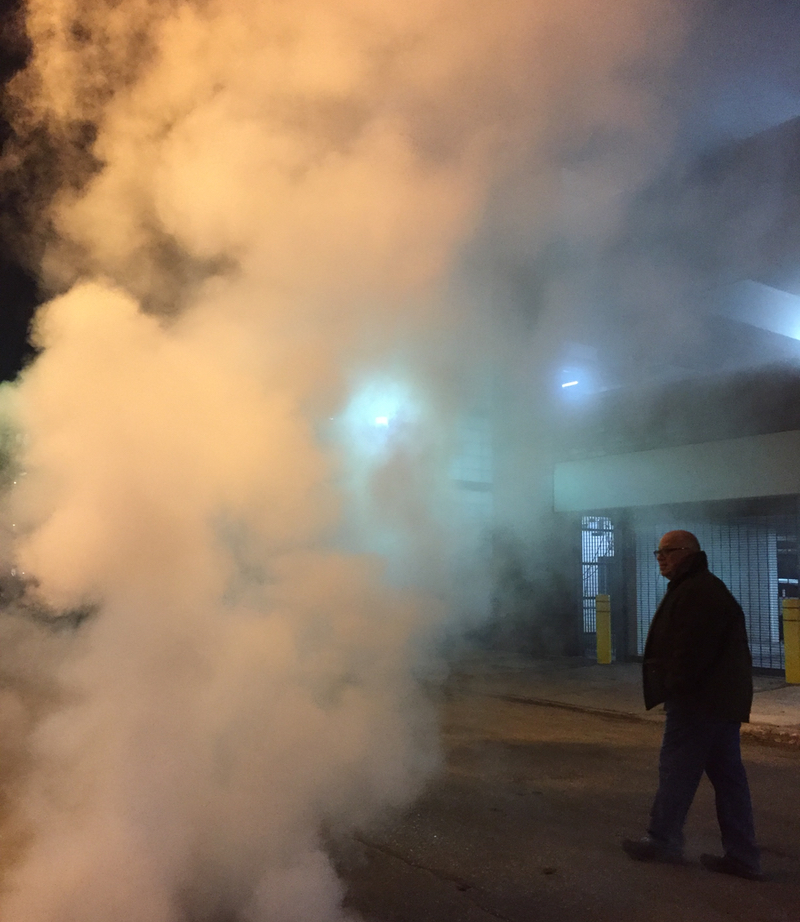
Detroit is always smokin’, one way or another.
Last in our Sad File today is this sad-but-wonderful piece by Tim Kiska, a local journalist and professor I know a little. Basset brought it to my attention Friday, and if you’re at all interested in urban history at the granular level, it’s absolutely worth your time. It’s about Detroit, but like so many similar stories, it’s really about every American city, one way or another. Kiska goes back to the block where he was raised and tells the story of how it, and the city, changed over time. You don’t have to love Detroit to enjoy the story.
So OK, then. Let’s end on an up note.
Someone posted John Scalzi’s examination of the GOP slate in comments last week, and I’ll repost it here, because it’s funny. I get out of the habit of reading Scalzi when he dedicates day after day to sci-fi fiction stuff, but I should get back into it.
Finally, it’s been years since I laughed through a SNL sketch beginning to end, and so this may constitute a miracle. It’s pretty damn funny.
And so Monday unfolds before us, herald to the week ahead.