God save the marriage.

So, it seems we’ll have a royal wedding to look forward to next year. For what it’s worth, I approve. The couple has had a long time to get to know one another, presumptive sexual contact and enough mileage in the rear view that there will be no ugly surprises, or nothing they can’t handle.

Prince William seems to have been both well-raised by his parents and enough of his own person to learn from their mistakes. And his grandparents were obviously chastened enough by the disaster of Charles and Diana to finally revise the job description for the future queen. A royal or aristocratic bloodline is no longer required, nor is virginity. It’s a new century, your majesty. Women are different. And in a good way. It still astounds me that in 1980, Lady Diana Spencer was required to undergo a gynecological examination to ascertain her, er, soundness.

Obviously no one can know precisely what grammy told No. 2 as he set about making his choice, but as I said, he seems to have learned well. Some people say there are two kinds of women in the world, first wives and second wives, Dianas and Camillas. I was never much of a Diana fan, so forgive me, but I think he’s found a Camilla, with enough of Diana’s virtues to satisfy everyone. Which is to say, she will look good in a dress, produce an heir and a spare and not trail a string of caddish boyfriends who will loosen their tongues to the tabs. I like the way she wears her hair long and loose and a little messy, is beautiful in an entirely approachable way and doesn’t seem to make too much of a fuss over anything. In this, she is very much an English girl, and if she isn’t a blueblood, well, pfft. You see what shopping in the luxury section got his father. Teach her to ride and shoot and no one will be able to tell the difference in a decade.

This paragraph from the NYT story made me chuckle:

The romance has had its setbacks. The pair split for several months in 2007, amid speculation (always denied) that the royal family was dismayed by the lower status of Miss Middleton’s family and that Mrs. Middleton had chewed gum and used un-aristocratic words like “toilet” and “pardon” in front of Queen Elizabeth, William’s grandmother.

I thought all Brits said “toilet.” In fact, I thought calling a spade a spade, and a toilet a toilet, was a hallmark of the British upper classes. Euphemism, especially about bodily functions, is a middle-class trait. Excuse me, but can you direct me to the powder room?

So, bloggage? Not very much:

Lisa Murkowski, throwin’ down with the mean girl.

Via one of my Facebook pals, the Westboro Baptist Church meets the Winter’s Bone demographic. Guess who won?

A website I’d fallen away from, and am now back in love with — Cute Overload. I think “cute” is one of those very current concepts, like “soft,” which Hank explores at one lengthy paragraph’s length in “Tinsel” (which by the way is out in paperback, with an excellent cover, which you should stuff into stockings up and down your gift list). We swing between extremes in so many things in our discourse; you’re red or blue, the president is a saint or a Marxist, people you’ve never met read something you wrote and send you an e-mail informing you you’re a shithead who should die in a fire. And yet we can join our hands at the table of brotherhood over LOLcats and pictures of hamsters. Go figure. Crazy world.

And with that, I have to skedaddle. Much work to do today, plus I have to make a birthday cake. It’s November 16, the day we honor the arrivals of Alan, Kate, Adrianne from our peanut gallery and Alan’s late elementary classmate, Elvis Whitehead. So I’m off to buy chocolate.

Have a great day, all.

Posted at 9:24 am in Current events, Popculch | 74 Comments
 

The senior portion.

I was out and about yesterday, and wandered into a mall bookstore — Borders Express. Like the regular Borders, only with more books by celebrities. Man, Barack Obama is the best thing to ever happen to any talk-show host looking for vertical integration. But what have we here? It’s Nora Ephron’s new collection of essays, “I Remember Nothing: And Other Reflections,” sure to be a best-seller.

I plucked it from the shelf, expecting something slight and breezy. I was not disappointed. Many magazines are thicker, and no, I’m not kidding. A September issue of Vogue — in a recession, even — is the OED compared to this book. I sat down with it on a step stool, to see how many I might have already read in the New Yorker, her periodical publisher of choice. At least one. Then I opened it at the halfway point and started reading. One essay was a list. A clever list, to be sure, but a list. The last two essays are lists, too. The margins are wide, the type is large, and while Ephron is, as always, a funny and engaging writer, it all served to remind me that this is “I Feel Bad About My Neck,” part 2, and “I Feel Bad About My Neck” was a book I felt very smart to have gotten from the library, because I read it in about 90 minutes and saved myself $21.95. I read about half of “I Remember Nothing” in 20 minutes. It costs $22.95.

This mostly hurts because Ephron used to be big, could stand shoulder-to-shoulder with any of the big swingin’ ones at Esquire back in the day, as smart about pop culture as anyone, and a lot funnier. She filed memorable essays on feminism, the Pillsbury Bake-Off, Rod McKuen and my personal favorite, an account of the birth of the feminine hygiene spray. My BFF Deb and I were twin Nora groupies, and we both went to see her on her “Heartburn” book tour, another slender volume but with a power-to-weight ratio worthy of a Mexican boxer. Deb saw her in South Bend, and wrote me a very entertaining letter about Nora’s dismantling, from the podium, of a Notre Dame brat who phrased an accusation in the form of a question, essentially charging Ephron with the single-handed destruction of her two marriages. At the appearance I saw, she said that the bread pudding recipe had omitted six beaten eggs, and I went home and made the notation in my copy, next to the passage where it’s woven into the narrative. Of course I could find it in a minute because I’d already read the book about three times and knew right where it was.

It’s not that these essays lack weight. It’s that they lack editing. The piece about egg-white omelettes, a food rant lite, could have gone, but then the book would have been 155 pages instead of 160. So could those lists (152 pages and falling…). And so on. But I guess maybe that’s the point, as the theme of this book, and the last, is aging and how it diminishes you. I really don’t think Ephron’s writing is so diminished, it’s that so much less is expected of her. And her publisher seems to expect very little of us, certainly. I guess we’ll pay $22.95 for anything.

Ephron is older than me, but I’m feeling older these days, too. Friday night I took Kate and a bunch of her friends to a concert — five bands, co-headlined by Anarbor and VersaEmerge, but Anarbor is all they were interested in. My job at these things is to drive, pay for things, hold coats, say as little as possible and stand in the background, a combination human ATM/factotum. I dressed accordingly — jeans, black sweater, black jacket and because I knew we’d be standing in line in the outside chill followed by the usual overheated club, one of my nice silk scarves around my neck. You know, for that little pop of color.

One of the girls lacked a ticket. I left them in line and walked inside to buy one. This is at the Majestic Theater complex on Woodward in Detroit, cornerstone of the Detroit music scene. Three venues, two restaurants and a bowling alley. White Stripes, Von Bondies, Electric Six, Was (Not Was) — you get the idea. A security guard directed me to the bowling alley, where I found a thirtysomething hipster spraying disinfectant into bowling shoes.

“Hi, I need one ticket for the show upstairs tonight,” I said.

He looked me over for 1.5 seconds and said, “The doors will be opening soon, ma’am, and your son or daughter can get a ticket at the top of the stairs then.”

Oh rly?

I looked him over for 1.5 seconds and said, “How do you know I’m buying for my son or daughter? How do you know it’s not for me?”

He said, “Your ascot?”

I felt bad about my neck. But not for long. Because soon we were upstairs, ticketed, the girls bolting for the stage so as to stand within sweat-spraying distance and me? I went to the bar. There were several other people of roughly my age there. All parents. No ascots, but some remarkable stories — one had driven his daughter all the way from Buffalo, another from Youngstown. To see VersaEmerge, with a female lead singer who reminded me of Natalie Merchant, if Natalie Merchant sang like a cat being strangled. The Buffalo father told me about how much he loves traveling with his daughter and how cool she is and how many shows they see together. When he started buying Crown Royal shots for the bartenders, I excused myself and wandered around taking low-light pictures.

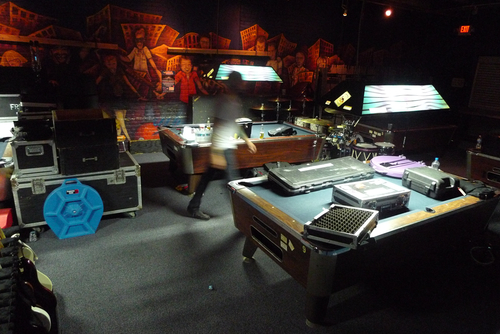
Mostly bad ones, which usually happens when I try to duplicate the Tri-X photography of my early colleagues:

Alan and I disagreed on whether the Magic Stick is a pool hall. I insisted it was, he said it wasn’t. I win, although during shows, the pool tables become the roadies’ area:

And the neon backs me up.

Sorry, Alan.

So, let’s skip to the bloggage:

As Thanksgiving drew nearer, Mr. and Mrs. Albom were discouraged by how many of their lovely invitations to spend the holiday in their gracious Bloomfield Hills home were returned with regrets. It was such a small request — spend five days in the bosom of one of America’s most beloved writers, providing him with column fodder, uncompensated by anything more than turkey. What is wrong with people these days, anyway?

It could be worse. You could be reminiscin’ with Bob Greene.

The crime that dare not speak its name: Term papers for hire — the perp’s side of the story. Seriously, worth a read.

Finally, we had some remarkable weather here this weekend — dense, pea-soup fog that lingered most of the day Friday and returned Saturday. Here’s the view of the water from the median strip on Lake Shore.

Best part? The foghorns.

Have a great Monday.

Posted at 8:55 am in Detroit life, Media, Popculch | 65 Comments
 

Self-destructing in 60 seconds.

Kate is playing in the school jazz ensemble this year, and one of the numbers they’re working on is the “Mission: Impossible” theme. (You weren’t expecting “Sketches of Spain” from eighth-graders, I hope.) This necessitated explanations: Yes, it was a movie, but it was a TV show first. It played into the ’60s vogue for all things spy-related, but as one-hour dramas go, it wasn’t bad at all. It was about a special force of secret agents who went around the world doing… oh, hang on. Let’s just look on YouTube.

I thought that if YouTube had anything, it should have at least one example of the opening set piece, where Peter Graves gets the mission, and all of those great pop-culture catch phrases: As always, if you or any of your IM force are caught or killed, the secretary will disavow any knowledge of your actions. This recording will self-destruct in 60 seconds. Good luck, Jim.

And YouTube had something, but it wasn’t the MI I remembered. It was the pilot episode. Not Peter Graves, but the old DA from “Law & Order.” Not a little tape recorder, but an LP in a featureless office where cryptic glances are exchanged. A different voice giving the mission. What the hell?

Well, the internet got me into this mess, and the internet can get me out. The usual Wikipedia caveats apply, but this sounds likely:

The leader of the IMF is initially Dan Briggs, played by Steven Hill. However, Hill, as an Orthodox Jew, had to leave on Fridays at 4 p.m. to be home before sundown and was not available until sundown the next day. Although his contract allowed for filming interruptions due to religious observances, the clause proved difficult to work around due to the production schedule, and as the season progressed, an increasing number of episodes featured little of Dan Briggs. Hill had other problems as well. After cooperatively crawling through dirt tunnels and repeatedly climbing a rope ladder in the episode “Snowball in Hell,” the following week (“Action!”) he balked at climbing a stairway with railings and locked himself in his dressing room. Unable to come to terms with Hill, the producers reshot the episode without him (another character, Cinnamon Carter, listened to the taped message, the selected operatives’ photos were displayed in “limbo”, and the team meeting was held in Rollin Hand’s apartment), and reduced Briggs’ presence in the five segments left to be filmed to the minimum. As far as Hill’s religious requirements were concerned, line producer Joseph Gantman simply had not understood what had been agreed to. He told Patrick J. White, “‘If someone understands your problems and says he understands them, you feel better about it. But if he doesn’t care about your problems, then you begin to really resent him.'” White pointed out, “Steven Hill may have felt exactly the same way.” Hill was replaced (without explanation to the audience) after the first season by Peter Graves as Jim Phelps, who remained the leader for the remainder of the original series and in the 1988–1990 revival.

For the record, I have never locked myself in my dressing room in my life. For the record, I’ve never had a dressing room. If I ever get one, maybe I’ll lock myself in, just for the hell of it. See what it feels like.

Something else I never would have known about here it not for YouTube: Tarp surfing.

And with that, it seems we have skipped to the bloggage. A few weeks ago we discussed a case here in which the local Fox affiliate played a significant role. Here’s another, far more tragic. At what point does seeking TV exposure cross the line into mental illness?

Dumb story, still funny — Joe Biden, comic icon. (You can see the Onion’s Midwestern roots here — only a Wisconsin-centric publication would give the vice president a Trans Am.)

And now I’m off to the shower, and to catch a rabbit. Thank a veteran today, or just turn everything up to 11.

Posted at 8:54 am in Popculch, Television | 78 Comments
 

Catching up.

You know how being sick with a subclinical malaise is — you feel fine until, all of a sudden, you feel awful. That’s me today. Let’s see how far fine can take me this morning.

As for my comments about “Winter’s Bone,” I keep coming back to a minor thread of the story — the main character, a 17-year-old girl, and her intention to join the army. The film is the story of this girl, Ree Dolly, and her quest to find her father, dead or alive. Charged with cooking meth, he bailed himself out by putting their house up for part of his bond. Now missing and presumed a fugitive, the family is days away from losing everything. And they don’t have much to lose. The Dolly family — Ree, her mentally ill, nearly catatonic mother and two young siblings — lives at the edge of the edge, in the Missouri Ozarks, in the sort of grinding, rural poverty where a neighbor stopping by with some venison and a few potatoes is the difference between being hungry that night or not. Career options seem to be limited to cooking meth or touring beautiful Fallujah. Ree’s inclination toward the service is covered in only a few lines, but it stuck with me.

She’s certainly qualified, with an interior toughness that you get only after years of the sort of things we see in the movie – poverty, criminal activity, an insular rural culture where women bond with men for the same protection it afforded Neanderthals, then learn to never, ever open their mouths. About anything. I’d hire her to be an army of one. And while I know that the armed service has always been a step into a sort of stability for exactly this level of society, it’s impossible not to think about our current military adventures overseas and think Ree might be no worse off dealing crank.

I was strongly reminded of Annie Proulx’s short story, ‘Tits-up in a Ditch,” two years old but surely in an anthology somewhere by now (and, for you New Yorker subscribers, in the digital edition), another story of just how hard hardscrabble can be.

Anyway, I had a late dissenter in Monday’s thread, calling “Winter’s Bone” a whole lot of wannabe Cormac McCarthy. I see the criticism, but I disagree, or rather, I don’t find wannabe-McCarthy enough of a charge to make it not worth your time. The story is smart about so much, and, like “Frozen River,” has the sense to show far more than it tells, and trust its audience to figure it out. There are some wonderful supporting performances, especially by John Hawkes and Dale Dickey, both of whom could have been cast on bone structure alone, but follow it up by actually climbing inside the skins of their characters. A truly haunting film.

And now I am racked with a coughing spasm. Looks like awful is just around the corner, so let’s get some bloggage out of the way, shall we?

Sarah Palin’s career as an economic policy critic, cut tragically short. Not that anyone would dare to tell her so.

Speaking of Alaska, Anne Applebaum makes a few points:

For whatever the reason, the hypocrisy at the heart of the (Republican) party – and at the heart of American politics – is at its starkest in Alaska. For decades, Alaskans have lived off federal welfare. Taxpayers’ money subsidizes everything from Alaska’s roads and bridges to its myriad programs for Native Americans. Federal funding accounts for one-third of Alaskan jobs. Nevertheless, Alaskans love to think of themselves as the last frontiersmen, the inhabitants of a land “beyond the horizon of urban clutter,” a state with no use for Washington and its wicked ways.

Duh.

And speaking of monetary policy, as someone who used to host a radio show where I heard from insane Fed-bashers on a regular basis, I was interested to read Bethany McLean’s explainer on how Fed-bashing has gone mainstream, in Slate.

Irresistible headline, funny column: For black men who have considered homicide after watching another Tyler Perry movie. Via Hank.

And because monetary policy isn’t all we’re about here, some pop-cult — JC Brooks and the Uptown Sound, via Roy. I see strong correlations with Sharon Jones & the Dap Kings, i.e., a retro soul band with four white hipsters in the back row, playing in their stingy-brim fedoras, etc., with an ol’ skool African American vocalist out front. If anyone can name a third, I’m calling trendsies. Nevertheless, “Baltimore is the New Brooklyn” is quite the toe-tapper:

Finally, for those who weren’t paying attention in the comments yesterday, a note from MMJeff:

You’ve said it before, but your readers are truly awesome people; yesterday I learned from our LCCH staff that they wanted to know what “Nancy Nall” was or who she was, because through the link on the website we’d gotten a couple of donations that noted your name as the reason for the giving, and also a “Jeff.” A third is inexplicable and distant-ish (New Jersey) and may well fit with the other two.

Anyhow, I told them, and told them I’d thank you “personally” for the venue and the opportunity; I also took the liberty of posting a news story at the thread yesterday with general thanks. Your kind words a few days ago have spurred some help our way, and direct donations are very appreciated by our service coordinators because that big hunk o’ HUD money comes with a million strings on it — we love it, and would close (many of our units, anyhow) without it, but there’s no room for creative problem solving and social worker skills. You fill out the forms, you work the process, you turn the crank and out comes the sausage.

The $35,000 we raise is small next to our $1.2 million total annual budget, but it represents so much more than that, to the staff and those they can do useful, interesting, and cool things for. A few weeks ago, they bought some nice shoes for a woman who got a good outfit for a job interview, and the service coordinator decided her self-confidence needed some rocking heels with the donated clothes. Federal dollars cannot be used to buy rocking heels, apparently; “local” fundraising can.

Again, thanks! I come for the recipes, not the fundraising (and a little provocation, occasionally), but this was just so unexpected, and so timely. And you may have picked up a few more readers from the Newark OH area in our offices at the Coalition.

This has happened before, with other worthy causes. You guys? You are the best. Srsly.

OK, off to shower and Wayne State, there to spread my germs around campus. Which may well be where they originated, for all I know.

Posted at 9:51 am in Current events, Movies, Popculch | 64 Comments
 

Make it un-snappy.

I suppose Starbucks officially became a “mature” business when they started opening locations across the street from one another, but today’s story in the Wall Street Journal pretty much confirms it: They’re “improving” service by making the baristas work on no more than two drinks at a time, which will almost certainly mean longer lines. And you know customers will love this, because if there’s anything coffee drinkers are, it’s infinitely patient. Particularly at the morning rush.

I’d never heard the term “mature business” before my newspaper’s publisher used it during a meeting some years back. It refers to one that has reached the end of its growth curve — well-established, very likely fat and happy, but no longer growing in any significant way. The only way to increase profits in a mature business is to innovate or cut costs. In the newspaper business, which has been mature longer than Morley Safer, we innovated by larding the management level with assistant managing editors with more slashes in their title than there were discarded Starbucks cups in the trash cans, i.e. assistant managing editor/enterprise/trends/features/fashion. We were told there was an AME at the Philadelphia Inquirer whose job it was to read other publications all day, not to steal ideas but to just get that plugged-in feeling, so that s/he could be the newsroom oracle of the Zeitgeist. I never knew who this person was. Honk if you did.

We also cut costs. Relentlessly. One of my last acts as an employee was to steal a package of brass brads from the supply cubicle. It’s not like anyone used them, and there they were, the nice fat ones I couldn’t find at Office Depot. I figured it was the least I could do to thank them for all they’d done.

In other words, the A-team, the visionary bastards who built the newspaper industry, the Hearsts and Knights and the rest of them, had long since moved on, leaving the bean-counters in charge. I assume this is what’s happening at Starbucks, which probably, now that I think of it, has literal bean-counters on the payroll. The McDonald’s of dark-roast coffee needs to shoot itself in the foot, needs to move into its assistant-managing-editors-with-slashes period, evidently. This is how it does it. Good luck to you, Starbucks. This is why I order my triple espressos without any of that fancy shit, unless it’s a fourth shot of espresso. Because when I need my triple-e, I don’t want something with a pretty fern traced into the milk foam. Because I don’t want milk foam. I WANT COFFEE AND I WANT IT NOW.

Rescued Chilean miners: 11 down, 22 to go. I see a reality show spinoff in the future. “Survivor: Mineshaft,” maybe. One thing I don’t think I’ve seen in all the coverage: What sort of mine is this? Coal, ore, minerals? Does anyone know?

Coozledad’s bull, Llewd, was feeling poorly, seems better now. With pictures. Reading C’s accounts of treating the livestock at his vegetarian petting zoo always stirs the same reaction: 1) I miss my horse, followed by 2) I don’t miss my horse. What I miss: Riding him around and jumping fences. What I don’t miss: The staggering amount of work required to keep animals that size healthy, fed and confined. Llewd hurt his foot during his most recent escapade. Hurt foots require doctorin’, and you can’t put a bull in crossties and expect him to stand quietly, not with those horns. But such a cute face, and that poll just invites scratchin’. I send you a scratch from a long distance, Llewd.

This was yesterday’s talker, although most of the talking was me, asking questions: Dog returns to life after vet allegedly euthanizes it. Such as, where was the dog in the interim between the shot and the attempt at burial? Doesn’t this vet use a stethoscope? What, the guy walked out with a “dead” Rottweiler in his arms through the waiting room?

I bought a sweater late last summer at the Gap, and when I put it on this week I noticed it has the new logo on the label, now the old label. What am I bid for a knee-length white cotton coat-style cardigan, worn maybe three times? In true Gap fashion, it is already starting to fall apart at the seams. P.S. I liked the new label. Who are these people who have all fucking day to complain about a logo on their Facebook pages? I have some student copy I can subcontract to you to edit, if you’re interested.

Which is what I need to do now. So have a swell one, all, and thank your lucky stars you’re not a Chilean miner. Imagine being the last guy out.

Posted at 9:54 am in Current events, Popculch | 55 Comments
 

Hard times.

Good story in the New York Times yesterday, which I heard expanded upon and rehashed on public radio, en route to Wayne State yesterday. It was about a growing movement to recall mayors and city councils, not for mal- or misfeasance in office, but for doing shit that pisses voters off. Lately, that would mean: “their jobs.”

I paid attention because it happened here. Grosse Pointe Shores, the wealthiest of our five leafy little Edens, went through a bruising recall earlier this year, aimed at the mayor and four council members who voted for a 1-mill tax increase to finance road repairs. There was a similar attempt in the Woods, where I live, over a similar tax bump, but it didn’t advance beyond the petition-passing stage. In the NYT story, the lead anecdote deals with another city:

Daniel Varela Sr., the rookie mayor of Livingston, Calif., learned this the hard way when he was booted from office last month in a landslide recall election. His crime? He had the temerity to push through the small city’s first water-rate increase in more than a decade to try to fix its aging water system, which he said spewed brownish, smelly water from rusty pipes.

“We were trying to be responsible,” said Mr. Varela, whose action set off a lawsuit in addition to his recall as mayor of Livingston, which is in the Central Valley. “But as soon as the rates started to kick in, people who weren’t paying attention were suddenly irate.”

In the radio interview, Varela said he was elected on a platform that included a promise to improve the city’s water quality, so he did. The voters’ response was, essentially, but it wasn’t supposed to cost anything!

In the Shores, city services are at country club-concierge levels. A woman I know who lives there said that on the first garbage-collection day after they moved in, there was a knock on the door. She opened it to find a city public-works employee, offering a key to her house. The previous owner wanted the trash picked up from inside the garage, he said; would she like to continue the arrangement, in which case he would keep the key, or would she like to take it back and put her own trash out? The police respond — promptly — to calls from residents fearful of entering their own houses, because they saw a strange car parked on the street; they will escort the resident inside and do a room-by-room check for monsters. For this, residents pay taxes on a par with the other Pointes, but the collapse of the real estate market has meant a disastrous shortfall in tax receipts, which means…well, you know the drill.

The standard taxpayer response is Tim Gunn’s: Make it work. That’s what’s going on now. Maintenance schedules are lengthening, user fees are rising, municipal employee salaries are frozen or trimmed; small perks like car allowances are disappearing. In the Pointes, we’re still in patch-patch-patch mode. But my students in public-affairs journalism, each of whom is covering a city in the metro area, are turning in stories that turn my hair white. One city is likely going to sell or otherwise privatize their municipal rec center. One school board held their first-year meeting in a cacophony of complaints about students not getting counseling services they need, thanks to millions in budget cuts just now being felt. More are surely coming.

The collapse of the auto industry surely would have brought some of this to pass no matter what, but for me, this is one more turn of events to blame on the people who wrecked real estate by turning the mortgage market into a casino. However, it is our mess to clean up, which is one reason I’m paying a great deal of attention to who is representing me in any number of public-policy arenas of late. When I think about it, I wonder what could have been easier than running a well-to-do suburb in the high-cotton days, the money flowing reliably year after year, the most perplexing decisions in how to spend it all. But those days are gone. We need people who are present, and engaged, every step of the way.

For the record, I have to say I understand the anger of voters, and it’s not as simple as them being big babies, as Michael Kinsley once called American taxpayers, who want everything, now, and at Third World prices. It’s very hard to justify tax increases in a recession, when everyone is already making do with less. I wonder if maybe this is one of those fulcrum moments in American history, when we redefine the whole idea of what “public” really is, and the very idea of a municipal rec center passes into memory as something we could once afford, but can’t anymore. Oh, well — kids can play basketball in their driveways, and isn’t an indoor pool just a little too luxurious, anyway? Why do we need libraries, when we all have broadband? And so on.

One thing I do know: I’m no longer paying attention to bumper-sticker politics. Don’t you even knock on my door and tell me you’re going to push for “balanced budgets.” If you can’t tell me how, take your literature down the road. The job’s too important to be a resume-padder for some lawyer looking to make partner next year.

Eh, let’s lighten up with some bloggage:

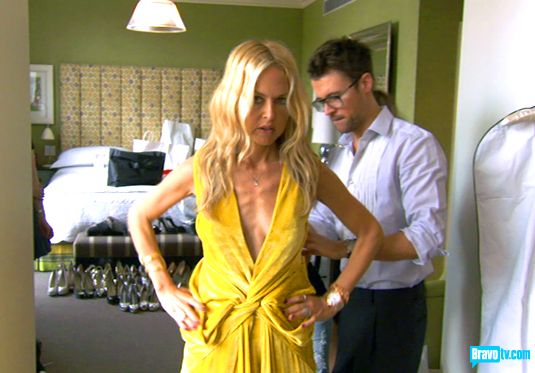
Tom and Lorenzo wind up a season’s worth of “Rachel Zoe Project” recaps with another winner. You are encouraged to check out the screen grab of the star in a dress that reveals her bony chest and the edges of her sad little fat-starved puppy-ear breasts. Her husband keeps bugging her to have a baby, but not to eat a sandwich. The body protects itself first, Rodger; I doubt this woman has ovulated in the last decade.

For the architects in the room, a WSJ column about the perils of designer buildings. I don’t know if the facts are entirely present — this is entirely out of my knowledge zone — but it echoes the experience of the Snyderman family of Fort Wayne, who once had a sexy Michael Graves house that went wrong from day one.

Speaking of celebrity architects, I met the owners of this Frank Lloyd Wright house in Detroit at a party a couple years ago, when they were still mid-restoration. Everybody seemed to know where this place was, but I didn’t, and so hadn’t seen it until the magazine story this month. Man, what a jaw-dropper. I know Wright houses are notorious for problems, but to live in a space that gorgeous would almost be worth a few leaky windows. Make sure you check out the photos.

The owners also have the best and most creative florist shop in town. Yeah yeah, I know — gay men, flower arranging, yadda yadda. But these guys are good. I remember talking to one about the difficulties in getting their early customers to appreciate the beauty of a bunch of daisies, tied in rough twine, stuck in a Mason jar. They don’t deliver out my way without a huge surcharge, which is probably for the best. I’d go broke cheering myself up.

And with that, I think it’s time to say adieu for the weekend. Our heat wave is ending. I’ll try to console myself with an apple pie.

Posted at 9:56 am in Current events, Popculch | 53 Comments
 

Clone me next.

I have a rather busy morning today, pals, and frankly, I’m a little tapped at the moment. Things will ease up after noon, but I think I’ll use the time to catch up on a little housekeeping — real, literal housekeeping — instead of blogging. Fortunately, good peanuts for the barflies today:

Fascinating: Farm boy steers his steer to a blue ribbon at the Iowa State Fair. Twice. He wins in 2010 with Doc before it’s revealed that Doc is a clone of Wade, who the same kid showed to the same title (“big steer”) two years previous. You have to be from Iowa — or Ohio — to understand how important a big championship at a big state fair can be, and while this has aspects of a joke, it was obviously intentional; the kid’s dad is president of a bovine-genetics firm. And maybe you have to have an amateur’s interest in animal husbandry, as I do, to find this interesting, but it is.

Fierce! Woman pulled over for suspicion of drunken driving walks the line like it’s a runway, demands her “Amanda rights.” Via Eric Zorn.

Fu’ u’: Via Roy, a look at libertarian thinking on the Tea Party. It all started with George W. Bush, says Steve Chapman, only it was apparently an invisible movement then. Huh. Meanwhile, Carl Paladino is a vile racist, and I’ll cut any bitch who says he isn’t. But, following Chapman’s reasoning, the GOP is “lucky” to have him.

Faboo: When your baby photo becomes a meme, better lie back and enjoy it.

Back tomorrow, with 50 percent less lameness.

Posted at 9:12 am in Current events, Popculch, Same ol' same ol' | 41 Comments
 

The dresses speak.

This is Fashion Week in New York. You might not know this, but in the Nall-Derringer co-prosperity sphere, with its alarmingly New York-centric newspaper and magazine subscriptions, it’s hard to escape. Maybe you’re feeling lost. I will try to help.

As some of you may know, I once covered fashion. Sort of. Here’s how it happened: My paper’s longtime fashion writer, June Wells Dill, a grandmotherly sort of woman who occasionally wore hats, was retiring. At the staff meeting to discuss her replacement, no one else wanted the job.

“Does it still include a couple trips to New York every year?” I asked. It did, I was told.

“OK, I’ll do it,” I said. And that’s how the big papers handled staffing, once upon a time. At least in the women’s department. And so I packed my suitcase and my portable computer — a primitive device that weighed a ton, generated a printout as you wrote and somehow managed to transmit an electronic copy of your story back to the newsroom — and went off to New York.

An aside: I required training on the computer. Because 90 percent of the newsroom travel at the time was done by the sportswriters, I was taught by our Cincinnati Reds beat writer.

“And this is how you make a quote mark. You’ll need this if the dresses have anything to say,” he said. A real wiseguy. Have you ever heard the sorts of things baseball players say? You could put that shit on a user key, only we didn’t know what a user key was, back then.

Anyway, off to New York I went. I didn’t go for Fashion Week per se, which didn’t exist in the current form. Rather, all the designers showed around the same time of year, and you ran around between their studios or whatever they had booked for their 20-minute shows. But that was for the New York Times, Women’s Wear Daily and the other bigs. Papers from Rubetown went for Eleanor Lambert’s coordinated week of shows, which was actually the forerunner of Fashion Week itself.

In my era, the event was held at the Plaza, and I sat there on the runway and got a self-taught crash course in descriptive writing. The thing about fashion is, after a while it’s just a blur. Dress dress dress suit suit suit dress dress dress wedding gown. (The wedding gown is — was — the traditional finale of every show. Does anyone do that anymore?) So I quickly learned the jargon, tissue faille and gabardine and ruching. And then I learned about the details, bateau collars and swing pleats and bugle beads. And then I learned the high-level vocabulary that everyone uses, almost all of which is meaningless and can be recombined endlessly. It’s based on a few simple adjectives, which I reveal to you now:

1) Modern
2) Sexy
3) Unconstructed / Constructed
4) Edgy
5) Retro

“It’s an unconstructed jacket with retro touches, very modern and sexy.”

“I love that edgy, constructed thing he has going on. It’s modern and retro at the same time. Which is what makes it so edgy.”

See how easy? Watch a few episodes of “The Rachel Zoe Project,” and play along. Rachel is famously inarticulate, so drop unconstructed/constructed and substitute major: “This collection is so major, so sexy and modern, I just love it.”

It’s amusing to me how often “sexy” gets thrown around, given how many clothes are designed by gay men, who have no sexual interest in women, and displayed on walking hangers with no tits or ass to speak of, parading with angry scowls on their faces, perhaps with violent slashes of neon-green eyeshadow or with their hair greased into threatening spikes. Some of these people have strange ideas of sexy.

Here’s a sexy dress, or so I’m told, one of the most famous red-carpet dresses ever, the Versace safety-pin dress worn by Elizabeth Hurley in 1994. I thought she looked like a streetwalker. Any dress you have to be glued into, that has to be minded at every minute lest your boobs pop out or your abdomen reveal a wrinkle, isn’t sexy to me. Halle Berry’s Oscar dress — that’s sexy.

But I’m getting away from my point. Oh, wait: I didn’t have one.

Can I just ask one question about Rachel Zoe, however: What, exactly, does she do for her clients that qualifies her to be called a stylist? A stylist, as I understand the job, puts together looks for you. Every time I see Rachel Zoe, she’s just shopping, swanning around fashion shows and boutiques, loving everything and name-dropping: I love this for Demi. It’s so major. She cadges free dresses, and her clients try them on, and she claps her hands. What’s her business model? How is she paid? Did Cameron Diaz finance those crackbrain shopping trips to Europe? I don’t get it. If you have the means to hire her, you should be spending your money on someone who can really help you look your best — a gay man.

Anyway, I have to go. There was a Tom Ford show yesterday, and I’m on the hunt for photos. Oh, wait — only one photographer was allowed to take pictures (which explains all these point-and-shoot pix of someone’s nostrils, with credit lines to the reporter). A fashion show with no photographers. How modern. How edgy.

Bloggage?

You know all that talk about how we’re going to have to come to grips with retiring later? Have you ever noticed how often it’s written by people with jobs like “economist” and “college professor?” A look at what work, real work, is like for many blue-collar workers, and why they can’t work until they’re 70.

Jon Stewart, last night. It’s worth watching just for his “Community Center of Death” graphic open.

I have two stories to write today. Nothin’ big — just 2,000 words by day’s end. Groan. Better get to it.

Posted at 10:23 am in Current events, Popculch | 41 Comments
 

Making more time.

The weather last Thursday was give-me-a-break hot, the sort of heat that makes you irritable because it’s already September, for cryin’ out loud and DO WE REALLY DESERVE 94 DEGREES? REALLY? Then a front blew through — and I do mean blew — and 15 minutes of horizontal rain later, it was fall. Justlikethat. The temperature on Saturday didn’t touch 70. Weirdest thing.

To me, it was perfect. I’m like a brick house at this time of year — it takes me a while to lose my heat. And anyway, it was only an early warning. Eighties again today. Then 70s, and then we march for real toward the dying of the light. At the Eastern Market Saturday I ran into Jim from Sweet Juniper. He said this was the peak weekend for the market; by next week the blueberries will be gone, then the peaches and tomatoes, and “before you know it, it’s six months of root vegetables.”

They should put that on our license plate, a special foodie edition: Six months of root vegetables. I’d buy that.

One of the things I did on my time away from the blog, and the internet, and all the rest of it was, well, two things, actually. I did some reading, and I did some thinking. I carried Laura Lippman’s latest, “I’d Know You Anywhere,” through Cedar Point, reading while the girls stood in line for the coasters. I went in with about half the book already under my belt, figuring these little intervals would be plenty to keep me covered for two days of coaster-waiting. It was not. I churned through the whole second half in one afternoon. Folks, we have a page-turner on our hands.

“Lippman’s best!” would be my blurb, but that’s just me. I think I wrote before, in discussing the disappointment of Scott Smith’s second novel (“The Ruins,” which featured an evil talking plant) as compared to his first (“A Simple Plan,” which featured evil talking people), that there’s little in life as mysterious and ultimately terrifying as the human heart, but it’s the hardest thing to write about in a world where crime fiction routinely features albino monks and deranged thrill killers. Readers who have been numbed by those “The Girl Who Owned the Bestseller List” doorstops might find Lippman’s main character, the hostage and sole survivor of a spree killer, a pale sister to Lisbeth what’s-her-name, but I ask you: What’s harder to write? A page-turner about a genius hacker who can sniff out buried urges, stage a hidden-camera rape (of herself!) to turn it to her advantage and crack the tightest computer security in the world? Or one about an average girl who survives a harrowing ordeal mostly by being sort of average?

Which is to say, Laura writes about real women in extraordinary situations, and still makes the action tense and complex. This is genre fiction, and certain tropes are expected, but they were in short supply here, or at least they felt integral to the story. An ordinary woman, behaving not like an ex-Delta Force commando, but pretty much like…an ordinary woman. And yet still you can’t put her story down. Read, enjoy, and try to figure out how she pulled it off. Not an easy thing to do.

Then I got home, and drew down my Amazon gift-card balance* with two purchases — “Freedom” and “Last Call,” both of which strike me as keepers. I read the NYT’s review of the former with my jaw steadily dropping toward my chest, and put it down thinking, jeez, get a room. But I still want to read it. I was one of those who read and loved “The Corrections,” Jonathan Franzen’s last novel, although I was equally entertained by the author’s ability to shoot his own foot off. This was the announced-and-withdrawn Oprah selection, after Franzen was a little too upfront with his ew-the-proletariat act. It was also, oddly enough, key to my first souring on post-9/11 blogger triumphalism. Jeff Jarvis wrote at the time that he’d bought the book, but couldn’t bring himself to read it in the Wake of the Day that Changed Everything, because he found blogs so much more satisfying and engaging. Show me a man who’d rather read Instapundit than Franzen, and I’ll show you a real idiot.

Which sort of leads to my second activity of the weekend — the thinking. I spent a lot of time marveling, “It sure is nice not being online this weekend.” (Although I was, but not much.) I considered how much I enjoy reading for pleasure, how refreshing it is to give your focus to lines on a page and sustain it for an hour or more at a time. Hank wrote earlier this summer about another book, “Hamlet’s BlackBerry,” that seems to capture this longing for just a little more time in the slow lane, ignoring YouTube and blogs and all the rest of it.

Hank notes:

One of my favorite things Bill wrote (and apparently one of David Carr’s favorites, too) was about the onslaught of “Did You See?” that infected our culture in the mid-2000s. (I like to write it as Didjusee?) It was about the beginning of the Internet all-you-can-eat buffet and the end of people actually reading or considering all the links they were clicking on or re-linking (now called retweeting). It no longer mattered. The question was only “Didjusee what so-and-so wrote on Slate?” “Didjusee the Lindsey Lohan video on TMZ?” “Didjusee what Mitt Romney told the Times?” Didjusee? Didjusee?

Ah, but did you read it as well? Usually no.

I want to read more. I want to write different things. I want to stop caring about viral video or what someone wrote on Slate. On today, the first day of school, the first day of Adult Summer (this still-warm, kid-free few weeks we grownups can enjoy before the weather turns for good), the beginning of a new year, it seems the right time to make a few resolutions.

So, some bloggage:

While we’re on the subject of Laura Lippman, from her own blog, a few thoughts about physical vs. digital books, and the frankly creepy digital triumphalism that has a lot in common with? See above.

Something I did not know until this weekend: There’s a film version of “The Big Valley” in production right this minute, and it almost shot in Michigan. “The Big Valley” was very popular with my high-school crowd, and yes, I guess you could say we watched it ironically. We each had a role; I was Audra Barkley, a girl too tempestuous to tame. I still occasionally run across an episode on the Western channel, and while I can see its many flaws clearly, I still think it’s a hoot and I see now why it was the embryonic gay men in my gang who singled it out — it had Barbara Stanwyck and Lee Majors, attitude and sex. The former was always ordering bad guys off her place with a shotgun, the latter posed a lot in chaps.

We had a party every Christmas in its honor — the Barkley party, cowboy hats and six-guns required. I’d suggest one for the release of the film, but alas, Jerrod and Nick are dead, Heath lives in the U.P. year-round and no one knows where Victoria is these days. That leaves me, Audra. Guess I’ll get some false eyelashes and give it a go.

And now my work week begins. Enjoy yours. Enjoy Adult Summer.

* If I haven’t mentioned lately how much I appreciate those of you who order your Amazon through my store, earning me a small kickback, let me do so now: I appreciate you.

Posted at 8:52 am in Popculch | 66 Comments
 

A millstone I call home.

Last week the roof project finally concluded with a little mop-up: A guy came out to rehang the back-side gutters and install a couple more downspouts. Now our brand-new roof will shed water efficiently. I pause to stick my finger in my cheek for a weak pop, and then I wave it in the air and say woo. Big effin’ deal.

This is new for me. In the past, I had pride of ownership in almost every repair we made, to this house and to our last house. There’s something about caring well for one’s house that’s always resonated with me, but not so much anymore. It’s true that a new roof doesn’t satisfy like a new kitchen, but it still felt virtuous, because you were adding to your home’s resale value and maintaining the property, which reflected on the neighborhood and made everyone rest a little easier at night.

But our real estate market can be explained in a headline which I swear I’ve read 400 times in the last five years in the local weekly: Has the market hit bottom? The answer is always the same: Maybe. The answer is always wrong, because the correct answer is: No. So putting a roof on my house, which used to feel like forgoing a new dress to put the money in the bank, now feels more like tearing up hundred-dollar bills and throwing them into a flushing toilet. And as long as we’re reading the Obvious News, it seems I have lots of company.

When this recession is over — if it ever is — and the historians start to sort it out, I don’t think anything will be as important, in the long run, as what it did to real estate. It’s still my main disappointment with Barack Obama, that he didn’t launch a big show trial on Jan. 21, 2009 that would have marched the Wall Street shitheads who wrecked the housing market before a tribunal of foreclosed and washed-out homeowners and a judge that was a combination of, ohhhh, Al Sharpton and Judge Judy, say. His gavel would be oversized, and he’d be welcome to use it on both his bench and the defendants’ heads. A guillotine would be right outside the courtroom, and we’d use it until the rope broke and the blade dulled.

That, at least, would show we take the damage these people did seriously. People who don’t own houses or apartments get a little impatient with this, and I guess I don’t blame them, but trust me: This crash hurts everyone, owner or not. For those of us who don’t live in the places where the middle class are shut out of owning real estate — which is to say, most of the country outside of New York City, San Francisco and much (but not all) of Los Angeles — our houses are the most expensive thing we own, and are far more than a place to lay our weary heads and store our record collections. The sale of my parents’ house provided half their retirement stake. They were of the generation that saved up for a down payment, shopped carefully, bought and stayed put. No flipping or trading up for them. Three bedrooms, 1.5 baths, bought in 1962 and sold in 1995, paid off and worth seven times what they paid for it.

My generation was different, but not Alan and me, so much. This is our second house, in our second city. I pay extra principal on our house every month, although God knows why. Optimistically, it’s worth half what we paid for it. Recovery of our purchase price might be 20 years off. The Detroit Metro has special problems, to be sure, but the whole country is sweeping up this wreckage, and I will never forget who caused it. (Hint: It wasn’t Barney Frank.)

For years, for practically ever, real estate was the safest investment you could make. My mom started bugging me to buy a condo as soon as I had a full-time job. You couldn’t lose. Everybody pays something for housing, after all, and you might as well pay yourself, plus the mortgage interest is tax-deductible. And housing always went up. It didn’t rise at the redonkulous rates of recent years, but a steady 1 to 3 percent was a given.

And while I may be overstating the virtues of ownership, I still firmly believe that a neighborhood of owners is, in the broadest terms, better than one of renters. When you have a financial stake in something, you pay more attention to it. You care if the local schools are good, even if you don’t have children in them. You don’t like it when your neighbors let their lawn go to prairie (unless everyone else’s is prairie, too). You keep the walks swept. It’s the broken-window theory on a less dramatic scale, and for generations, it worked.

But that’s only part of it. Local governments rely on property-tax revenues to provide services. When property values slide, so do tax receipts. We’re only beginning to see these problems, cities letting streets go or not replacing lighting or laying off firefighters. And how long did I say it might be before recovery?

When you think about it, pretty much everything in our economy is predicated on the idea that we’ll always be growing. (Certainly our health-care costs have done that.) A few flat years we can handle. But a full-on retreat, a crash? This is new for me. Last week our boring old city council got a little testy over some penny-ante travel for the city clerk, nothing big, but one of the members grumped that they were looking at another enormous shortfall the following year, and nickels and dimes add up. I can’t imagine what they’ll be fighting over in three years. Probably which one gets to quit first.

My house, my millstone. But with a nice new roof.

So, a little bloggage? Sure. Scott Rosenberg at Salon looks at a phenomenon I’ve been seeing in my news searching for a while now: The content farms have gamed Google. Don’t be evil!

“I think his dad’s bought them off, sometimes. He’s practically selling dope out of the trunk of his car. I have to give him one thing, though. Watching his personality disintegrate made me give up pot for good. Well, that and the fact the shit makes you so fucking retarded these days. The last time I smoked was spring last year. I was so paranoid I walked out of the house and hid in that big wall of shrubs by the sorority house. And the girls started that goddamn singing. ‘Together forever. Together forever.’ Do you have any idea how much that sounds like you’re eavesdropping on some kind of blood sacrifice?”why I added Coozledad’s blog to my RSS feed. I was missing too many of these, or discovering them days later.

Another great Tom-and-Lorenzo Mad Style entry, this one on Francine Hanson, played by the sublime Anne Dudek.

I’ve taken a casual interest in Stephanie Seymour ever since Alan and I discovered the “November Rain” video on MTV. One of us would always say to the other, “She dies in the end.” Today, the NYT did a silly-season Sunday Styles front on the disintegration of her marriage to Peter Brant, described as “a taller, more dashing version of Buddy Hackett.” Her “November Rain” role was described thusly: “she portrayed a bride who dies.” Everyone remembers her!

So have a great Monday, all. Mine will, as usual, be busy.

Posted at 1:11 am in Current events, Popculch, Same ol' same ol' | 52 Comments