And justlikethat, we’re into birthday season. The birthday twins will be celebrating later today, and I have to get up and start cooking in a bit, so until then, let’s have a little fun.
And play Connections!
Which may be entirely unknown to those of you who don’t have NYT subscriptions, but let me just say: The Times is killing it in their Games section. It’s not just the venerable crossword puzzle anymore, but an expanding array of phone-friendly games like Wordle, Tiles, Spelling Bee, Letter Boxed and Sudoku.
But Connections is my new fave. It looks simple: Take a tiled array of 16 words and divide them into four groups. Here’s a recent one:
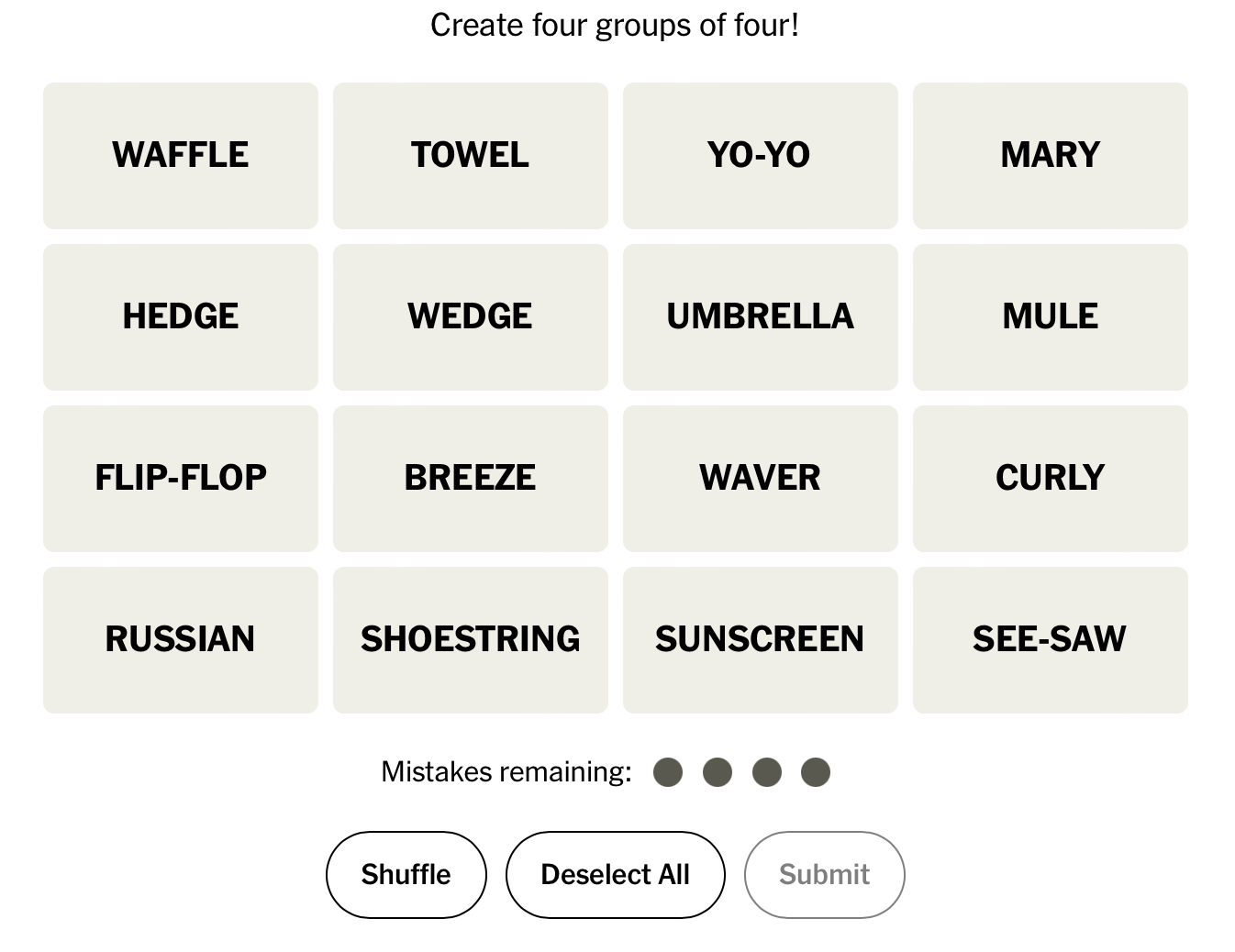
The groups are color-coded: Yellow, green, blue, purple. Yellow is the easiest level, purple the trickiest. You get four mistakes, after which you’re locked out until the following day. I almost always solve it, and as I’ve gotten better at it, I’m starting to hold myself to my own standards — zero mistakes, maybe, or getting blue or purple first. But as you can see looking at these 16, you have to consider which words might have more than one meaning, and might belong in multiple categories. “Waffle,” for instance, could belong with “waver,” as the two are synonyms in one sense of the word. It might also go with “hedge,” when you think about it — they’re all ways of putting off a firm decision.
But that’s for the easier levels. The key to getting a difficult level first, I’ve found, is to pick a word that seemingly has no similarities with anything else, and then bear down. On this one, I did pretty well once I started thinking about the apparent outlier “Russian.” Once I connected it with “bloody” and “mule,” I was home free. This is how I solved it:

As you can see, “hedge” and “waver” did go together, but not with “waffle.”
Anyway, it’s a fun thing to knock out over your second cup of coffee. Always the second — I’m still fuzzy until the first hits home.
Since we’re nearing the end of the month, let’s do some gift links to other NYT content. Here’s an interesting column about the why-aren’t-people-marrying-anymore conundrum that looks at it from the ground level:
On the rare occasions that women are actually asked about their experiences with relationships, the answers are rarely what anyone wants to hear. In the late 1990s, the sociologists Kathryn Edin and Maria Kefalas interviewed 162 low-income single mothers in Camden, N.J., and Philadelphia to understand why they had children without being married. “Money is seldom the primary reason” why mothers say they are no longer with their children’s fathers. Instead, mothers point to “far more serious” offenses: “It is the drug and alcohol abuse, the criminal behavior and consequent incarceration, the repeated infidelity, and the patterns of intimate violence that are the villains looming largest in poor mothers’ accounts of relational failure.”
But it doesn’t take behavior this harmful to discourage marriage; often, simple compatibility or constancy can be elusive. Ms. Camino, for her part, has dabbled in dating since her partner left, but hasn’t yet met anyone who shares her values, someone who’s funny and — she hesitates to use the word “feminist” — but a man who won’t just roll his eyes and say something about being on her period whenever she voices an opinion. The last person she went out with “ghosted” her, disappearing without warning after four months of dating. “There are women that are just out here trying, and the men aren’t ready,” she told me. “They don’t care, most of them.” Who, exactly, is Ms. Camino supposed to marry?
With that, I gotta get cookin’. But first, today’s Connections. Happy week ahead, all.