Gratitude adjustment.

theguys.jpg

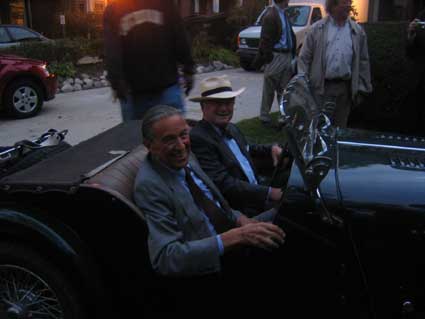
When I win my Oscar, or my Pulitzer, or Peabody, or Chamber of Commerce Parent of the Year (third runner-up), or whatever lies in my future, I have to thank these two guys. Of course we’d all have to live to 150 for that to happen, so the Knight-Wallace Fellows spent much of the weekend thanking them anyway, for what they gave us and what we still hope to give back.

The highlight of the weekend was the giant Introduction of the Fellows. It took forever, but it was worth it, the microphone passing around the room and all 200 or so of those assembled telling everyone what we did at Michigan, what we ended up doing after and how the former helped the latter. And you know what? It was inspiring.

These last few years have been grim in journalism — newspapers cutting off limbs, television news descending into WWWA-TV, the usual platter of miseries — but journalism is as important as ever. More important, even. And there were a lot of horror stories; “I went to Ann Arbor for a year, and all I got was my job eliminated” was not a unique storyline. But by and large, those people landed on their feet, doing things differently, doing things better. A pox on corporate journalism, but dammit, we may pull through after all. The stories were wonderful: A network producer goes independent. A demoted reporter goes back to school. An editor starts a foundation. A writer becomes a documentary filmmaker. A columnist becomes a novelist. A TV guy becomes an entrepreneur.

Entrepreneurs were everywhere. That was the theme of the weekend — going unilateral. Stickin’ it to the Man. But still, doing it better than the Man ever dreamed of.

So thanks, Charles (Eisendrath, the guy in the hat, director of the program) and thanks, Mike (the other guy). I had the time of my life, and continue to do so. Every day is a winding road; long may you drive.

Posted at 6:14 pm in Media | 2 Comments
 

Does this make me look fat?

I love when I can spot myself, unnamed, in someone else’s writing:

Fort Wayne Observed and Indiana Parley allow Harper to satisfy his desire to comment on politics, government and local oddities, and both daily newspapers offer blogs by staff members. But many other blogs are embarrassing exercises in pointless narcissism.

Gotta love it.

Next aspiration: To be a thinly veiled character in a Lance Mannion short story! Give me long legs and a nice ass, Lance.

Posted at 12:48 pm in Media | 25 Comments
 

Broadcast history lite.

OK, so I’ll admit it: I watched approximately 180 seconds of Katie Couric’s debut newscast. It so happened I had just started dinner — that is, ordered a pizza — and had about five minutes to put my feet up. I was in a room with a TV, there was the remote, and thanks to the momentous publicity blitz, I recalled that I could, at that very moment, watch some “historic” television.

So I did. For three minutes. History just ain’t as thrilling as it used to be.

If my current viewing patterns are any indication, I’ll next watch Katie in 2015. I hope she has a nice career.

Really, though, do you watch network news? How often do you have the magic combination of time and opportunity to sit down and get your news the way Walter Cronkite used to deliver it? For me, the answer is “pretty much never.” I don’t keep a TV in my kitchen, which is where I usually am at 6:30, but I do have a radio there, and have NPR on at that hour. If any glowing screen comes into my kitchen, it’s my laptop, and I guaran-damn-tee you it’s not running network-news video broadband.

I don’t know about you, but I suspect I’m fairly typical. Others are still commuting home from work, having an end-of-day run/yoga session, mixing cocktails or doing anything other than sitting in one place and allowing a handful of network producers to select their day’s information.

So, that said, is there anything that marks newspapers as network news’ dance partner in the fading sunset of a general-interest media universe more than the obsessive attention paid to this titanic non-story? I’m saying…no.

And the Photoshop diet? This just in: Marketing departments preparing photos of marketable celebrities frequently apply digital-retouching techniques to make sure they look as good as possible. Stop the goddamn presses.

UPDATE: J.C. has a timeline demonstrating the content/breaks ratio. (And more thoughts, from a much more informed perspective.)

OK.

Jury duty: How I longed for a better experience. But it was pretty much like jury duty everywhere, in that I sat in a sweltering room in the Frank Murphy Hall of Justice with 300 other citizens for four hours before we were all turned loose. We watched the standard how-our-court-system-works video, then “Men in Black” for amusement. We were called in groups to courtrooms, only to be told the case was settled or the defendant took a plea or the lawyer decided to extend his Labor Day holiday by 24 hours. Although I never got called. I read the New York Times, then prepped for my afternoon interview, then read Kenneth Turan’s latest collection of movie reviews, which Alan took off the anybody’s pile at work. Is there anything more perishable than a movie review? Not much, and yet I read and read and read, because movie reviews are a) easy to chew; and b) I’d finally seen most of the movies in question. It made me want to see “Mystic River” again, and I decided anew that, in the bout between “Million Dollar Baby” vs. That Moron Michael Medved, it’s a first-round KO.

Kate went back to school yesterday. I have a to-do list the length of my forearm today. Better get to it.

Posted at 8:40 am in Media, Movies | 30 Comments
 

Going native.

bilde.jpg
Homegirl Kate Moss, waiting for the rebound

From the Department of Well at Least She Can Score Some Good Drugs Here comes the morning’s gem:

Guess which local municipality is the recipient of an extraordinary valentine in the September issue of W magazine? “Detroit is coming back, reborn as one of the most vibrant cities in the world,” proclaims W, the chic fashion monthly published in New York.

And here I thought fashion-magazine lies were confined to touting anti-aging formulas that turn back the clock.

But no, this is W, which is no mere fashion magazine. The salute to Detroit — and please, note the razor wire on the fence behind Kate in one of the most vibrant cities in the world — comes as part of a 54-page spread, which is sort of W’s signature. They were the ones that brought you that weird Brad-and-Angelina photo thing, in which they seemed to be impersonating a ’50s couple who hated one another. Then there was the similiar-size Madonna thing a couple months ago, a tryout of the costumes from the equestrian portion of her current show. (I was looking at those photos online while IMing with a guy in San Francisco, who was doing the same thing. “What if Madonna f*cked a horse?” he wondered. “Would anyone care?”) Both were sort of the ultimate statement on fashion-magazine editorial copy, in the sense that they contained little useful information — captions, location notes, where-to-buy info. Just pictures: Here’s a horse. Here’s Madonna regarding the horse lustfully. Here’s Madonna lying down on the horse, smoking a cigarette. (Which led to the what-if question.) Now we have 54 pages on Detroit, an equally strange choice to devote that much editorial space to. Although, it seems, there is amusing copy to go with it:

“I don’t know who I’m more in love with, Kate Moss or Detroit,” (photographer Bruce) Weber is quoted as saying in a short bio.

I guess there are some fashion facts in this layout, but on the whole, it just seems creepy. The Metro Times is not amused, and makes some very good points along the way.

It’s an all-media bloggage bouquet today: Local press critic Jack Lessenberry on the decline of the Detroit dailies.

And some comic relief, via Mitch Harper via Gawker, demonstrating that when it comes to being provincial, no one quite does it like Indianapolis. That’s a restaurant review, and from the headline (“Ooh la la”) to the little details (the critic notes each table has its own “brass pepper grinder”), it’s a delight. I shouldn’t spoil the surprise, but for those who won’t click through, I have to single out this:

The menu has many words in French, my undergraduate minor. But it’s been a while, so I asked a waitress for a few interpretations. It’s lucky I did. Otherwise I might have accidentally ordered goose liver pate as an appetizer.

Heavens to Pierre!

Posted at 10:35 am in Media | 18 Comments
 

Read Tess.

I suppose, having left Laura Lippman’s latest over there on the nightstand for so long — I finished it weeks ago — I oughta say something about it. Laura reads this blog, pops in once in a while, and generally offers good advice when asked and anyway, I wrote about “The Ruins,” so I should also write about “No Good Deeds.”

For me, it’s the old praise/pan problem. Pans are easier, and “No Good Deeds” deserves praise. High praise. It’s the Best Tess Yet — Tess being, of course, Tess Monaghan, Lippman’s serial character. (She’s been writing so-called standalone mysteries every other book, in recent years.) I used to think the best thing about mysteries and crime fiction was, they didn’t ask too much of the reader and so we wouldn’t ask too much of them. That was a long time ago, before I read Elmore Leonard and John D. MacDonald and Martin Cruz Smith and any number of cut-above genre novelists. I didn’t realize how accustomed I’d become to good mysteries until I read a bad one, which I did this week: “The Abortionist’s Daughter.” Great title, lousy everything else. I guessed whodunit not long after the character was introduced, flipped ahead to confirm my suspicion and took my time getting through the rest of the story. I put it down whenever it got on my nerves or required a suspension of disbelief I didn’t want to make, and the last one made me put it down for good. Every so often I want characters in fiction to break the fourth wall and speak the truth; I wanted Lt. Sipowicz on “NYPD Blue” to tell his little boy, “Mommy died because she got the lead in a sitcom next season,” for instance. The only thing that could have saved “The Abortionist’s Daughter” for me would be for one of its characters to say, “Hey, who left all these herrings lying around? And why are they all red?”

So, back to Tess, and Lippman. I guess it’s common knowledge that Lippman is the best girlfriend of David Simon, the executive producer of “The Wire,” and everything critics say about him when they’re tripping over themselves to top last season’s superlatives can be said of Lippman, too: She doesn’t make up stories so much as she reveals what makes stories happen. That is, her genre is as much social realism as it is crime, and “No Good Deeds” is her most successful so far at demonstrating how the characters got where they are — how Tess’s boyfriend, Crow, happened to bring home a street kid he met working a flat-tire scam outside a Baltimore soup kitchen; how the street kid happened to have knowledge of a recent murder of an assistant U.S. attorney; how the people investigating that crime do their jobs; and, of course, because Lippman was a victim of clueless newspaper management, how those stories get covered in the proverbial first draft of history. (I don’t think I’m giving anything away to reveal: Not very well.)

I don’t know what you look for in fiction, but for me as a reader, one of the deepest satisfactions is watching a writer get better over time. Tess’ stories keep getting better — more involved, yes, but not ridiculously so. Just deeper and more satisfying. There’s still a long weekend of summer left. You could do worse than to spend it with Tess.

Posted at 2:38 pm in Media | 6 Comments
 

Snakes in a drain.

A few months ago, in my neverending quest to bore the crap out of every last reader I had, I mentioned I was having slow-drain problems. All slow-drain problems, in my experience, go back to a single source — hair. Maybe in some specialized environments (Jame Gumb’s basement, a morgue) they have other causes, but in a house with two women, you can pretty much count on what you’re going to find when you go a-plumbing.

Our long-haired reader and correspondent Mindy suggested that I buy myself a gadget called a Zip-It, that it would spare us much grief the next time the drains ran slow. It so happened that this weekend the planets aligned and gave me slow-running drains and an errand to an Ace hardware store, sole distributor of the Zip-It, according to Mindy. I snatched one up for $2.99. It’s a long (18 inches or so) strip of flexible plastic with sharp teeth pointed upward. The directions were simplicity itself: Insert into drain all the way to the hilt and remove. No twisting, fiddling or other technique required.

I got it home, stuck it in the drain and pulled it out. With it came an enormous wad of greasy hair. Halle-freakin’-lujah. I disposed of the repulsive nodule in the toilet and turned on the water to rinse away the rank drippings.

Within seconds, the water backed up. Where before the drain was running slow, now it wasn’t running at all. Further attempts with the Zip-It were fruitless. Apparently my removal of one clog had dislodged another one, out of its reach. I considered several options, including calling Mindy to tell her this amusing story. Instead I told Alan. He fetched a drain snake — which I didn’t know we had — and stuck it down the drain. He reported finding one obstruction at three feet and another at five, and now the drain is clear again.

The moral of the story is: Mindy is a long-haired LIAR. What works for me may not work for you. Although Alan says we should keep the Zip-It and give it another try. He was intrigued by reports of its apparent initial success, as illusive as it turned out to be. Who knows — maybe a regular poking with the Zip-It will keep the drain snake in its hole the next time.

Bloggage:

Tim Rutten at the L.A. Times has a theory about the Reuters photo doctoring I hadn’t considered, but makes sense the more I think about it: Blame the bean-counters. Works for me!

When the New York Times publishes a report from Indiana, of course I’ll pay attention. But this thing made no sense to me at all.

This week’s going to be tops in busy. Partly cloudy, chance of no-shows here and there.

Posted at 10:46 am in Media, Same ol' same ol' | 39 Comments
 

Our friends succeed.

Congratulations are in order for my young Fort Wayne friend Zach Klein, who has achieved the American dream at the tender age of 23: Selling his new-media internet company to deep-pocketed old media — story here — for big, big bucks. Selling price undisclosed, but you can bet there are many digits to the left of the decimal point. Enough that he will be buying the drinks next time, and every time until I get bought out by Barry Diller, too.

I met Zach when he was still in college and we were two of the very few bloggers in town. He was home from Wake Forest for the summer, interning at Lincoln National (and not liking it too much). We had our own Meetup, at Chili’s on Coliseum Boulevard. We had margaritas, which I think were purchased illegally, because Zach was not yet 21. It’s not every day that I get the opportunity to contribute to the delinquency of a minor at my age, so you can see why I remembered it.

I have to say, his company’s main site, CollegeHumor.com, gives me the willies. In my day, when we wanted to humiliate someone who was passed out drunk, we just took a photo — Sharpies never entered the picture. (Please don’t get me started on The Shocker.) And yet Zach is the guy for whom the phrase “what a nice young man” was invented. He stopped after one margarita at our Meetup. I don’t think he even owns a Sharpie. Although maybe he’s just continuing the long young-person’s tradition of bullshitting his elders. It’s entirely possible.

Zach’s blog. His Flickr page. His Vimeo page, another of his startups. Invest early.

UPDATE: Oh, and not to pile on, but Fort Wayne Observed takes note of what my ex-employer thought this story was worth. To recap, this is a local kid (now lives in NYC, but parents and siblings still in the Fort), about to become a multimillionaire at 23, previous stated interest in becoming a patron of his hometown’s worthy causes, background story on file and winner of the newspaper’s own high-school scholarship competition six years ago. This story was, wait for it … a one-paragraph brief in the business digest. The other paper wrote nothing. Well, Zach always was modest.

More bloggage today:

Another friend sent me a link to one of his friend’s photos — you know, we should start an internet networking site…oops, Zach is already hooked up with one of those, too… — of the Gay Games, last month in Chicago. Endlessly fascinating stuff — ballroom-dancing lesbians and no-surprise-there bodybuilders, and my personal favorite: Brokeback Mountain on ice. A great gallery. Enjoy.

Posted at 11:24 am in Media, Same ol' same ol' | 8 Comments
 

Jeane Kirkpatrick’s wrinkles.

I once walked in on a news photographer printing a picture, back in the pre-digital olden days. The photo was of Jeane Kirkpatrick, Ronald Reagan’s U.N. ambassador. The photog printed the picture several times while I was there, burning and dodging with his fingers, messing with the contrast, goofing with this and that. Finally I asked him what was the big hoop-de-do over what was, after all, a glorified headshot.

“I’m trying to make her look more wrinkly,” he said. “I hate her.”

Huh. Ohhhh-kay. We all have our own ways of wasting time at work — you’re reading one of my favorites — and this seemed to fall somewhere in the midrange of the what’s-the-point scale. If you click the link above, which includes a photo of Kirkpatrick from roughly the same era, you’ll notice several things about her, among them a) she’s no spring chicken, and b) she wasn’t exactly Heidi Klum to start with. She was then nearly 60, and looked like what she is — a public intellectual with a low-maintenance hairdo and no patience for elaborate makeup rituals, unafraid to look her age because she didn’t live in the mirror, but in her mind. I don’t share many of Kirkpatrick’s views, but hey, we can always use more women who don’t give a fat rat’s ass what In Style says about them.

I’m trying to figure what the chances are that some impressionable soul read the story about Kirkpatrick’s speech, looked at the photo printed to enhance her wrinkles and said, “You know, if neoconservatism has no room in it for decent skin-care products, it has no room in it for me.” I’m thinking it’s pretty low. In this, it has approximately the same impact as the infamous Reuters photo that’s the subject of this Slate piece.

The link will take you to both photos, side-by-side — the original picture of a smoldering Beirut skyline, and the one Reuters transmitted to its clients, with the smoke darkened and made a little more bulbous through the clumsy use of Photoshop’s clone tool. This was discovered by bloggers earlier in the week, and made much of.

I dunno. I looked at both pictures and thought: Um, why? That Beirut was bombed is not in question. That smoke was rising was not in question. The smoke was a fact, like Jeane Kirkpatrick’s wrinkles. How many people would look at the smoke-enhanced version and say, “Well, this changes everything.” Again, I’m thinking it’s something like zero.

The rest of that Slate article points out the obvious: That every photo is a lie. This is a duh revelation if there ever was one. Haven’t you ever arrived at a vacation spot and thought, “It looks nothing like the pictures”? Haven’t you ever taken a photo and said, later, “It didn’t look like this”? Hell, haven’t you seen a photo of yourself lately? I look in the mirror and I see the same me I saw 25 years ago. Photos would suggest things are different now. Damn photos.

After years of this, I’ve come up with a pretty simple explanation: A photo is a fact, but a fact is not the truth.

It applies to most of the rest of journalism, too: A story is a collection of facts (or better be). It’s not necessarily the truth.

If you had nothing better to do, you could spend the rest of the year researching the ethics of photojournalism to know why, exactly, it was wrong to enhance Jeane Kirkpatrick’s wrinkles for personal reasons. And you could spend the rest of the next five years writing a book about the truth and lies of photography, but you might as well give up now, because Susan Sontag pretty much covered that waterfront already.

I pity photo editors these days; Photoshop has rocked their world in a million ways, many of them unwelcome. Good Photoshoppers can use the software to make so-so pictures better, good pictures great and every picture a potential firing offense. So many decisions seem so innocuous — a photographer took a Diet Coke can off a coffeetable in a news picture a few years ago, and whole forests had to die to accommodate all the fulmination. Meanwhile, the standards are different everywhere. I work mainly in magazines now, and if you tell a magazine photographer he can’t add or remove things from a picture he’ll quit on the spot; digital manipulation is as necessary as pretty models.

I guess what most interests me about this case is the essential irony of it, which is the same that lies at the heart of the Jayson Blair/Stephen Glass scandals, too — that some people want to be successful journalists so badly that they’re willing to commit the single unforgivable sin in journalism, the one that closes doors forever. That is, to step outside the facts/truth model into the bullshit/lies realm. Even before it was discovered to be a fake, that picture of the roiling smoke was small change. And yet.

Posted at 2:29 pm in Media | 22 Comments
 

Pottymouths.

Was droll Jim Romenesko having a bit of fun when he wrote this item? I think so:

Tori Daugherty’s complaint about the cursing in “All The President’s Men” got two grafs in Deborah Howell’s WP ombud column Sunday. The Fort Wayne News-Sentinel devoted 22 grafs to the 15-year-old girl’s appearance in the big-city paper.

Here’s the WashPost column. Here’s the 22-graf story-about-the-story. Here’s the part I noticed: A teenager is interested in working in journalism, but not if people are going to talk the way they did in “All the President’s Men.”

“I find it ignorant that a person who writes and a person who uses language would use language in that way,�? she said of the journalists portrayed in the film.

The story is unclear, but the chain of events seems to be: She saw the movie in journalism class, and brought her case for its offensiveness before the principal first. Unsatisfied, she then wrote to the Washington Post, demanding answers, because she’s considering journalism as a career but “I don’t want to be around (that kind of) language a lot.�? The ombudsman thought her letter was adorable and patted her wee head:

“Yes, Tori, many journalists curse,�? Howell wrote in The Post. “They curse when their computers break down, when people lie to them, when they make mistakes and when they’re on deadline. But usually, they’re nice to people…Please don’t think that cursing is a prerequisite to be a journalist. A promising young journalist who does not curse would be a welcome addition to any newsroom.�?

Awww, how sweet. When I read that, I knew that not only does young Tori have a future in journalism, she’s management material. In fact, she might as well just bypass the newsroom entirely and go straight to an endowed chair at the Poynter Institute. And then, as these incidents frequently prompt me to do, I took a trip down Memory Lane.

(Gilligan’s Island-style swimming-screen effects here.)

We had a girl like that in our college newsroom. She was a transfer, from a small Catholic girls’ college that couldn’t take her all the way to a journalism degree. Catholics speak of “formation,” the molding of souls and intellects and the rest of it, and this girl was well-formed, in more ways than one. You could have balanced a demitasse cup on her head all day, and it wouldn’t wobble. I recall her face held one expression, which suggested she had just smelled something offensive. And she had many opinions about her new school. I only recall one: That the deadlines in journalism class were impossible. The newswriting class was 90 minutes, and the way the drill usually worked, you got an assignment in the first half-hour, and then had an hour to write your story, due at the end of class. This was simply ridiculous, in her opinion; the nuns gave you a week. (Of course the class was structured this way for a very good reason — the ratio of assignments-that-must-be-finished-in-an-hour and those-that-must-be-finished-in-a-week is, for a beginning reporter, pretty lopsided. So you might as well get your practice before your paycheck depends on it.)

This was in the days before people felt the need to inform total strangers of their sexual history, but I’m pretty sure she let us know she was wearing the letter V and would be until her wedding night.

And the punchline: She was a faultless beauty. Blonde, clear skin, fine features. She could have stood toe-to-toe with Grace Kelly and not blinked.

She disapproved of swearing, too, which is probably why she wore that expression all the time, because the walls of our college newspaper office were covered with graffiti, much of it obscene. (There was a list of euphemisms for masturbation that covered a quarter of a bathroom wall and may have been the root cause of her distress, as it included the phrase “polishing the bishop.”)

Anyway, I don’t know if this story has a point or what, but as I recall, she really, really didn’t fit in, which could say as much about us as her — we were all pretty insufferable back then. But she still found a career in journalism. Believe me, I was shocked to discover this, but a few months ago I got an e-mail from my friend Deb, who as a fellow Catholic-school transfer took a particular interest in her, informing me that not only was our former classmate gainfully employed, she was …wait for it… a columnist.

I looked up her portfolio. She still disapproves of many, many things.

So be not discouraged, Tori. I’m sure your path through the dirty-talking portion of the newspaper business will be straight and swift. Columnists frequently have doors they can close and lock. Better yet, many work from home.

Bloggage:

I never liked Joe Lieberman. I never understood the need for Gore to choose a “values candidate” after Clinton, as the voters had pretty overwhelmingly demonstrated that they considered what Clinton did forgivable. (If you were one of those upset by Clinton’s shenanigans in office, consider the alternative. Doesn’t seem so bad now, does it?) He always had that listen-to-me-the-orthodox-Jewish-sage thing going on, but in the end, a veep is always a shrug issue, for a voter — what can you do? No one votes for a veep.

I like him even less today. John Scalzi sums it up pretty succinctly.

I read Nora Ephron’s “I Feel Bad About My Neck” yesterday. I would add it to “On the Nightstand,” but it never made it that far; I realized I’d read most of it before in various magazines, and the parts I hadn’t read I consumed while making dinner. Wide margins, generous line spacing, not very thick to start with — you know the drill. That didn’t make it unenjoyable. I will always enjoy Nora Ephron’s essays, no matter what. When I was in that graffiti-smeared college newsroom, Ephron was my role model, and still is, in many ways. Her deft touch is one I’ve aped all my writing life, and I’ve never forgiven her for stopping for so long, to make all those awful movies (with the exception of “When Harry Met Sally…”). I guess she had her reasons.

That said, there’s no single essay in here that comes close to the best of her earlier work, but ah well, the book’s about aging, so you can’t really expect it, can you? Still, very enjoyable. You could do worse.

Posted at 12:43 pm in Media, Same ol' same ol' | 22 Comments
 

P.S.

My ex-congressman is STILL a moron. He’s quoted reacting to last month’s story about the Department of Homeland Security’s potential-target list, a little late but nonetheless dim as ever: “This is all about money,�? said U.S. Rep. Mark Souder, R-3rd District, suggesting the New York Times’ July coverage of the alleged terror target list reflected a desire to secure more Homeland Security funds for large Eastern cities by “mocking the rest of America.�?

Yes, that was certainly its intent, don’t you think? Damn the New York Times for thinking New York should get more money for homeland security! There is surely no earthly reason to believe “large Eastern cities” should get more attention from the federal government than Amish popcorn factories in his district, is there?

I mean, is there?

Posted at 12:05 pm in Media | 37 Comments