Ron’s series continues. Today’s focus is Big Pharma:
When General Motors Corp. CEO Rick Wagoner has nightmares, they might be about Toyota. Then again, they might be about Mae Gumbinger.
The 79-year-old wife of a GM retiree in Port St. Lucie, Fla., takes 15 prescription medicines each day. She takes Plavix to thin her blood and Mincandis to lower her blood pressure. She swallows Namenda and Aricept for her memory, Clarinex for her allergies and Nexium for her stomach. One pill helps her sleep, another pill cuts her pain, and six more prescriptions are supposed to help with a skin condition she’s had for years, though she can’t remember what the skin condition is and she’s pretty sure the drugs aren’t helping.
General Motors will pay about $16,000 for drugs this year for Mae and her husband, GM retiree Ralph Gumbinger, the equivalent of giving the couple a new Chevrolet Malibu.
The story is full of little jaw-droppers; every story about GM is full of jaw-droppers. Most Americans simply don’t understand just how big this company is, which is the underlayment for a certain what-can-you-do attitude you find around here among GM workers (most people) and those whose fortunes are tied to it (everyone). The company is the Nimitz, a giant aircraft carrier plowing through heavy seas. It can take a few torpedoes. If it can’t exactly turn on a dime, well, it’s unsinkable too.
Or so people believe. Please, no Titanic jokes.
Anyway, those jaw-droppers: GM spends $17 million a year — $17 million! A year! — on erectile dysfunction drugs. Sixty percent of the money spent on antibiotics is flushed down the toilet, because they’re prescribed for conditions that don’t respond to antibiotics. In 1999, seven years ago, half of GM employees were getting name-brand drugs, even when generics were available. The introduction of a generic equivalent for Zocor, a cholesterol-lowering statin drug, presents the opportunity for GM to save $100 million a year.
(Again: $100 million. For one drug. This is one big company.)
The passage about Zocor is unclear, but seems to imply that workers have a choice to switch to the generic; “education and financial incentives” are the plan to get more of them to do so. How about this for a financial incentive: Switch to the generic or pay for it out of your own pocket, bub. I’ve had drug plans like that, and I know they’re out there. The day Zocor went off-patent earlier this year, pharmacy benefits managers all over the country were on the phone to the generic drug plants in India at 12:01 a.m., wondering when those pills were going to start rolling out, and how soon could they get them. When $100 million is at stake, you play hardball.
Unless of course, the choice is part of a labor contract, which is entirely possible. Defiance, Ohio, my husband’s hometown, is a GM town, and its retirees are common in my mother-in-law’s social circle. They whine like toddlers over the idea of a $5 co-pay for prescription drugs, because they used to pay nothing, and now they have to pay something.
As this NYT column points out, Most families in the 1950’s paid their medical bills with ease, but they also didn’t expect much in return. After a century of basic health improvements like indoor plumbing and penicillin, many experts thought that human beings were approaching the limits of longevity. “Modern medicine has little to offer for the prevention or treatment of chronic and degenerative diseases,�? the biologist René Dubos wrote in the 1960’s.
But then doctors figured out that high blood pressure and high cholesterol caused heart attacks, and they developed new treatments. Oncologists learned how to attack leukemia, enabling most children who receive a diagnosis of it today to triumph over a disease that was almost inevitably fatal a half-century ago. In the last few years, orphan drugs that combat rare diseases and medical devices like the implantable defibrillator have extended lives. Human longevity still hasn’t hit the wall that was feared 50 years ago.
Most of those retirees, once upon a time, would have taken their gold watch, shuffled off to Florida, played a little golf and quietly expired by their 70th birthday or thereabouts. Now they’re living to vast old ages, helped along by technological and pharmaceutical wizardry. Now it’s time to pay. Especially if you’re taking drugs for restless legs syndrome.
Oh, well. Don’t want to bore you all silly.
Last Saturday was a fine, sunny one, and I spent my Saturday bike ride stopping at garage sales. (Does this negate the aerobic exercise? I choose to believe it doesn’t.) Scored a nice cut-glass wine coaster and a silverplate serving piece, seen here:
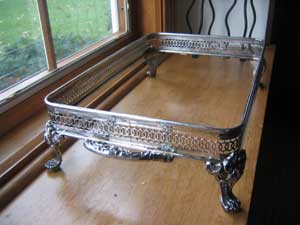
It holds a 9-by-13 baking dish; you can practically see the potatoes au gratin in it now, can’t you? It was black with tarnish, and as you can see, a little elbow grease works wonders. I paid $6 for the two items, and overheard a conversation among the proprietors:
“Can you imagine? He offered me a dollar. I told him, ‘I would rather throw this away than let you have it for a dollar!’ He made me so mad.”
This is not a useful attitude to have in business, is it? Certainly not in garage sales. The bargain in a garage sale is simple: You offer crap you don’t want anymore, in hopes that others will not consider it crap, and will pay you a little bit of money for it. “A little bit of money” — this is the garage-sale bargain, at least my garage sales. You can set your prices wherever you want, but you’d better be willing to come down a little. Many don’t seem to understand this. Case in point: I stopped at a sale not long ago, and immediately spotted a small nightstand. I can use one of those. It was from the L.L. Bean cottage collection, and was brand-new, still wrapped in plastic. A hand-lettered sign said: “Amazing bargain! Was $299, now $199!” Which seemed pretty damn high, but OK, let’s take a look. I opened the drawer, which slid out smoothly, and revealed the original price tag: “WAS $299, NOW $199.”
In other words, someone made a bad purchase, couldn’t use it, and now wants to get their money back. All of their money back. You’ve got to be kidding.
The silver piece was priced at $5. I offered $4. She agreed. Now it has a new home and Thanksgiving to look forward to. I bet that nightstand is still in the original seller’s basement, waiting for the next inflationary spike to make $199 look like a bargain.
Not happening. There’s a generic equivalent now: Ikea. It’s the 21st century, and it’s every man for himself.