Michael Pollan was on “Fresh Air” yesterday, and as usual, I was left nodding my head in agreement with everything he said, while simultaneously mistrusting all of it with every fiber of my being.
Yes, our agriculture policy needs a huge overhaul. Yes, we should pursue policies that encourage more food to be grown locally. Yes, the world is not well-served by huge feedlots and monocrop farming. Sure, the White House should have a Victory Garden to set an example for the rest of the country and donate the leftovers to local food banks. Yes, let’s consider the rising cost and toxic fallout of fossil fuels when we consider how government will play its role in the marketplace. Yes, yes, yes.
And yet.
There seem to be a dozen places in Pollan’s stump speech, at least, in which “and then a miracle happens” seems to hover over the narrative. I soon learned that it was linked to the parts where Pollan says, “I’m not a policy maker, but…,” another way of waving one’s hand dismissively while saying, “details, details.” I didn’t hear every single minute, so maybe he addressed this at some point, but the biggest stumbling block to agricultural policy, Pollan-style, is the loss of an essential skill in this country: Cooking. Of course I cook, and you cook, but all you have to do is look at the explosion of “convenience” and other heat-n-serve, half-baked and other food in the grocery these days to know that an awful lot of people don’t. And I don’t know how we make our way away from high-fructose corn syrup and toward unprocessed-and-organic without that skill.
If I’ve told this story before, forgive me, but I always think about it when I think of the loss of cooking skills: My newspaper once sponsored a cooking demonstration, for which I served as the speaker’s Vanna White. At one point we made cupcakes in foil muffin cups arranged on a cookie sheet. She filled the first three and I did the rest. All of hers came out perfect and mine spread out like pan pizzas. She pointed out I overfilled the cups by just a tad, and that tad was enough to buckle their sides. “This is stupid,” I said. “Why don’t we just put the cups in muffin tins, the way you’re supposed to?” Alas, not possible. Reynolds Aluminum, one sponsor of the show, wanted the cups demonstrated freestanding on cookie sheets, because they were aimed at home cooks who owned a pizza pan, but not a muffin tin. Sometime in the last 25 years or so, a muffin tin became as exotic as a brioche mold or a tart pan.
I could tell more stories. A couple years ago I did a business-mag story on the explosion of specialty groceries in Detroit, whose biggest growth area is in pre-marinated chicken, pre-assembled casseroles and other just-add-heat entrees. “My wife doesn’t cook, so we live on this stuff,” said one owner. (P.S. His wife is a stay-at-home mother, which suggests she’s also a real underachiever.) “No one I know cooks anymore.”
“I cook,” I said.
“You do?” he said. “Well, you’re in the minority.”
And I’m a college-educated, middle-class person. We’re not even talking about the poor, whose nutritional status is even more perilous. At least the grocer’s wife is getting decent ingredients; the poor kids are living on Red Zone Mountain Dew and pork rinds.
I suppose Pollan would point out that cooking is easy, that a delicious meal can be assembled from a box of spaghetti, some olive oil, garlic and Parmesan cheese. Of course these skills can be taught. But good luck teaching them in a world where muffin tins are specialty kitchen equipment.
I also break out in hives when Pollan says that “food should be expensive,” as though it’s not expensive enough now, pretty much admitting that he’s advocating a Whole Foods-ification of the marketplace. There’s a winning position, pal. Ride that pony all the way to Washington, whydontcha?
So, bloggage:
Obama goes off to hold his dying grandmother’s hand, and you know someone’s gonna have a problem with that. Roy has the rundown.
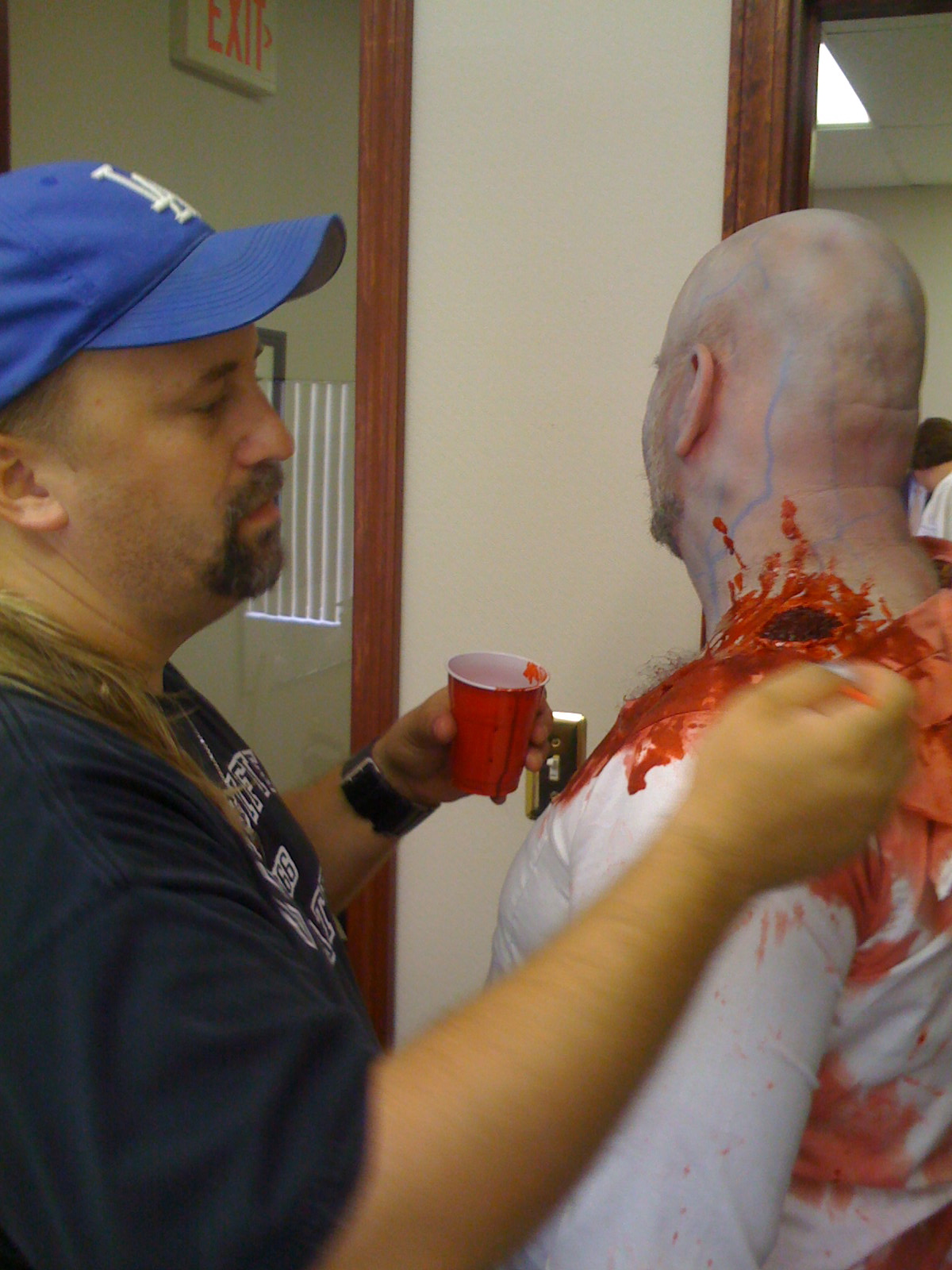
When we were taking breaks from making our zombie movie, of course a few of us dared speak of the Holy Grail — making a real movie, and how it might be done well on a very small budget. Then I stumbled across a trailer for this movie, which appears to be a big stinkin’ p.o.s. shot in SEVENTY MILLIMETER, entirely financed by corporate America. Has anyone seen this? And how can I get Wal-Mart, Coca-Cola, American Airlines and MasterCard to finance my movie?
Off to the gym, folks. I neglected it all last week, so it’s time to pay the piper.