This is Fashion Week in New York. You might not know this, but in the Nall-Derringer co-prosperity sphere, with its alarmingly New York-centric newspaper and magazine subscriptions, it’s hard to escape. Maybe you’re feeling lost. I will try to help.
As some of you may know, I once covered fashion. Sort of. Here’s how it happened: My paper’s longtime fashion writer, June Wells Dill, a grandmotherly sort of woman who occasionally wore hats, was retiring. At the staff meeting to discuss her replacement, no one else wanted the job.
“Does it still include a couple trips to New York every year?” I asked. It did, I was told.
“OK, I’ll do it,” I said. And that’s how the big papers handled staffing, once upon a time. At least in the women’s department. And so I packed my suitcase and my portable computer — a primitive device that weighed a ton, generated a printout as you wrote and somehow managed to transmit an electronic copy of your story back to the newsroom — and went off to New York.
An aside: I required training on the computer. Because 90 percent of the newsroom travel at the time was done by the sportswriters, I was taught by our Cincinnati Reds beat writer.
“And this is how you make a quote mark. You’ll need this if the dresses have anything to say,” he said. A real wiseguy. Have you ever heard the sorts of things baseball players say? You could put that shit on a user key, only we didn’t know what a user key was, back then.
Anyway, off to New York I went. I didn’t go for Fashion Week per se, which didn’t exist in the current form. Rather, all the designers showed around the same time of year, and you ran around between their studios or whatever they had booked for their 20-minute shows. But that was for the New York Times, Women’s Wear Daily and the other bigs. Papers from Rubetown went for Eleanor Lambert’s coordinated week of shows, which was actually the forerunner of Fashion Week itself.
In my era, the event was held at the Plaza, and I sat there on the runway and got a self-taught crash course in descriptive writing. The thing about fashion is, after a while it’s just a blur. Dress dress dress suit suit suit dress dress dress wedding gown. (The wedding gown is — was — the traditional finale of every show. Does anyone do that anymore?) So I quickly learned the jargon, tissue faille and gabardine and ruching. And then I learned about the details, bateau collars and swing pleats and bugle beads. And then I learned the high-level vocabulary that everyone uses, almost all of which is meaningless and can be recombined endlessly. It’s based on a few simple adjectives, which I reveal to you now:
1) Modern
2) Sexy
3) Unconstructed / Constructed
4) Edgy
5) Retro
“It’s an unconstructed jacket with retro touches, very modern and sexy.”
“I love that edgy, constructed thing he has going on. It’s modern and retro at the same time. Which is what makes it so edgy.”
See how easy? Watch a few episodes of “The Rachel Zoe Project,” and play along. Rachel is famously inarticulate, so drop unconstructed/constructed and substitute major: “This collection is so major, so sexy and modern, I just love it.”
It’s amusing to me how often “sexy” gets thrown around, given how many clothes are designed by gay men, who have no sexual interest in women, and displayed on walking hangers with no tits or ass to speak of, parading with angry scowls on their faces, perhaps with violent slashes of neon-green eyeshadow or with their hair greased into threatening spikes. Some of these people have strange ideas of sexy.
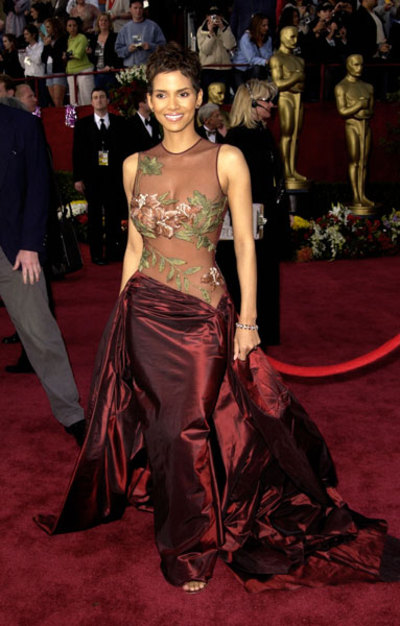
Here’s a sexy dress, or so I’m told, one of the most famous red-carpet dresses ever, the Versace safety-pin dress worn by Elizabeth Hurley in 1994. I thought she looked like a streetwalker. Any dress you have to be glued into, that has to be minded at every minute lest your boobs pop out or your abdomen reveal a wrinkle, isn’t sexy to me. Halle Berry’s Oscar dress — that’s sexy.
But I’m getting away from my point. Oh, wait: I didn’t have one.
Can I just ask one question about Rachel Zoe, however: What, exactly, does she do for her clients that qualifies her to be called a stylist? A stylist, as I understand the job, puts together looks for you. Every time I see Rachel Zoe, she’s just shopping, swanning around fashion shows and boutiques, loving everything and name-dropping: I love this for Demi. It’s so major. She cadges free dresses, and her clients try them on, and she claps her hands. What’s her business model? How is she paid? Did Cameron Diaz finance those crackbrain shopping trips to Europe? I don’t get it. If you have the means to hire her, you should be spending your money on someone who can really help you look your best — a gay man.
Anyway, I have to go. There was a Tom Ford show yesterday, and I’m on the hunt for photos. Oh, wait — only one photographer was allowed to take pictures (which explains all these point-and-shoot pix of someone’s nostrils, with credit lines to the reporter). A fashion show with no photographers. How modern. How edgy.
Bloggage?
You know all that talk about how we’re going to have to come to grips with retiring later? Have you ever noticed how often it’s written by people with jobs like “economist” and “college professor?” A look at what work, real work, is like for many blue-collar workers, and why they can’t work until they’re 70.
Jon Stewart, last night. It’s worth watching just for his “Community Center of Death” graphic open.
I have two stories to write today. Nothin’ big — just 2,000 words by day’s end. Groan. Better get to it.