The thing about the medina is, it’s old. Old means narrow streets, some so narrow two people can’t walk beside one another comfortably. Sometimes it looks like this:
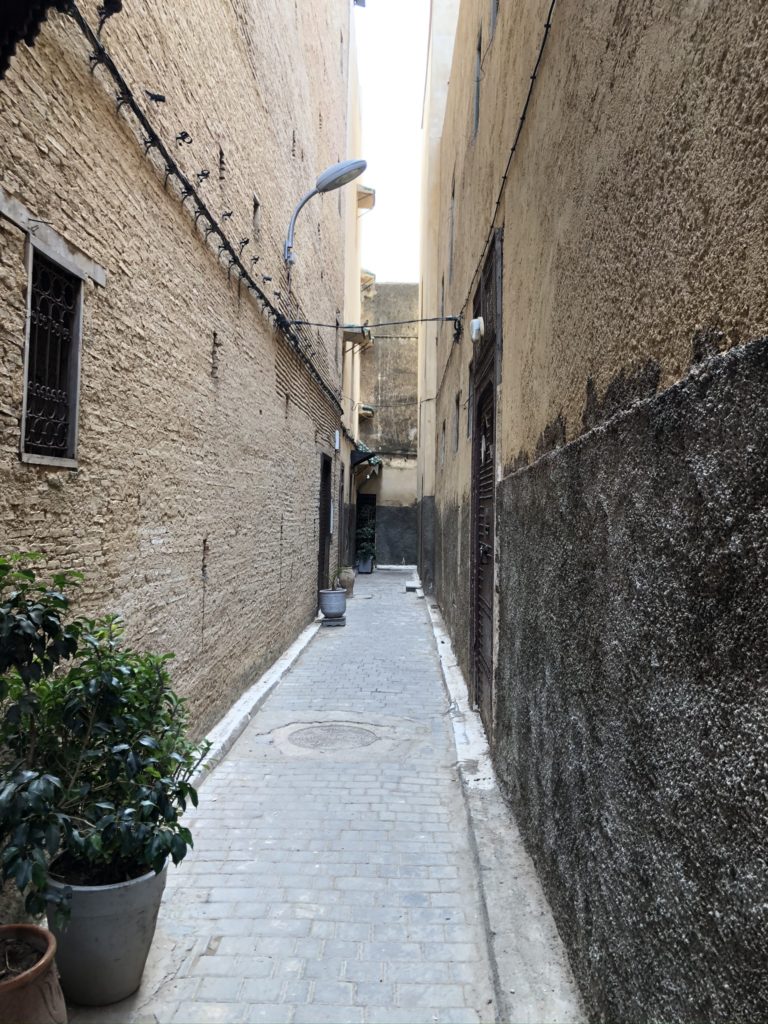
A quiet street. That’s the one that leads to the riad where we’re staying. It leads, after many turns and a couple of dead ends until you learn the way, into one that looks like this:
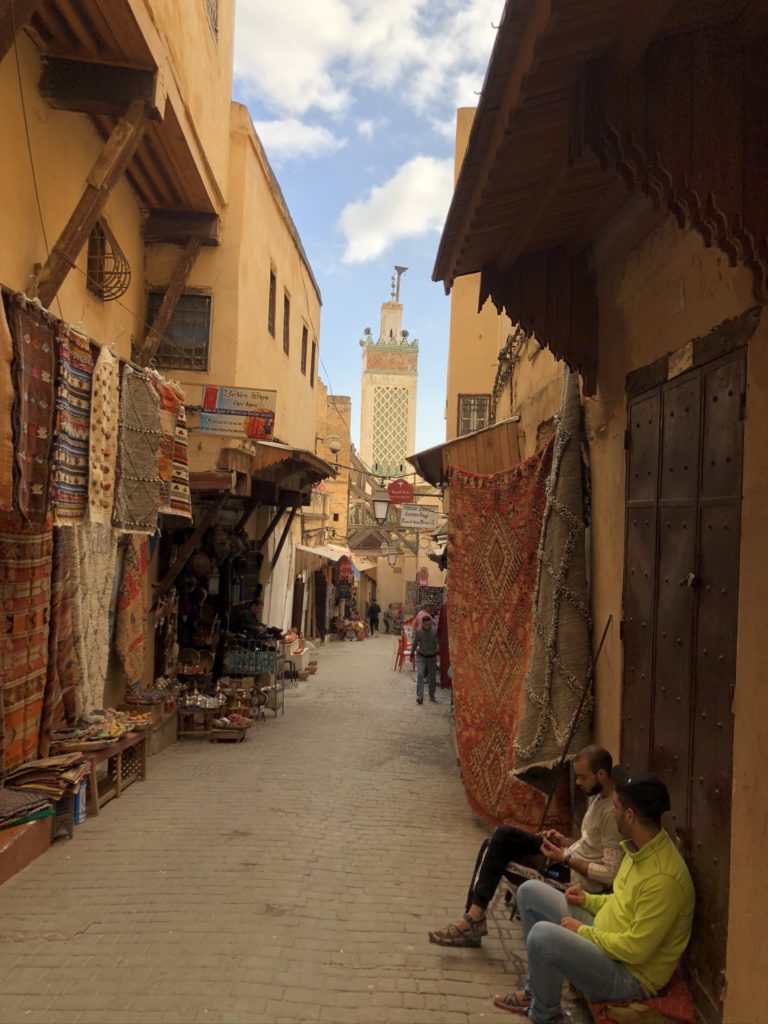
That’s the main road. Still pretty narrow, but depending on the time of day, hundreds, maybe a thousand or more, will pass along it. Most will be walking. Some will be pushing wheelbarrows piled with goods for the businesses within. Some will be driving donkeys or mules, ditto. Some will be on motor scooters, and no, I’m not kidding. And in the midst of it all, it goes something like this:
(Fade in generic Arabic music — ouds and percussion and a voice singing in that mournful-sounding, wobbly way that could be anything from a story of lost love to anything, really. No, don’t fade it in; crash it in, because we’re diving in.) “Bonjour madame come and see how we make the rug. Family business! Best price!” “Attention!” Look around, here comes a donkey or more likely a wheelbarrow because wheelbarrows don’t eat. “Madame, sir, are you looking for restaurant? I take you to restaurant, good food, good price.” Then a door opens, and it’s not marked, just a door, but there may be another door behind it, or maybe three doors, and out come 20 children — school’s out! And these kids are amped up, and running and darting everywhere, and now there’s a scooter and oops a tour group of Asians or Germans, and I’m pretty sure the Asians are Chinese and I know the Germans are German, because they’re saying “Was ist das?” and I’m not that dumb. Their guide is in a djellaba and kisses one of the Germans, man-to-man, big hearty laugh and they set off for their next stop, maybe the metalworkers souk or maybe the leather tanneries and my feet hurt and I’m sweating and you don’t dare stop because someone will try to sell you something and I’ve already bought a purse and two scarves, and maybe paid too much but I didn’t mind because it was still cheap and I’m a rich American and I’m finding I kinda enjoy the dickering, at least if they make it fun, and they do: “Sister, I have already given you my best price, you are stealing from me,” or the guy with one arm who sold me the scarves. “I don’t like the shiny,” I tell him; it’s a nice scarf but metallics aren’t really my thing, but he says, “I make you promise. You believe this Moroccan man. You wash in cold water two times and no more shiny. I promise.” And I laugh and then Alan walks up and I say, “This scarf is Fez blue. The Moroccan man made me a promise. Fez blue — very special,” and we both laugh and the man laughs and he says, “Your wife is good woman, you are lucky man. You are Rambo man!” And I give him about $10 for what I could probably get him down to $8 or even $5 for, but now it will always be my Fez blue scarf and shit, he has one arm and what am I going to do, win this one? And yes, this is all one paragraph but IT WAS A ONE-PARAGRAPH KIND OF DAY, YOU FEEL ME?
As we were finding our way back to the riad, I looked up at the tour group passing us single file going the other way, and coming toward me, unmistakable and unmissable: A man wearing a MAGA hat. Reader, I have no shame in admitting, as he passed me I barked “Fuck that MAGA shit,” and a woman ahead of me turned and smiled and I wish I could have played that one over the loudspeaker on the nearest minaret, because WHO DOES THAT? Here, of all places? Disney World, fine, I wouldn’t say a thing. But here? Talk about the ugly American.
He didn’t stop, I didn’t stop, we couldn’t stop — the medina has its own flow and you fight it at your peril. But I sincerely hope he heard me.
What else? Feral cats are as common as squirrels in Michigan:

Although there are other creatures:
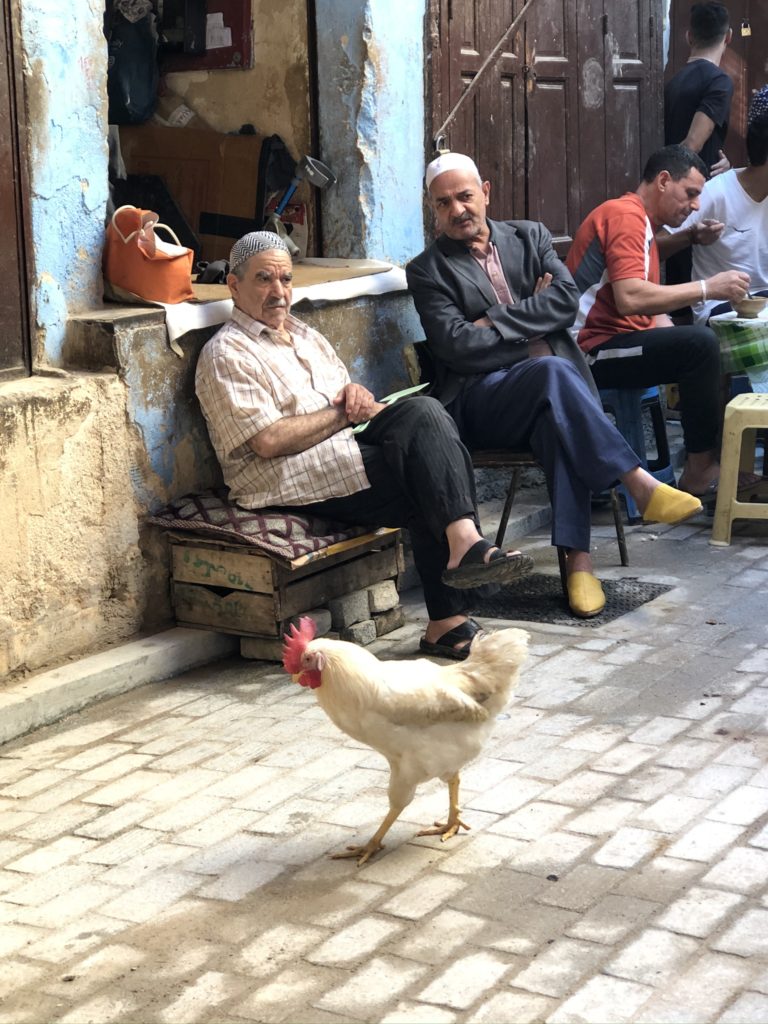
This was near a poultry seller, and I’d bet that chicken is in a pot by now because they ain’t for decoration around here. Go to my Twitter or Instagram and check out the goats’ heads if you don’t believe me.
And that’s it for now because this is supposed to be fun, not a chore, and dinner time is approaching. Over and out from about a mile from here: