War.

The best thing about slow travel is how random encounters can send you off in new, interesting directions. It so happened we were talking Me Too stuff at a waterside cafe in Barcelona, and I was explaining to Alan about Bill Cosby and his quaaludes when a British voice from the next table asked, “You wouldn’t happen to have a few of those tablets on you now, would you?” Ha ha. But long story short, this nice British couple said they were doing a Spanish Civil War walking tour the next day, I said that sounds interesting, and they dropped an easy-to-remember name: Nick Lloyd. Just google it with Spanish Civil War, he said, and he’d come up.

And so he did. I booked us for one a few days later. What a great recommendation.

Going in, I confess my Spanish Civil War knowledge was sketchy. Franco and his fascist nationalists on one side, Republicans on the other. Franco won, stayed in power for decades and became a Saturday Night Live one-liner. Guernica. That was about it. On my seventh-grade trip to Spain with my mom, I remember soldiers on every other corner, well-armed and scary-looking. This would have been in the early ’70s, before Franco died.

So much I didn’t know, so our three-hour walking tour with Nick and about a dozen others was a revelation and unsettling. Unsettling why? Let’s start with the roots of the conflict, when King Alphonso XIII abdicated in the global depression of the early ’30s. The second Spanish Republic formed and adopted a constitution with a lot of crazy progressive ideas, including: Spain should not have a state religion. Women should have the vote. And so on. The moving forces behind it were left-oriented — communists, anarchists, labor unions, republicans. A loose coalition of nationalists, monarchists, the Catholic Church (of course) and other right-wing groups decided this was too much, and a coup began in July 1936. Strip out the objections in Spain and replace them with the trans menace and critical race theory and about a dozen other hand-wringing topics Fox News likes to get on about, and, well, it starts to sound uncomfortably familiar. The Spanish war had no Mason-Dixon Line; it tore apart towns, neighbors, families. The scars remain today, and sometimes it seems they’ve barely closed. Sound familiar?

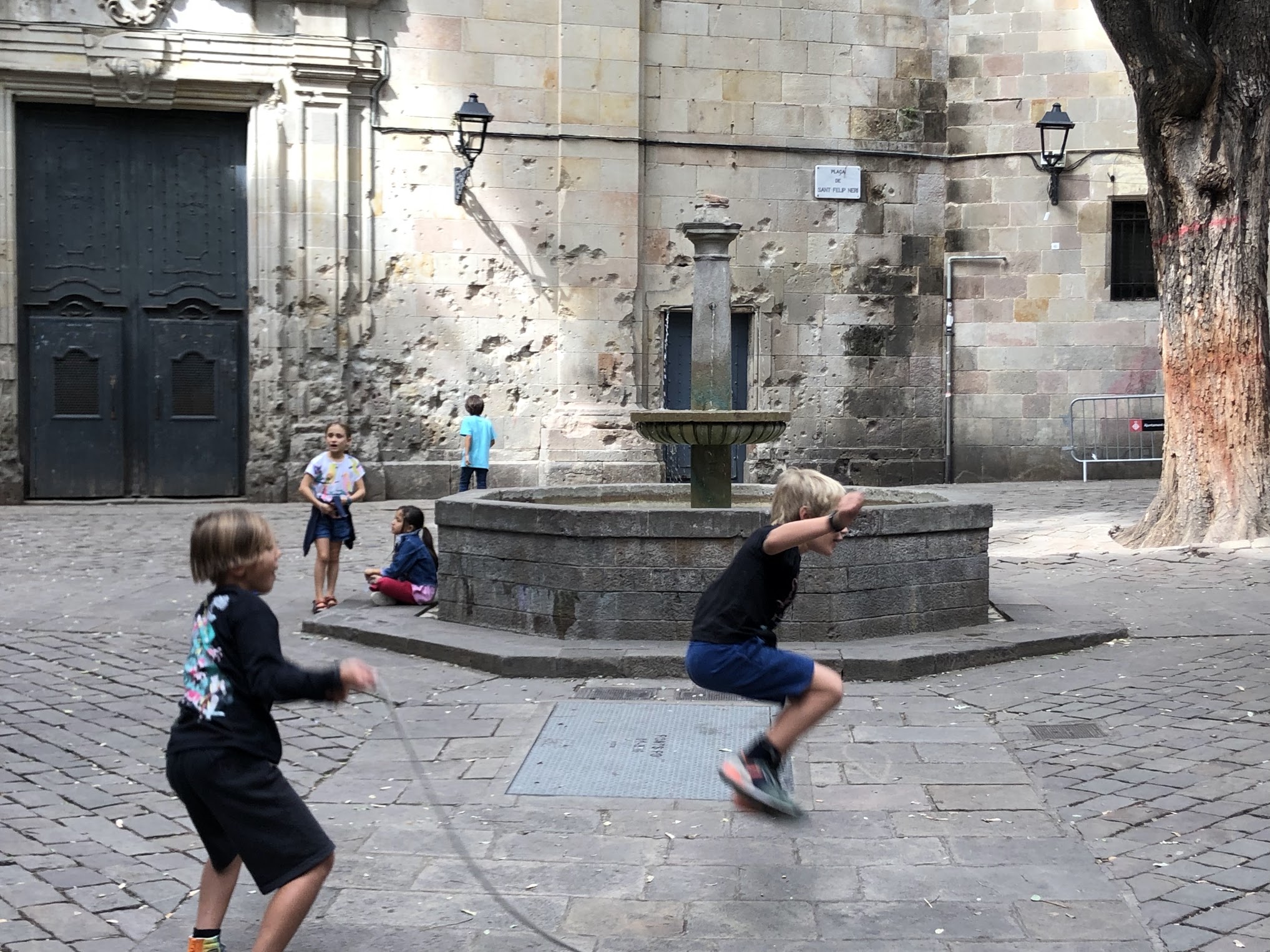
I won’t run through the whole tour, but it was fascinating. Yes, Atrocities Were Committed on Both Sides, but I’m still giving the edge to the fascists who allied with none other than Adolf Hitler. Here are children playing in a square in Barcelona’s Gothic Quarter. See the pitted walls at the far end? Those are scars from a bomb attack carried out by none other than the Luftwaffe, supporting the fascists. The death toll in this strike was something like 169, all civilians:

(God, Spanish children are so cute. You see them out and about, and they’re playing like you expect kids to play, with soccer balls and jump ropes. They must get phones at some point, but I didn’t see any carried by younger kids.)

And then there was Guernica. Hitler: “Hey Frankie, I got a new idea for carpet-bombing a civilian population. Mind if I practice in your neck of the woods? Maybe on a market day, for maximum casualties?” Franco: “Sure, be my guest. There’s this pain-in-the-ass Basque town I’m thinking of.”

We saw the painting in Madrid. When was the last time a work of art got people talking like Picasso’s “Guernica?” Maybe “Piss Christ,” or Robert Mapplethorpe with a bullwhip up his ass.

Nick had a lot of ephemera from the period. This was an ID case or dues record or something from the workers’ union, which included a fair number of anarchists.

They never did get their shit entirely together, but they produced some nice graphic design.

Military footwear. Imagine marching miles in these:

Anyway, without deep-diving into George Orwell, etc., here’s one story that’s in most of the guidebooks to Toledo, which we visited during our Madrid stay: A nationalist commander, Col. Moscardo, was under siege at the Alcazar of Toledo in the earliest days of the war. The Alcazar was a fortification at the highest point in town; it started as a castle, then bumped through the centuries as this and that, and in 1936 was a military base, and the Republicans wanted the munitions it held. Col. Moscardo was holding them off when a Republican commander telephoned Moscardo’s office and told him they were holding his son, Luis. If he didn’t surrender in 10 minutes, Luis would be shot. Moscardo asked to speak to his son, and is said to have told him, “Commend your soul to God and die like a hero.” Luis handed the phone to whoever was holding him, and Moscardo said, “I don’t need 10 minutes. I will never surrender the Alcazar.”

It was a long siege, but Moscardo was as good as his word. (Luis was not shot immediately, contrary to newspaper accounts at the time, but was disposed of a month later with some other hostages.) For some reason, this struck me as the most Spanish Civil War story ever. Half a million people died. Moscardo’s office is preserved as a museum exhibit now. Here’s where it happened:

Anyway, while we’re on the subject, a pivot to some bloggage, Fiona Hill interviewed in Politico about the Ukrainian situation. Elon Musk is the Henry Ford of the 21st century, very smart in some areas, criminally dumb in others:

Reynolds: We’ve recently had Elon Musk step into this conflict trying to promote discussion of peace settlements. What do you make of the role that he’s playing?

Hill: It’s very clear that Elon Musk is transmitting a message for Putin. There was a conference in Aspen in late September when Musk offered a version of what was in his tweet — including the recognition of Crimea as Russian because it’s been mostly Russian since the 1780s — and the suggestion that the Ukrainian regions of Kherson and Zaporizhzhia should be up for negotiation, because there should be guaranteed water supplies to Crimea. He made this suggestion before Putin’s annexation of those two territories on September 30. It was a very specific reference. Kherson and Zaporizhzhia essentially control all the water supplies to Crimea. Crimea is a dry peninsula. It has aquifers, but it doesn’t have rivers. It’s dependent on water from the Dnipro River that flows through a canal from Kherson. It’s unlikely Elon Musk knows about this himself. The reference to water is so specific that this clearly is a message from Putin.

Now, there are several reasons why Musk’s intervention is interesting and significant. First of all, Putin does this frequently. He uses prominent people as intermediaries to feel out the general political environment, to basically test how people are going to react to ideas. Henry Kissinger, for example, has had interactions with Putin directly and relayed messages. Putin often uses various trusted intermediaries including all kinds of businesspeople. I had intermediaries sent to discuss things with me while I was in government.

This is a classic Putin play. It’s just fascinating, of course, that it’s Elon Musk in this instance, because obviously Elon Musk has a huge Twitter following. He’s got a longstanding reputation in Russia through Tesla, the SpaceX space programs and also through Starlink. He’s one of the most popular men in opinion polls in Russia. At the same time, he’s played a very important part in supporting Ukraine by providing Starlink internet systems to Ukraine, and kept telecommunications going in Ukraine, paid for in part by the U.S. government. Elon Musk has enormous leverage as well as incredible prominence. Putin plays the egos of big men, gives them a sense that they can play a role. But in reality, they’re just direct transmitters of messages from Vladimir Putin.

Posted at 12:33 am in Same ol' same ol' | 24 Comments
 

Toro.

My friend Lynn texted before we went to the bullfight one night in Madrid. “If you see a worthy bull, bet a few Euros on him for me.” I thought what I’d already told her more than once: You don’t understand. The bull never wins.

Bullfighting is, to put it plainly, animal torture for human entertainment. There’s really no way around it. A bull is turned loose in a ring and harassed, mentally and physically, for 20 minutes, at the end of which he is killed, more or less humanely, if you discount the previous 19 minutes and change.

However. I’ve never seen a real* bullfight, and neither had Alan. I was curious. Not going wouldn’t have saved the six bulls who died that night, and I’m not going to take PETA’s word for anything. Also, Culture. So we went to Las Ventas — the arena that is, to bullfighting, what Michigan Stadium/Ohio Stadium/the Rose Bowl is to college football. We were going at the tail end of the season, and the program indicated novillados. Novices, facing off with younger bulls, i.e. the minors. But that meant lower prices and thinner crowds. Fine with me.

The subway there was packed, mostly with older men, many carrying bags with seat cushions inside. Everybody got off at the Ventas stop, and we made our way to the ticket window. Rick Steves said choose section 8 or 9 for shade and the best view; the toreros tend to push the action to that side of the arena, to reward the premium seats. So we did, and found a stadium scene familiar to anyone who’s been to one, anywhere, but maybe more stripped down. The refreshments were beer and blanched almonds, sold by vendors in the stands (the fighting runs roughly 6-8 p.m., and no one eats dinner that early in Spain). We found we could rent seat cushions for 1.50 Euros, and good thing we did, because the seating was cold and hard:

Note: No railings. If you fall, you fall. People come here to see blood, and it might as well be yours.

There was some sort of hall of fame in the hallway leading to the seats. Don’t ask me whether these guys were notable sires, or just put up a hell of a fight; I’m a stranger here myself:

This was the crowd close to starting time. Not huge, but better than the Detroit Tigers did, many nights this season:

The show started at the stroke of 6 with the traditional parade of toreros, picadors, support staff and even the mules who will drag away the carcasses:

They make one lap of the arena, take their places, and the first bull is released. He’s already pissed off — I believe they stick him in his hump first to get him in a bad mood. The toreros work as a team, with half a dozen or so hassling him with bigger capes, to rile him up. These guys are matadors in training, so at this level, minor-minor. They show a little style, but they know their place, even though they’re all dressed the same:

The torture really starts when the picador comes out. This guy’s job is to draw the bull to attack his horse, and the first time this happened I gasped, but all the horses seemed prepared, and unharmed by it. Once the bull makes contact, the picador stabs him right in the hump. This wound gets the bull to lower his head for the rest of the fight, which is safer for the humans; makes a goring less likely. I’m adding a video; I hope it works for most of you, and if it doesn’t, I’m sorry. Enlarge it to fullscreen:

After the picadors come the banderilleros. Their job is to further inflame the animal, by placing twin picks in his hump (stylishly!). They face the animal, it charges, and they place the banderillas with a leap. This happens three times. If you see a classic bullfighting print, the sticks you see hanging from the bull’s shoulder? Banderillas.

Then the final act begins, at about the 10-minute mark. The matador comes out with a smaller, red cape — the muleta — and starts the tercio de muerte. The muleta is braced with a sword, but it’s just a prop. The matador’s job at this point is to tire the bull out, but do it fancy-like, showing his bravery. (We called our favorite, of the three guys who performed that night, Mick Jagger. He struck all the traditional poses, inching forward, leading with his pelvis, that stuff that gets the girls hot.) And then he exchanges his toy sword for a real one, comes back, sights down it dramatically, and charges in for the kill. In this stage, he needs to jump into the air, so the sword can come down between the shoulders, ideally to the hilt and severing the aorta or piercing the heart itself. Mick Jagger accomplished it on his first bull, but the second was kind of a disaster; he needed three tries, which was probably expected from a novillado.

At that point, the bull goes to his knees, theoretically, and a final guy comes in with a dagger and gives him a stab just behind his head, severing his spinal cord. The animal pitches over onto his side, dead. The end. Cue the mule team.

It’s pretty brutal, yes. But we watched the whole thing. Afterward, it was time to wave farewell to Las Ventas and have some dinner. Alice, let’s eat! Who wants a hamburger?

I’m glad we went. I eat meat, so I can’t claim any purity around killing bulls for human ends. I’m not sure an American slaughterhouse is a much less distressing way to go. In one of Jim Harrison’s many memorable turns of phrase, he described cattle as giant machines to turn grass into shit. But they feed us well in the end, so.

If you want to know more about all of the above, I suggest this post on Spanish Traveller, where I got a lot of the terminology, at least the Spanish phrases.

On and as for that *asterisk, above: This was actually my second trip to Spain. My mother took me to Malaga and the Costa del Sol for spring break when I was in…seventh grade, I think. It was March, but there was a “bullfight” put on for the tourists down there somewhere. It wasn’t even the season. Some steps were skipped — no picadors. I don’t know who the matadors were, maybe some waiters picking up extra coin. But the bulls were killed and, get this, ears were awarded. Even I could tell this was (sorry) bullshit staged for people who read James Michener’s “Iberia” and took it to heart. Getting an ear — cut from the dead bull and given to the matador for a superior performance, by order of the judge and seconded by the crowd, is an infrequent occurrence. Getting two ears is very rare. The highest honor — two ears and a tail — is even rarer. Here’s a funny note on the semiotics of this gesture. Needless to say, no ears were awarded the night we were there, not even to Mick Jagger.

Posted at 10:00 pm in Same ol' same ol' | 16 Comments
 

Spain, first of a few.

The lazy person’s credo: If you wait long enough to do a job, often someone else will do it. And lo, it has happened.

OK, not really. But it turns out none other than Neil Steinberg was in Spain at the same time I was — in Madrid, even — and while we didn’t meet for coffee, we did come away with many of the same impressions of the place, including this conclusion:

Spain is a majority-Catholic country where abortion has been legal nationwide for a dozen years. As for trans issues, a court there found that barring transgender minors from gender changes is unconstitutional. Sure, they have their own troubles — police in Madrid feel obligated to cluster around the entrance of their downtown headquarters, brandishing shotguns and assault rifles. We’re not quite there, yet.

So I don’t want to be one of those Americans who goes abroad and starts running down home. America is still a great place to live, despite all the efforts to turn it into a zombie cult. But we are more of a backward-looking nation in the grip of religious fanatics than Spain. Which strikes me as news, and not good news.

But I’m getting ahead of myself. The trip was wonderful. I’d only have changed a few things about it. Stayed in more cities, maybe. But we landed on this land-here-move-minimally travel strategy for a few reasons, including:

** Every time you move cities, you lose a day. That was the lesson of Morocco, with its slow trains. Just too much time spent on them, not enough time strolling medinas.

** The point of these trips isn’t to bolt from one tourist draw to the next, but to settle in and try to get a real sense of a place. To live like a local, to the extent that’s possible — to cook on induction hobs, make coffee in their comical low-tech gadgets, to view a rainy day not as a catastrophic disruption to a set schedule, but a good opportunity to read for a few hours, maybe with the terrace door open to street sounds. To try, if only for a few weeks, to be less American. Also, to eat gelato.

It works, mostly. I don’t like induction cooking, but I understand it. Moka pots are pain in the ass, and don’t get me started on the washing machines, which would give even Barbie a headache (“How are you supposed to wash more than one outfit at a time? And why does it take three hours?”). That said, if we go to Italy next year (please recover, retirement nest egg), we’ll do at least three cities, maybe four. And eat lots of gelato.

But the trip had many, many pleasures. We were able to meet up with American friends, twice. We became, if not experts, at least confident users of two urban mass-transit systems. We heard music, went to a rock show (Brian Jonestown Massacre, Barcelona), viewed masterpieces, saw bullfights, walked Barcelona’s civil-war sites on a spectacular history tour, saw lotsa Gaudi, Rubens, Goya, Picasso. Sweated profusely (it’s still summery there, despite the locals shivering in puffer coats), ate one million olives. Broke my gin curse*, which an evil witch put me under when I was in my early 20s and overindulged on the stuff. Oh, and we were burned — lightly, but I have holes in my clothing to prove it — in a native festival, in Sitges:

It was some saint’s festival; there are a lot of those in Catholic Spain. We met some people at a local bar, dressed identically, carrying drums, obviously pregaming. Was something going on, we asked? Why yes, there was a parade starting in a couple hours. There’d be “giants”…

…followed by marchers he struggled to describe in his limited English, but turned out to be what every Detroiter recognizes and calls Big Heads (they’re in our Thanksgiving parade)…

…and then there’d be diablos. Even I know what a diablo is. We stuck around; trains run back to Barcelona every 20 minutes or so until almost midnight, so why not. And after the giants, and the Big Heads, came the diablos, led by groups of drummers like our new friends. They were dressed in burlap with devil-horn heads, and carried sticks with several whirling, spark-spitting, loud-banging fireworks, which showered the onlookers in whoo-ouch-that-smarts stinging tastes of hell:

Others carried figures — a dragon, a lizard — outfitted with their own fireworks. When a shell was spent, they’d reload.

Barcelona has a similar festival around the same time called La Mercé, but getting this close to it would have required the dedication of a Macy’s Thanksgiving hard-core fan. In Sitges, we were able to be right in the thick of it, crouched in a doorway, yelling at each other DO YOU SMELL BURNING HAIR? IS IT MINE? So much fun.

That was the first week. It was a good month.

My takeaway, similar to Neil’s, came during our Spanish Civil War tour, and it’s pretty simple, as befits a simpleton like me: We’re on the same path. But I’ll discuss that later this week.

One final note: I’m writing this on a brand-new laptop. I shut down the old one before we left, and left it on the charger. I’ve been leaving it on the charger all the time, because its second battery is now failing. Got home, booted it up, started to wade through some email and wondered why the track pad didn’t seem to be clicking right. I was about to text Kate and ask if it had been knocked off the desk or something while we were gone, when I noticed the keyboard was bulging up. Googled, and learned that by continuing to use it, I was risking, yes, explosion, an actual exploding battery. Or a fire. Shut it down, unplugged, went to the Apple store.

It was time. The old one gave me eight, EIGHT years of service. (The bulge is pronounced enough that by the time I pulled the plug, it no longer closed correctly.) Now to find a USB B-to-C converter so I can transfer my music and photos. (Also, a toxic waste recycler for the battery.) But there is a takeaway, and this is it: Back up to clouds whenever you can. I was able to start the new machine and, thanks go my iCloud and Google accounts, get to work almost immediately. Our world, it is a marvel.

Now for some coffee and breakfast. Coffee made in a MoccaMaster, as God intended.

Posted at 8:15 am in Same ol' same ol' | 28 Comments
 

New post, just because.

Hello from Madrid. Can’t really blog without a proper keyboard, but here’s a new post for your abundant conversations in my absence. Also, a picture of an amazingly gruesome Jesus in the cathedral in Segovia, taken yesterday. Home by the weekend! See you soon.

On the base: “By his stripes we are healed.”

Posted at 4:05 am in Uncategorized | 33 Comments
 

We had ourselves a time.

A former colleague messaged me on Facebook the other day, asking for my address. He’d been cleaning out some papers and had some stuff to send me. Stuff like this:

And stuff like this (not my handwriting, and I don’t know whose, but I have a suspicion):

And stuff like this:

Newspaper people keep amusing files. So does everybody short of actuaries, but ours are best. Were best, anyway.

Once, after I left Ohio, the Fort Wayne Children’s Zoo sent a young giraffe to the Columbus Zoo. Giraffes are delicate and don’t travel well, and this one was let out of its crate, made a single galloping lap around its new yard and dropped dead. Evidently I sent a postcard:

I was big on postcards for a while. I still have boxes of them. I should get rid of a few. Send me your mailing address at nancy (at) nancynall.com and I’ll send you one. Puns not included. I don’t know how I got so pun-ny in this one, because I’m generally not a pun person. I have no memory of being a pun person. But I guess that’s why we save stuff like this.

Also included, but not reproduced here: Several notes I wrote on the half-sheets that were on every desk, which we used to, duh, send notes to one another, typed on our IBM Selectrics. There’s also an evening-news roundup, which the night staff was required to watch and summarize for the morning crew. I tried to make mine funny, because what’s the point of such boring duty if you can’t be funny. It begins:

good morning, carolyn. it’s (i mean it is) 6:35 p.m. and this is the news.

I never used capital letters back then. The “it is” stuff refers to a high-ranking editor who, furious that his people couldn’t tell the difference between its and it’s, banned the contraction from the newspaper. Which led to some awkwardness in copy and headlines: Happy New Year! It is party time! And so on.

The most interesting part, to me, is that in my on-paper notes, I used perfect manuscript editing marks. I bet you can’t find a journalist under 50 who even knows what they are.

Anyway, thanks to Robin for, at the end of my career, taking me back to its beginning. Life is all about bookends for me, lately. This was a good one.

And I think this will be the last entry before we leave, unless something huge happens. I’ll be posting photos, etc., on my social channels (@nderringer on Insta, @nnall on Twitter). And there’s always a chance I can make something work on our Airbnb wifi and my ailing iPad Mini. But no promises. This is a vacation, after all.

Bon voyage to us, happy first-of-the-fall to you all.

Posted at 5:31 pm in Media | 218 Comments
 

Washington slept here.

The death of a prominent figure on the world stage is like a train: The news itself is the engine, and certain predictable cars are dragged behind. Sometimes it’s the New York Times obituary where the byline is of a person who died years earlier. Sometimes it’s the previously unknown (to most, anyway) secret children. But always, always there’s the localization.

Localizing is how editors connect events happening far away to people, businesses or other actors close to home. Princess Diana worked briefly as a nanny, and we all got to meet the American family she nannied for, who remembered her as sweet and pretty and good with the children. The late Jim Barbieri, in little ol’ Bluffton, Ind., could localize a plane crash half a world away with no Americans onboard: “Bluffton-made Franklin Electric submersible motors” were used in the hunt for the black boxes.

So when Queen Elizabeth died, it was only a matter of time before they started turning up. Thanks to Mitch Harper in Fort Wayne for digging up some good ones:

On Mackinac Island, they’re remembering when Elizabeth and Phillip, aboard the royal yacht Britannia, passed under the Mackinac Bridge:

Two hundred thousand turned out to see her in Windsor, across the river from Detroit:

But the best of all might come from little Crown Point, Ind., where they’re thinking of…flowers:

Hey, it’s usually a reach, but people like to feel connected.

You’d be hard-pressed to get me to say a kind word about Ronald Reagan, but I have always liked this photo:

But that’s me: Always a sucker for a horse. We generally see Reagan in western wear, in a western saddle. But a good horseman can handle both, easily. It’s nice to see two people enjoying a shared enthusiasm.

So then, the week begins. We’re winding down to our departure for the next leg of our world travels, and the very last, or sorta-last chore in the refreshment of our house. The floors are finally refinished, and we should move back into our bedroom in a couple more days. Which should leave just enough time to remake the bed, pack the suitcases and run to the airport. Next stop: Barcelona.

But I’ll be back between then and now. So take care, and have a good week.

Posted at 3:43 pm in Current events | 39 Comments
 

Long live the king.

I observed the passing of Queen Elizabeth by pushing my bomb-ass battery-powered sweeper around, sucking up dog hair and thinking about the butterfly effect. What drove Wallis Simpson to set her cap for the Prince of Wales in 1930-something? (My guess is: Money and position, but honestly I don’t care because I have always found their love story boring in the extreme.) Anyway, when she made her play, she set in motion the events that would lead the prince’s niece to become sovereign, rule for 70 years and die as the beloved great-grandmother of a diminished empire, but at least not one that consorted with Nazis.

Funny, that.

Of course, the talk was always that Edward VIII was probably gay and probably sterile (mumps), and even if Wallis had been a blushing virgin and not a twice-divorced American well past heir-producing age, at some point a different line of succession might have had to be drawn up. Still. The crown did a hop, skip and jump, and went first to Elizabeth’s father, who became George VI, before landing on her 25-year-old head in 1952. And there it would stay until Thursday.

That was her on Tuesday after she greeted the new prime minister, and invited her to form a government in her name. You can complain about the waste and anachronistic nature of royalty all you want, but I’d wager most of the tourists who visit the U.K. at least make some time to drive past a palace or three, and as for doing the job, well, she worked overtime.

Imagine holding the same job – and a job it is – for 70 years. She had to hang on through so, so much: The latter half of the 20th century was no picnic for an institution like the monarchy, and then there was the country itself, losing its empire piece by piece. Her children, sensitive Charles and bold Anne, then the second thoughts, Andrew and Edward, had to go through their own wild youths and midlife crises and all the rest of it, all in a spotlight that only grew brighter and hotter with time. Give her this: She outlasted Diana.

Along with the spotlight comes all these, these …commoners, with their own ideas. “The crown should go directly to William,” opined one dipshit American on Facebook. “He’s much more of a leader than Charles.” And this is based on what, exactly? Because Charles cheated on his pretty wife with his homely old girlfriend, I expect would be the answer. Anyway, lady, this isn’t fucking Game of Thrones, anyway. The crown goes to the sovereign’s firstborn, it’s not up for a vote. Charles has been in the waiting room all his life.

Anyway, I’m looking forward to Charles’ monarchy. His goofball interests and life experiences will give the world a different monarchy than his mother’s, and I want him to do the job he’s trained so long for. Long live King Charles III. I hope he has a grand coronation. If hereditary monarchy has to endure this long, at least it should be interesting.

P.S. Queen consort Camilla will be a trip, too – at least I hope so. I so want her to be the three-G&Ts fun grandma of Buckingham Palace.

Other than the excitement of current events and sweeping up dog hair, my only outing Thursday was to Costco, to pick up a prescription and note that not only is the Christmas merch out, but I heard “Joy to the World” on the sound system. I’m so old – how old are you? – I’m so old I remember when people complained that Halloween was too early to start thinking of the holidays.

Have a swell weekend, all.

Posted at 4:42 pm in Current events | 48 Comments
 

Fatness.

I don’t know when it happened, if it was them or me, but I’ve kinda lost my taste for NPR.

It’s been so long since I was a regular listener to commercial radio I can’t even remember — 35 years? Forty? A long time. Obviously nothing should stay frozen in time, especially not a journalism outlet. I don’t miss Bob Edwards, but I miss the personal essays they used to run. I miss the offbeat stories from corners of the world I’ll probably never visit. They’ve been replaced by sometimes painful, flop-sweaty pieces to satisfy someone’s diversity agenda, and what’s worse, they’ve elbowed out actual news.

The other day Alan remarked that one of the January 6 hearings had gotten 30 seconds in the top-of-the-hour news roundup, while a stupid feature on a group called the Lesbian Avengers had gone about eight minutes. What are the Lesbian Avengers? “…An organization that focuses on lesbian issues and visibility through humorous and untraditional activism.” Thanks, Wikipedia. Alan only remembers that they sometimes pass out Hershey’s Kisses with notes attached: “Smile, you’ve been kissed by a lesbian.”

OK, then. Today the story was about Brendan Fraser’s six-minute standing O at the Venice Film Festival, where his latest film debuted. Called “The Whale,” it’s (quoting from the NPR story):

…about a reclusive English teacher (Fraser) who weighs 600 pounds, and as he struggles with his health, tries to reconnect with his estranged daughter. A combination of prosthetics and CGI help Fraser as he portrays this character.

The first half of the story was about how beloved Fraser is, by fans and colleagues alike, and how recent years have been rough on him, for a variety of reasons. He’s had some health challenges, and gained weight, although nowhere near 600 pounds. Maybe 40. He’s no longer Hollywood-slender and matinee idol-handsome. He looks like a Green Bay Packers fan. So what, though. In Darren Aronofsky, he’s probably found the ideal director for his comeback. (Remember what he did for Mickey Rourke in “The Wrestler.”) So why does the headline for this story read Why Brendan Fraser’s Hollywood comeback story is both warming hearts and raising ire, hmm?

Because an advocate for fat Americans is miffed, that’s why:

Indeed, critics have turned to social media to say that the movie’s premise is inherently dehumanizing. There’s a question of whether it should have been made at all.

Aubrey Gordon, an author and co-host of the Maintenance Phase, a podcast focused on debunking health fads, took to Twitter to call out the movie’s aim.

“It’s so telling that so many only see fat people as ‘humanized’ in media that shows us doing exactly what they expect: living short, small lives; ‘eating ourselves to death’; feeling sad & regretful. All reminders of how tragic it is to be fat, and how superior it is to be thin,” she wrote.

This kind of media just “reinforces viewers’ anti-fat bias,” she wrote.

Gordon is smart, and I’m with her on the inherent societal bias against obesity. (She’s fat, if you haven’t guessed.) Fat acceptance, sign me up. Different-size models in advertising? Yes, please. Fat doesn’t necessarily mean unhealthy. But 600 pounds? Any way you slice it, that’s pretty damn unhealthy. One of the undone stories of my career, one I wanted to do for Bridge but left before I could put it together, was on super-obesity, those whose weight has passed the quarter-ton stage and suffer mightily as a result. I met a doctor who paid house calls on those patients, and told me what it leads to, i.e., a spiral. The bigger you are, the harder it is to move, the harder it is to move, the less you move. The less you move, the worse you feel. Which leads to more eating, weight gain, etc. Most of his patients that size were virtual shut-ins, afraid to get out much in the world, for all the reasons you can imagine. Needless to say, everything hurt, especially hips and knees.

Tommy Tomlinson is a gifted writer, a former columnist in Charlotte, married to a former colleague of mine in Fort Wayne. At his heaviest, he weighed 460 pounds, and his memoir, “The Elephant in the Room: One Fat Man’s Quest to Get Smaller in a Growing America,” was full of excruciating detail about the million calculations one has to make when you’re that size: Will that chair hold me? Will any other furniture hold me? If I’m not sure, can I stand without social awkwardness? And so on. I read excerpts and felt not anti-fat bias, but deep empathy – we all have our addictions, our weaknesses, and the idea of seeing an actor as talented as Fraser bring this complicated emotional stew to life sounds pretty great to me.

I’m reminded of the backlash to “Fatal Attraction,” the way feminists hollered over the idea of a crazy spurned lover, that it dehumanized single women, etc. As a sane single woman at the time, I didn’t feel dehumanized.

So while I appreciate that NPR is stretching like Elastoman to include the fat person’s perspective, I think this is fairly ridiculous in this context, and if it weren’t for the musical weekends on WDET, I probably wouldn’t give them another dime. There’s a question of whether it should have been made at all! Mercy.

So, bloggage:

It was a pretty fun long weekend for us. We saw Kate play in both of her bands, at the Hamtramck Labor Day festival, and both performances were pretty great. The second band, the side project, is GiGi, which got a little ink ahead of the fest, and I had NO IDEA it had appeared, which shows where my head’s been of late.

A local theme park, Cedar Point, announced it was retiring one of its very edgy coasters, following the injury of a rider a couple years back. The park was not held responsible, for the record. I always thought there was a book in the development of a modern roller coaster. When I started taking Kate to Cedar Point, I was amazed at how high-tech and insanely scary they are, yet still (mostly) safe. They gave me heart palpitations just to look at them, honestly. But I’d read a book like that. Cedar Point, hire me! I’m a good explainer.

Finally, in the bottomless pit of indignities our former president has visited upon our land, here’s this: He tried to pay a lawyer – a Jones Day lawyer, no less! – with a horse.

That’s a good note to end on. Happy Wednesday.

Posted at 8:37 pm in Current events, Media, Movies | 49 Comments
 

Her pet goat.

You Ohioans probably know, or remember when, the Ohio State Fair was a big honkin’ deal. Former Gov. Jim Rhodes, a country boy from down Jackson County way, purely loved it, and used it as a platform for publicity, every single year.

He would personally attend the livestock auction in the fair’s last days, not actually doing the patter but cheerleading the bidding, which set new sale price records every year. The papers ran photos of all the winners and their bids, which were astronomical. I think I’ve told this story, but here it goes again: After Rhodes left office, there was some pushback on the higher-every-year thing. Rhodes always framed it as “you’re helping send a farm kid to college,” or at least helping him or her with a down payment on their own spread, but one year the seller of the grand champion beef steer took his mid-five-figure sum and spent it on a new pickup truck with all the shit on it. This displeased the buyer (usually Wendy’s). Some time after that, another high-dollar steer went to slaughter and, when the hide was stripped off the animal, globs of silicone gel fell out, touching off a cheating scandal in the formerly all-good-news arena of the country’s biggest state fair.

(Yeah, I know, Texas blah blah. I don’t believe it.)

Prices dropped sharply thereafter. :::touches earpiece::: Wait, I have a correction to make. Prices seem to have risen again. This year’s grand champion steer — always the highest-priced animal in the sale — was sold for $225,000 and HOLY SHITBALLS that’s a lot of money for some hamburgers. It sold to a Volvo dealer, too. Huh. Well, that doesn’t contradict everything above, although clearly prices didn’t stay low forever.

All of this is getting to the story I was leading up to, about the year a girl brought her lamb into the ring and started to cry. The lamb bleated and nuzzled her hand, and every time it did, she cried harder. She knew what fate awaited her pretty, prize-winning lamby, and the governor stopped the auction and made a speech. “This lamb was raised by this girl from the minute it hit the ground, and she loves it like a pet,” he said, along with something else to the effect that he expected whoever won the bid to respect that. The gavel fell, and the buyer announced he was immediately giving the lamb back to the girl. There was lots of cheering and hugging. This touched off a cascade of charity, and at the end, everyone had spent a lot of money and every kid was taking their animal or animals back home. (Where, I have to think, almost every single one was immediately sold again, to a slaughterhouse.)

At the time I thought this was a sweet story, and told it to a 4-H official in Indiana, after I moved there. His brow furrowed. That was absolutely, positively the wrong thing for the governor to do, as well as everyone else, he said. Farm kids know what animals are raised for, even sweet fluffy lambs, and that’s what the competition is all about — not the cutest lamb, but the meatiest, the best conformation, the highest potential return on investment, which is, after all, what keeps a farm paying its bills. Click the link and take a look at that quarter-million-dollar steer, and you’ll see that is no typical farm-field specimen.

And now, more than 500 words into it, we get to the story of Cedar the goat, as told by the New York Times.

Cedar also had a sentimental owner, a California girl under the age of 10, perhaps not cut out for a farming career:

She fed him twice a day and walked him everywhere, often on a leash, like a puppy, (Jessica) Long said in an interview on Thursday. The goat was afraid at first, having been taken from his herd, but he warmed up to the girl and ran up to greet her, Ms. Long said.

So as the June 25 auction approached, the idea that Cedar would be sold — not as a creature but as 82 pounds of meat — began to horrify the girl, who was enrolled in a local 4-H program.

They tried to withdraw it from the auction. Not allowed. They moved Cedar to a farm 200 miles away. The fair sent the law after Cedar; two cops made a 500-mile round trip to fetch him back. And now Long is suing:

“They went and took Cedar without a warrant from this property and brought him back that evening,” Ryan R. Gordon, a lawyer for Ms. Long, said in an interview on Thursday. “All the sheriff’s deputy told me was, we turned him over to who we deemed was the owner. And that’s the problem. The sheriff’s deputies are not the judge. They don’t get to deem who the owner is.”

So much drama! Over a goat! And what happened to Cedar? It wasn’t a happy ending, we know that much:

Mr. Gordon, who is co-director of the nonprofit law firm Advancing Law for Animals, said he believed Cedar might have ended up at a barbecue organized by another young farmers’ group, the National FFA Organization, the next day, but he did not know for sure.

There’s more to the story: The winning bidder was a state senator making a gubernatorial bid, who probably wishes he was a million miles away now. There’s also this priceless line:

“It is noteworthy that Cedar’s successful bidder was not entitled to, and did not purchase, Cedar,” the lawsuit stated. “Rather, the successful bidder was entitled only the cuts of meat that were Cedar.”

It sounds like the girl didn’t take this well, as you might expect. Poor Cedar. He looked like a very nice goat.

And now state fair season is over. Cedar is dead, summer is dying, and today it barely rose above 70 degrees. (It felt GREAT.) Happy labor day, all.

Posted at 7:00 pm in Current events | 45 Comments
 

Decibels for days.

I didn’t watch Biden’s speech last night. I hardly ever watch presidential speeches, especially the State of the Union. If they’re brief and of the breaking-news variety, like Obama announcing the death of bin Laden, sure. But stuff like last night, I read the transcript. And I found little that was specifically objectionable in there, although I admit I was surprised, and not in a bad way, that he mentioned Trump by name.

High time, though.

Of course, the MAGAs are flipping out over this, but I have a feeling we’re well into the “find out” phase of their fucking around, so you can’t say it wasn’t coming.

I managed to be out most of today, and came home to discover sanding is well underway. The noise, oh the noise, so I’ll keep this short. Also, the weekend awaits, and we all want to get that underway.

Just one piece of bloggage, really:

This woman, endorsed by Trump, is the GOP nominee for secretary of state. Shudder.

Have a great weekend. Swim, picnic, have a blast.

Posted at 4:48 pm in Current events | 21 Comments