My friend Lynn texted before we went to the bullfight one night in Madrid. “If you see a worthy bull, bet a few Euros on him for me.” I thought what I’d already told her more than once: You don’t understand. The bull never wins.
Bullfighting is, to put it plainly, animal torture for human entertainment. There’s really no way around it. A bull is turned loose in a ring and harassed, mentally and physically, for 20 minutes, at the end of which he is killed, more or less humanely, if you discount the previous 19 minutes and change.
However. I’ve never seen a real* bullfight, and neither had Alan. I was curious. Not going wouldn’t have saved the six bulls who died that night, and I’m not going to take PETA’s word for anything. Also, Culture. So we went to Las Ventas — the arena that is, to bullfighting, what Michigan Stadium/Ohio Stadium/the Rose Bowl is to college football. We were going at the tail end of the season, and the program indicated novillados. Novices, facing off with younger bulls, i.e. the minors. But that meant lower prices and thinner crowds. Fine with me.
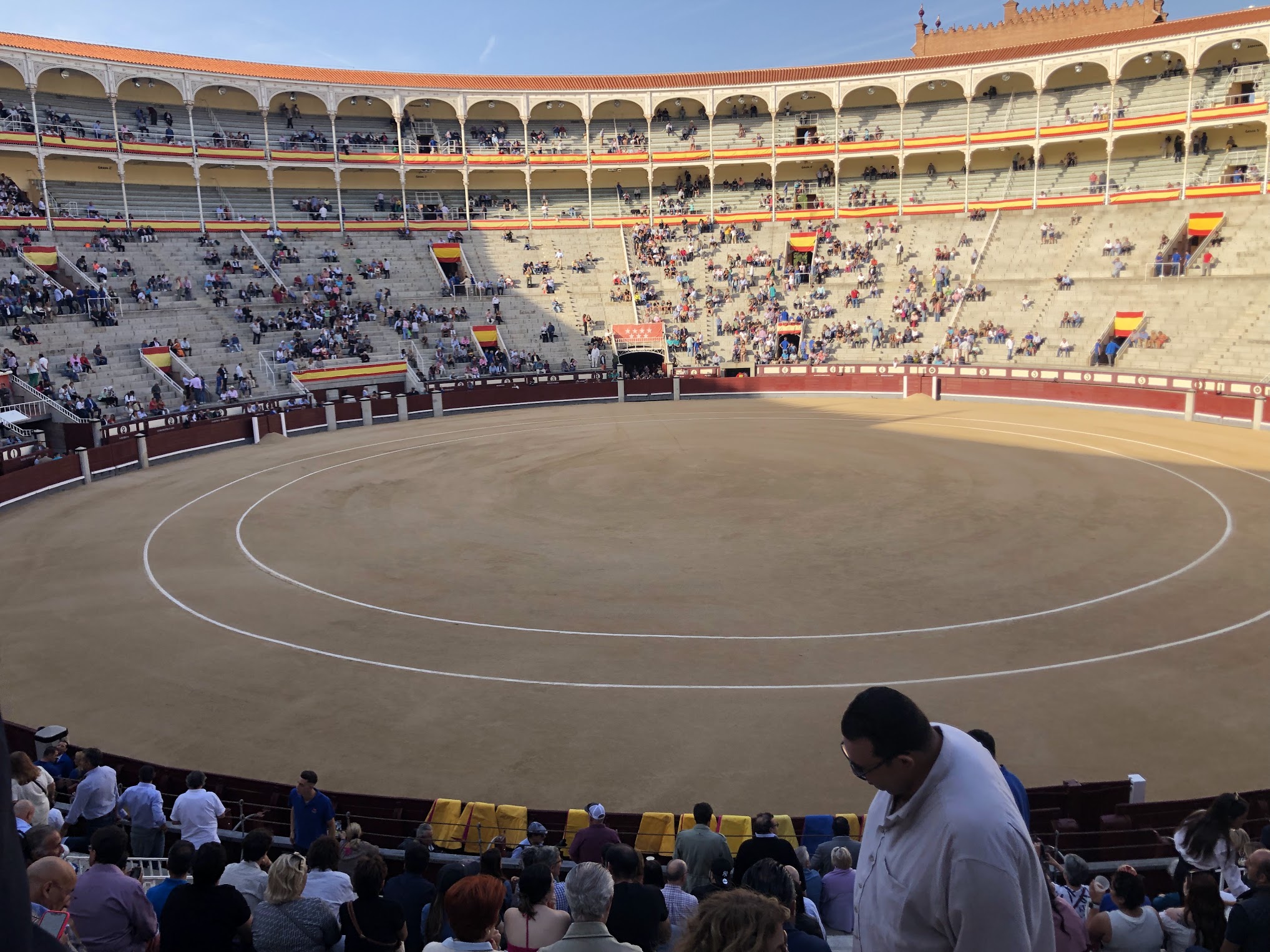
The subway there was packed, mostly with older men, many carrying bags with seat cushions inside. Everybody got off at the Ventas stop, and we made our way to the ticket window. Rick Steves said choose section 8 or 9 for shade and the best view; the toreros tend to push the action to that side of the arena, to reward the premium seats. So we did, and found a stadium scene familiar to anyone who’s been to one, anywhere, but maybe more stripped down. The refreshments were beer and blanched almonds, sold by vendors in the stands (the fighting runs roughly 6-8 p.m., and no one eats dinner that early in Spain). We found we could rent seat cushions for 1.50 Euros, and good thing we did, because the seating was cold and hard:

Note: No railings. If you fall, you fall. People come here to see blood, and it might as well be yours.
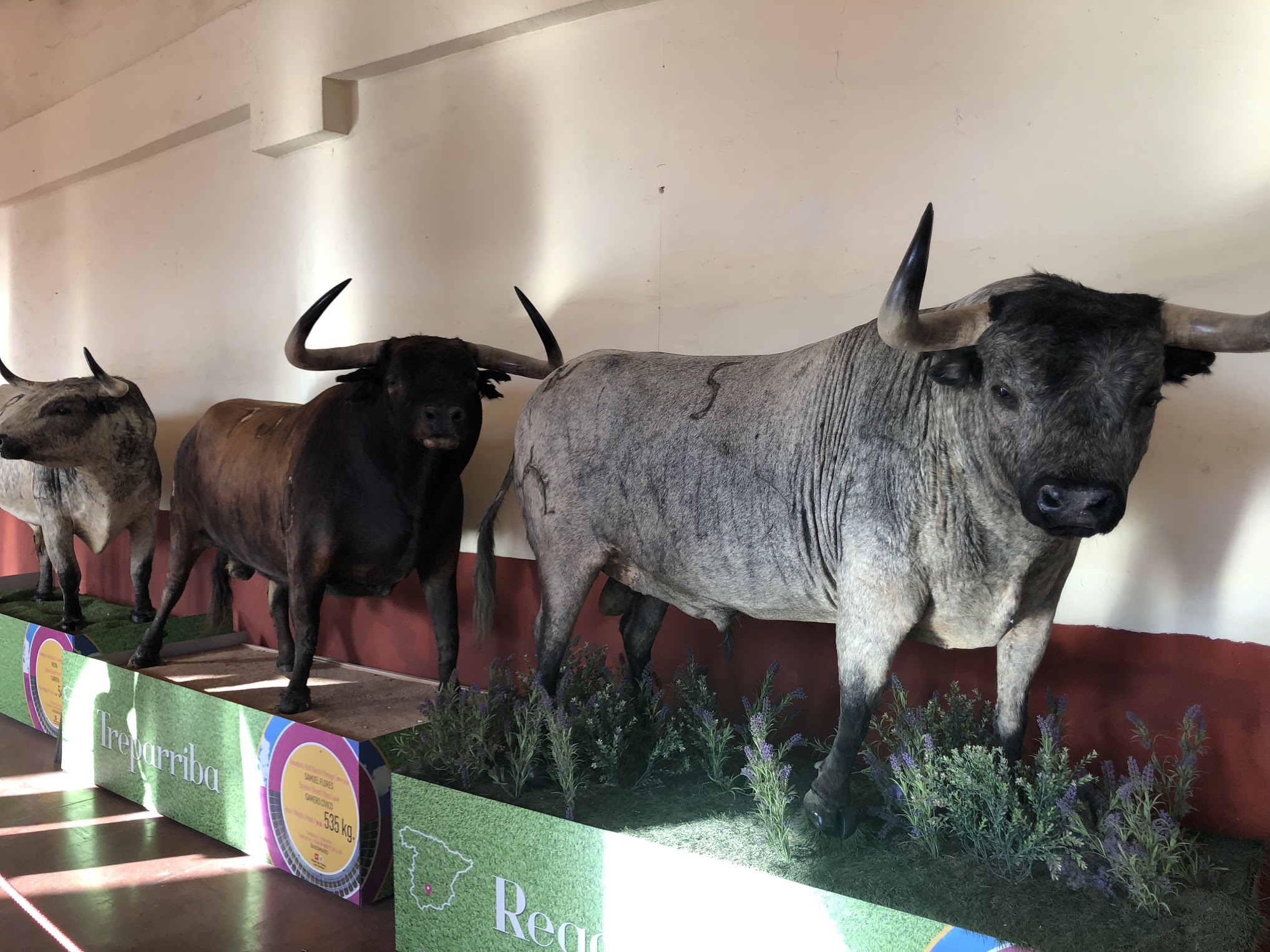
There was some sort of hall of fame in the hallway leading to the seats. Don’t ask me whether these guys were notable sires, or just put up a hell of a fight; I’m a stranger here myself:
This was the crowd close to starting time. Not huge, but better than the Detroit Tigers did, many nights this season:
The show started at the stroke of 6 with the traditional parade of toreros, picadors, support staff and even the mules who will drag away the carcasses:

They make one lap of the arena, take their places, and the first bull is released. He’s already pissed off — I believe they stick him in his hump first to get him in a bad mood. The toreros work as a team, with half a dozen or so hassling him with bigger capes, to rile him up. These guys are matadors in training, so at this level, minor-minor. They show a little style, but they know their place, even though they’re all dressed the same:

The torture really starts when the picador comes out. This guy’s job is to draw the bull to attack his horse, and the first time this happened I gasped, but all the horses seemed prepared, and unharmed by it. Once the bull makes contact, the picador stabs him right in the hump. This wound gets the bull to lower his head for the rest of the fight, which is safer for the humans; makes a goring less likely. I’m adding a video; I hope it works for most of you, and if it doesn’t, I’m sorry. Enlarge it to fullscreen:
After the picadors come the banderilleros. Their job is to further inflame the animal, by placing twin picks in his hump (stylishly!). They face the animal, it charges, and they place the banderillas with a leap. This happens three times. If you see a classic bullfighting print, the sticks you see hanging from the bull’s shoulder? Banderillas.

Then the final act begins, at about the 10-minute mark. The matador comes out with a smaller, red cape — the muleta — and starts the tercio de muerte. The muleta is braced with a sword, but it’s just a prop. The matador’s job at this point is to tire the bull out, but do it fancy-like, showing his bravery. (We called our favorite, of the three guys who performed that night, Mick Jagger. He struck all the traditional poses, inching forward, leading with his pelvis, that stuff that gets the girls hot.) And then he exchanges his toy sword for a real one, comes back, sights down it dramatically, and charges in for the kill. In this stage, he needs to jump into the air, so the sword can come down between the shoulders, ideally to the hilt and severing the aorta or piercing the heart itself. Mick Jagger accomplished it on his first bull, but the second was kind of a disaster; he needed three tries, which was probably expected from a novillado.

At that point, the bull goes to his knees, theoretically, and a final guy comes in with a dagger and gives him a stab just behind his head, severing his spinal cord. The animal pitches over onto his side, dead. The end. Cue the mule team.
It’s pretty brutal, yes. But we watched the whole thing. Afterward, it was time to wave farewell to Las Ventas and have some dinner. Alice, let’s eat! Who wants a hamburger?

I’m glad we went. I eat meat, so I can’t claim any purity around killing bulls for human ends. I’m not sure an American slaughterhouse is a much less distressing way to go. In one of Jim Harrison’s many memorable turns of phrase, he described cattle as giant machines to turn grass into shit. But they feed us well in the end, so.
If you want to know more about all of the above, I suggest this post on Spanish Traveller, where I got a lot of the terminology, at least the Spanish phrases.
On and as for that *asterisk, above: This was actually my second trip to Spain. My mother took me to Malaga and the Costa del Sol for spring break when I was in…seventh grade, I think. It was March, but there was a “bullfight” put on for the tourists down there somewhere. It wasn’t even the season. Some steps were skipped — no picadors. I don’t know who the matadors were, maybe some waiters picking up extra coin. But the bulls were killed and, get this, ears were awarded. Even I could tell this was (sorry) bullshit staged for people who read James Michener’s “Iberia” and took it to heart. Getting an ear — cut from the dead bull and given to the matador for a superior performance, by order of the judge and seconded by the crowd, is an infrequent occurrence. Getting two ears is very rare. The highest honor — two ears and a tail — is even rarer. Here’s a funny note on the semiotics of this gesture. Needless to say, no ears were awarded the night we were there, not even to Mick Jagger.